Vector Field Formula for Graph in [-2,2] x [-2,2]

Click For Summary

Discussion Overview

The discussion revolves around finding a formula for a vector field that resembles a given graph within the domain defined by the box [−2, 2] x [−2, 2]. Participants explore the properties of vector fields, singular points, and the implications of undefined values in the context of gradients and cross products.

Discussion Character

  • Exploratory, Technical explanation, Debate/contested

Main Points Raised

  • Some participants suggest that a vector field can be expressed as the gradient of a function $f(x,y)$, with specific attention to singular points at $x=\pm 1$.
  • One participant proposes the formula $f(x,y) = \frac{1}{x-1}$ as an example where $x=1$ is a singular point.
  • Another participant questions the validity of a proposed formula, emphasizing that it does not represent a proper function.
  • There is a discussion about the implications of having a denominator equal to zero, leading to undefined values in the vector field.
  • One participant suggests using $f(x,y) = \frac{y}{x-1}$ and provides the gradient of this function.
  • Concerns are raised about the cross product of the intervals [-2,2] and its relevance to the vector field, with some confusion about the concept of cross products in two-dimensional space.
  • A participant clarifies that the cross product mentioned does not apply to the intervals as they represent the domain of the function rather than vectors.

Areas of Agreement / Disagreement

Participants express differing views on the appropriate formulas for $f(x,y)$ and the interpretation of singular points. There is no consensus on the implications of the cross product in this context, leading to ongoing debate.

Contextual Notes

Some participants exhibit uncertainty regarding the definitions and properties of vector fields and singular points. The discussion reflects various assumptions about the mathematical operations involved, particularly concerning the cross product in two dimensions.
carl123
Messages
55
Reaction score
0
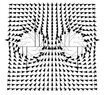
Give an example of a formula for a vector field whose graph would closely resemble the one shown. The box for this figure is [−2, 2] x [−2, 2].View attachment 4930

Not sure where to start.
 

Attachments

  • Capture.JPG
    Capture.JPG
    38.8 KB · Views: 108
Physics news on Phys.org
carl123 said:
Give an example of a formula for a vector field whose graph would closely resemble the one shown. The box for this figure is [−2, 2] x [−2, 2].
Not sure where to start.

Hi carl123! (Smile)

Typically we can write a vector field as the gradient of some $f(x,y)$.
From the graph given, there are 2 singular points at $x=\pm 1$.
Can you think of a $f(x,y)$ such that those are indeed singular points? (Wondering)
 
Will it be f (x,y) = f (-2,2)?
 
carl123 said:
Will it be f (x,y) = f (-2,2)?

Huh? That's not a formula for f(x,y). (Worried)

Consider that for instance $\frac{1}{x-1}$ is a formula where $x=1$ is a singular point.
 
I like Serena said:
Huh? That's not a formula for f(x,y). (Worried)

Consider that for instance $\frac{1}{x-1}$ is a formula where $x=1$ is a singular point.

where x = 1 is a singular point, the denominator will be 0 then.
 
carl123 said:
where x = 1 is a singular point, the denominator will be 0 then.

Exactly! (Nod)
 
I like Serena said:
Exactly! (Nod)

if the denominator is 0, the formula will be undefined. What does that say about the graph?

Also, when I found the cross product of [-2,2] and [-2,2], I got 0. Does that mean, there's no field that resembles the graph?

Thanks.
 
carl123 said:
if the denominator is 0, the formula will be undefined. What does that say about the graph?
Suppose we pick $f(x,y)=\frac{y}{x-1}$.
Then the gradient will be:
$$\begin{pmatrix}\pd f x\\\pd f y\end{pmatrix} =\begin{pmatrix}-\frac{y}{(x-1)^2}\\\frac{1}{x-1}\end{pmatrix}$$

We can see the resulting vector plot here.

Also, when I found the cross product of [-2,2] and [-2,2], I got 0. Does that mean, there's no field that resembles the graph?
How would that cross product be related?
 
I like Serena said:
Suppose we pick $f(x,y)=\frac{y}{x-1}$.

How would that cross product be related?

Their cross product is equal
 
  • #10
carl123 said:
Also, when I found the cross product of [-2,2] and [-2,2], I got 0. Does that mean, there's no field that resembles the graph?

Thanks.
[-2,2] x [-2,2] is not the cross product of two vectors. (How can you take the cross product of two vectors in 2D space??) It represents the domain of the function: [math]x \in [ -2,2 ] [/math] and [math]y \in [-2,2] [/math].

-Dan
 

Similar threads

  • · Replies 3 ·
Replies
3
Views
2K
  • · Replies 13 ·
Replies
13
Views
2K
  • · Replies 6 ·
Replies
6
Views
2K
  • · Replies 3 ·
Replies
3
Views
2K
  • · Replies 28 ·
Replies
28
Views
3K
  • · Replies 3 ·
Replies
3
Views
2K
  • · Replies 2 ·
Replies
2
Views
1K
Replies
1
Views
1K
  • · Replies 13 ·
Replies
13
Views
4K