What Does "Curl" Mean in Vector Fields?

  • Context: High School 
  • Thread starter Thread starter erocored
  • Start date Start date
  • Tags Tags
    Curl Mean
Join the discussion
Ask a follow-up here, or get your own question answered by working scientists, mathematicians and engineers — people, not an autocomplete.
Real named experts · corrections over time · the nuance an AI answer skips
3 replies · 2K views
erocored
Messages
30
Reaction score
7
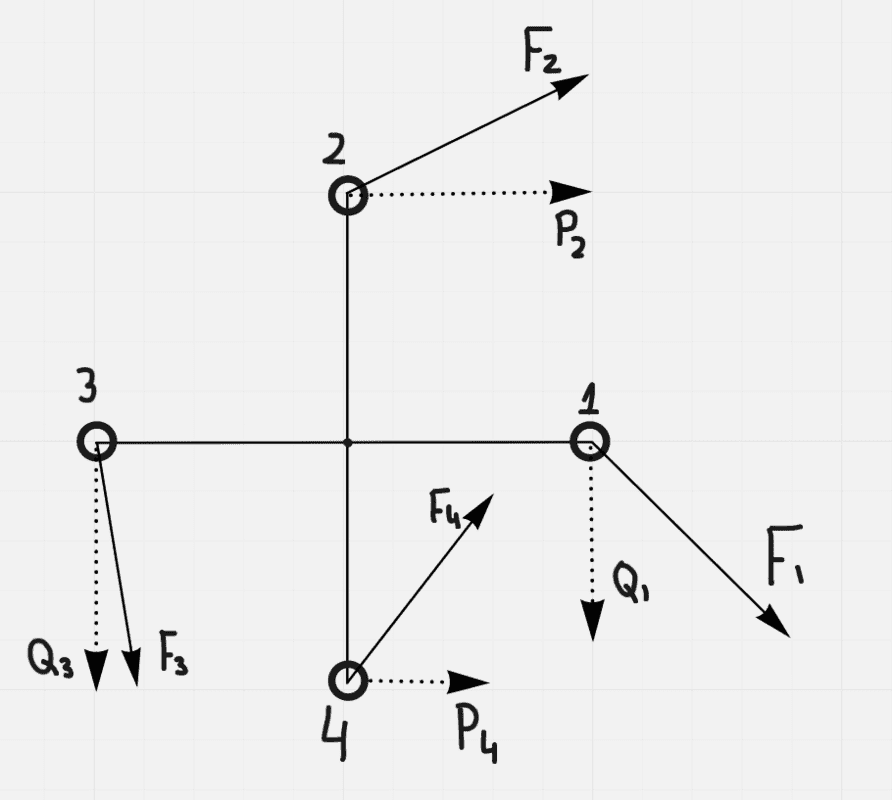
That is how I understand curl:
2021-04-10 (2).png

If I have a vane at some point ##(x,y)## of a vector field, then that vane will experience some angular velocities in points 1 ##(x+dx,y)##, 2 ##(x,y+dy)##, 3 ##(x-dx,y)##, 4 ##(x,y-dy)##. Adding those angular velocities gives me the resulting angular speed of this vane. But why is it important to know this resulting angular speed, what else does it give?
 
Physics news on Phys.org
Curl is how much a vector field (sorry for tautology) curls. The vector field representing water velocity as it circles down the drain has a big curl. Wind blowing eastward over some field would have near-zero curl. Chapter 1.2 of griffiths electrodynamics gives good explanation- he is extremely clear and curl is important in e and m. https://www.zackrauen.com/PublicFiles/School/Textbooks/Electrodynamics.pdf
 
Reply
  • Like
Likes   Reactions: erocored
adnmcq said:
The vector field representing water velocity as it circles down the drain has a big curl. Wind blowing eastward over some field would have near-zero curl.
From this statement, this is how I interpret curl:

Let's say you have a vector field. Now let's say you have some function that takes said vector field as its argument and returns the direction of the vector field at a given point. The curl is basically the derivative of that function with respect to the coordinates that the field is defined at.
 
Reply
  • Like
Likes   Reactions: erocored