Solving Vector Diagrams: Finding Displacements & Velocities

  • Thread starter Thread starter g9WfI
  • Start date Start date
  • Tags Tags
    Diagrams Vector
Click For Summary
SUMMARY

This discussion focuses on solving a projectile motion problem involving vector diagrams, specifically finding displacements and velocities. The correct approach involves treating horizontal and vertical motions separately using kinematic equations. Key calculations include determining time using the vertical displacement equation, where s = 50 m, u = 0, a = 9.8 m/s², leading to t = 3.19 s. The horizontal distance is then calculated as 48 m using the constant horizontal velocity of 15 m/s.

PREREQUISITES
  • Understanding of kinematic equations in physics
  • Knowledge of projectile motion principles
  • Familiarity with vector components in Cartesian coordinates
  • Ability to perform trigonometric calculations, specifically with tangent functions
NEXT STEPS
  • Study the derivation and application of kinematic equations for projectile motion
  • Learn how to separate vector components in physics problems
  • Explore the concept of constant acceleration in vertical motion
  • Investigate the use of trigonometric functions in resolving vector quantities
USEFUL FOR

Students studying physics, educators teaching kinematics, and anyone interested in mastering projectile motion analysis.

g9WfI
Messages
13
Reaction score
4
Homework Statement
A stone is thrown horizontally at 15 m/s from the top of a vertical cliff, 50 m above the sea. Calculate the distance from the bottom of the cliff to the place where the stone hits the water. g = 9.8 m/s^2
Relevant Equations
trig, suvat
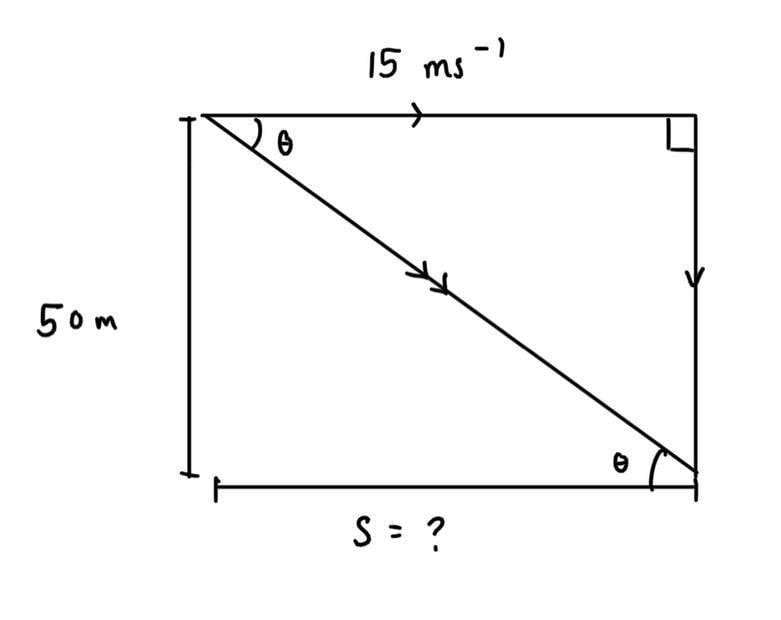
Here is my attempt at the vector diagram:
IMG_6C9734C444CE-1.jpeg

Could anyone give me any clues as to where to go from here? Is this diagram correct?
I tried finding θ using inverse tan 50/15 but I don't think I can do that because that's mixing up velocity and displacement.

EDIT: I copied and pasted the incorrect mark scheme here.
Correct mark scheme:
For the fall, s = 50 m, u = 0, v = ?, a = 9.8 m s–2 , t = ?
s = ut + ½at2 ⇒ 50 m = 0 + 4.9 m s-2 × t 2 ⇒ t 2 = 50 m ÷ 4.9 m s–2 = 10.2 s2
t = √(10.2 s2 ) = 3.19 s
horizontally, s = ut = 15 m s–1 × 3.19 s = 48 m (2 s.f.)

How do I find the corresponding displacements/velocities of the vectors with only this information?
I don't know if I'm making much sense, but I don't understand how to get the displacement from velocity;
I know s = vt but I'm not really getting anywhere with my working.
 
Last edited:
Physics news on Phys.org
Not sure why you are attempting a vector diagram here. This is a projectile motion problem. One "secret" is to treat horizontal and vertical motions separately. First consider the vertical motion, since you have all the info you need to figure out the time it takes for the stone to hit the ground.
 
  • Like
Likes   Reactions: g9WfI
This is a projectile motion problem. Split the problem into the horizontal (x) and vertical (y) directions. Analyze the projectiles motion in each direction independently using the kinematic equations.
 
That diagram does not seem helpful.
You have already given the solution for the problem.

Velocity in the horizontal direction is constant.
Acceleration in the vertical direction is constant.
Time can be found by solving for time from the equation for vertical displacement, which you have given.
This can be used in the equation for horizontal distance to compute horizontal distance.
 
You can't mix vectors of different physical dimensionality like that. It doesn’t mean anything to add a velocity and a displacement.
 
  • Like
Likes   Reactions: Delta2
Yes you are right that it is wrong to mix distance and velocity in ##\tan\theta=\frac{50}{15}##, instead you should say that ##\tan\theta=\frac{50}{48}## as i think you calculated correctly the horizontal distance to be 48m.

If you want a vector diagram for velocity the main problem is that the vector of velocity keeps changing in magnitude and direction for this problem. However in cartesian coordinate system the vector of velocity formula is $$\vec{v}(t)=v_x\hat x+v_y\hat y=15\hat x+9.8t\hat y$$ as the x-component of velocity is constant and equal to 15 but the y-component of velocity keeps changing as time passes and it is ##v_y=gt=9.8t## where t the time elapsed.
 
  • Like
Likes   Reactions: g9WfI

Similar threads

  • · Replies 3 ·
Replies
3
Views
1K
  • · Replies 8 ·
Replies
8
Views
2K
  • · Replies 6 ·
Replies
6
Views
585
  • · Replies 3 ·
Replies
3
Views
992
  • · Replies 12 ·
Replies
12
Views
1K
Replies
6
Views
2K
Replies
12
Views
2K
  • · Replies 6 ·
Replies
6
Views
1K
  • · Replies 5 ·
Replies
5
Views
3K
  • · Replies 13 ·
Replies
13
Views
1K