How Does the Verlet Algorithm Compare to R-K Methods in Energy Conservation?

  • Thread starter Thread starter Arman777
  • Start date Start date
  • Tags Tags
    Algorithm
Click For Summary
The discussion focuses on understanding the Verlet algorithm and its steps, particularly the calculations involving velocity and position updates. Participants clarify that there is no step 8.78, but rather sequential steps 8.78a and 8.78b, which are not part of a loop. The conversation also touches on the accuracy of the Verlet method compared to Runge-Kutta (R-K) methods in energy conservation, noting that Verlet tends to better maintain total energy constancy. Additionally, the importance of analyzing total energy rather than averaging kinetic and potential energy separately is emphasized, with suggestions to compare the methods over multiple orbits for clearer insights. The overall aim is to enhance understanding of energy conservation in numerical simulations of gravitational systems.
Arman777
Insights Author
Gold Member
Messages
2,163
Reaction score
191
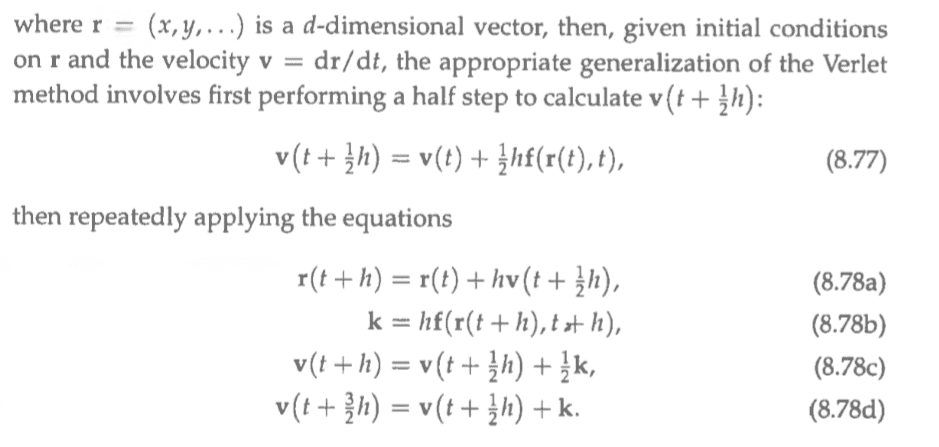
I am trying to understand the verlet algorithm but I am kind of stuck.
1570303410061.png


I guess first we are findind the ##v(t + 1/2h)## then we are leaving it there and starting a loop for 8.78 ?

Also I did not understand the meaning of the equation 8.78 ? We are never using ##v(t + 3h/2)## ? Or in the loop ##v(t + 3h/2)## becomes ##v(t + 1/2h)##
 
Technology news on Phys.org
Arman777 said:
I am trying to understand the verlet algorithm but I am kind of stuck.

View attachment 250751

I guess first we are findind the ##v(t + 1/2h)## then we are leaving it there and starting a loop for 8.78 ?
Yes, you calculate v(t + h/2) using the formula in 8.77.

No, there is no step 8.78, but there are steps 8.78a, 8.78b, and so on. And these steps aren't a loop -- you do them in succession. IOW, first you calculate r(t + h) as in 8.78a, then you calculate the vector k as in 8.78b, then v(t + h) and finally v(t + 3h/2).
Presumably there is some description of f(r(t), t) that isn't shown on the attached image.
Also part of the formula for step 8.78b is confusing in the 2nd argument to f. It looks like t + h, but maybe there is a smudge on the paper?
Arman777 said:
Also I did not understand the meaning of the equation 8.78 ? We are never using ##v(t + 3h/2)## ? Or in the loop ##v(t + 3h/2)## becomes ##v(t + 1/2h)##
It's not clear to me, either. It would be a good idea to look up Verlet algorithm to see if you can find a clearer description.
 
Mark44 said:
Yes, you calculate v(t + h/2) using the formula in 8.77.

No, there is no step 8.78, but there are steps 8.78a, 8.78b, and so on. And these steps aren't a loop -- you do them in succession. IOW, first you calculate r(t + h) as in 8.78a, then you calculate the vector k as in 8.78b, then v(t + h) and finally v(t + 3h/2).
Presumably there is some description of f(r(t), t) that isn't shown on the attached image.
Also part of the formula for step 8.78b is confusing in the 2nd argument to f. It looks like t + h, but maybe there is a smudge on the paper?
It's not clear to me, either. It would be a good idea to look up Verlet algorithm to see if you can find a clearer description.
I searched online but they are using acceleration... I guess Verlet algorithm is also not much accurate... I did not understand the idea .. I was trying to solve a "one" body problem by using RK method but it seemed dead end so I was trying to do it with verlet but I couldn't understand the steps.

1570307551281.png


In Newtonian Gravity If I have $$d^2r/dt^2 = -GMr/r^3$$ so then in the above picture ##a(t)=-GMr/r^3## ?

I actually wanted to use Bulirsch-Stoer method but I am not sure how can I manage that without doing Verlet properly
 
Last edited:
Arman777 said:
In Newtonian Gravity If I have $$d^2r/dt^2 = -GMr/r^3$$ so then in the above picture ##a(t)=-GMr/r^3## ?
My copy of Halliday & Resnick shows one form of Newton's law of universal gravitation as
$$F = G\frac{m_1m_2}{r^2}$$
Your equation has just one mass in it -- M. For gravitational forces, you need to have two masses at least, with each attracting the other with forces that are equal in magnitude but opposite in direction.
 
Mark44 said:
My copy of Halliday & Resnick shows one form of Newton's law of universal gravitation as
$$F = G\frac{m_1m_2}{r^2}$$
Your equation has just one mass in it -- M. For gravitational forces, you need to have two masses at least, with each attracting the other with forces that are equal in magnitude but opposite in direction.
$$F = m \frac{d^2\vec{r}} {dt^2} = -\frac{MmG\vec{r}} {r^3} $$
so
$$\frac{d^2\vec{r}} {dt^2} = -\frac{MG\vec{r}} {r^3}$$
 
I guess I solved it ( The question claims that we should find a non circular orbit, but near elliptical one ). Here is the graph of the orbit
Figure_1.png


Now I ll try to calculate the total energy of the system if it matches with the real values great!
 
Gotcha.
Arman777 said:
so then in the above picture ##a(t)=-GMr/r^3## ?
Looks fine to me. Keep in mind that r is a function of t. Also, in post #6, you're distinguishing between r in the numerator (a vector) and r in the denominator, the magnitude of the vector.
 
  • Like
Likes Arman777
Mark44 said:
Gotcha.
Looks fine to me. Keep in mind that r is a function of t. Also, in post #6, you're distinguishing between r in the numerator (a vector) and r in the denominator, the magnitude of the vector.
Yes I was careful about that
Figure_1.png


"-." lines are potential energy
"--" lines are kinetic energy and other is total energy.

My findings
Potential energy: -5.30517849127762e+33 Kinetic Energy: 2.6525789562766106e+33 Total energy: -2.6525995467214404e+33

And these values from a site
-5.29201E+332.66762E+33-2.62439E+33
I guess they are somewhat matching. Maybe I can increase the accuracy by decreasing the time step (?)

Now I took the average of the energies, more close to the actual values. (Before this I only took the last values in the data array, :p what a mistake)
 
Last edited:
Arman777 said:
Maybe I can increase the accuracy by decreasing the time step (?)
Yes, up to a point. Beyond some level, you'll be getting errors in the calculations because computers don't do perfect floating point calculations.
 
  • Like
Likes Arman777
  • #10
Mark44 said:
Yes, up to a point. Beyond some level, you'll be getting errors in the calculations because computers don't do perfect floating point calculations.
Indeed. Also the method is not so perfect. Thanks for the help
 
  • #11
Arman777 said:
Now I took the average of the energies, more close to the actual values. (Before this I only took the last values in the data array, :p what a mistake)
Why are you doing this? There is nothing to be learned from looking at KE and PE separately and averaging them, the point is that the TOTAL energy should be CONSTANT at each step. The velocity verlet (and other leapfrog algorithms) are generally better at doing this than R-K methods because the error terms in the alternate 'half-steps' (8.78(a) and 8.78(c) in the extract you quoted in #3) tend to cancel out.

Why not go back to the R-K method and compare it side-by-side with the velocity Verlet to see how the total energy behaves? Also, run for 10, 100, 1000 orbits and see what happens.
 
  • #12
pbuk said:
Why are you doing this? There is nothing to be learned from looking at KE and PE separately and averaging them, the point is that the TOTAL energy should be CONSTANT at each step. The velocity verlet (and other leapfrog algorithms) are generally better at doing this than R-K methods because the error terms in the alternate 'half-steps' (8.78(a) and 8.78(c) in the extract you quoted in #3) tend to cancel out.

Why not go back to the R-K method and compare it side-by-side with the velocity Verlet to see how the total energy behaves? Also, run for 10, 100, 1000 orbits and see what happens.
I don't think energy will be conserved in the RK method. Well yes you are right, I just wanted to print them. For instance If the code runs for binary system and not for an normal orbit, we will need kinetic and potential energy values of the system. In this case avg values will not be usefull I guess but just for orbital case its good enough I guess.
 

Similar threads

Replies
9
Views
3K
  • · Replies 13 ·
Replies
13
Views
5K
  • · Replies 8 ·
Replies
8
Views
3K
  • · Replies 15 ·
Replies
15
Views
2K
  • · Replies 3 ·
Replies
3
Views
2K
  • · Replies 3 ·
Replies
3
Views
2K
Replies
1
Views
4K
  • · Replies 2 ·
Replies
2
Views
1K
  • · Replies 3 ·
Replies
3
Views
2K
  • · Replies 3 ·
Replies
3
Views
2K