Vibration of a mass connected via preloaded spring

Click For Summary
SUMMARY

The discussion centers on the dynamics of a mass (m1) connected to a significantly larger mass (m2) via a preloaded spring under vibrational forces. The key conclusion is that separation occurs when the inertial force (F_inertia = m1 * a) exceeds the spring force (F_spring = -k(Δx)), where k is the spring constant and Δx is the displacement from the spring's resting state. The maximum distance between the two masses can be determined by equating F_spring and F_inertia, particularly when the system vibrates at its resonance frequency, calculated as sqrt(k/m1). The preload must be considered in this analysis to accurately predict the system's response.

PREREQUISITES
  • Understanding of Newton's laws of motion
  • Familiarity with spring dynamics and Hooke's Law
  • Knowledge of resonance frequency calculations
  • Basic principles of vibration analysis in mechanical systems
NEXT STEPS
  • Study the principles of forced vibrations in mechanical systems
  • Learn about resonance frequency calculations for spring-mass systems
  • Explore the effects of preload in spring dynamics
  • Investigate methods for isolating sensitive instruments from vibrations
USEFUL FOR

Mechanical engineers, structural engineers, and anyone involved in vibration analysis or designing systems that require vibration isolation.

sfensphan
Messages
9
Reaction score
1
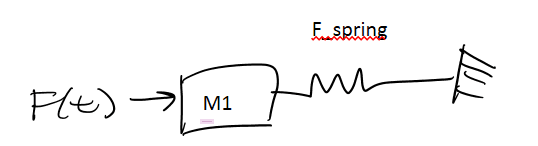
The setup: I have a mass (m1)connected to a much, much larger mass (m2) via a preloaded spring. They start out in contact because the preloaded spring holds them together. Now suppose the large mass is subject to vibrations, possibly at the resonance of the structure. Will the two masses separate? If they do, what is the maximum distance between the two?

Will the two masses separate?
My original chain of thought was that if the spring force is less than the inertial force of the small mass, then the two will separate.
F_spring = -k(Δx)
k = spring constant
Δx = displacement from spring resting state. Since there is a preload, this is non-zero

F_inertia = m1 * a
m1 = mass of the small mass
a = acceleration. This should be sinusoidal, since it's a vibration

I would then compare the two and see which one is larger. I would use the max value of F_inertia during this comparison.

If they do, what is the maximum distance between the two?
This is where I get a little lost. A static calculation would be to find where Δx is such that F_spring = F_inertia.
But what if the system vibrated at resonance frequency (which I believe would be sqrt(k/m1) for this case)?
How do I deal with the preload?
Is the Force body diagram such that the sinusoidal force acts directly on the m1?
Do I need to know how much the larger mass is displaced?
upload_2018-7-14_0-15-27.png
 

Attachments

  • upload_2018-7-14_0-14-51.png
    upload_2018-7-14_0-14-51.png
    3.8 KB · Views: 614
  • upload_2018-7-14_0-15-27.png
    upload_2018-7-14_0-15-27.png
    3.8 KB · Views: 724
Engineering news on Phys.org
sfensphan said:
I have a mass (m1)connected to a much, much larger mass (m2) via a preloaded spring. They start out in contact because the preloaded spring holds them together. Now suppose the large mass is subject to vibrations, possibly at the resonance of the structure. Will the two masses separate? If they do, what is the maximum distance between the two?

just as a help to your approach one can see the given reference-

actually ...In engineering practice, we are almost invariably interested in predicting the response of a structure or mechanical system to external forcing.

For example, we may need to predict the response of a bridge or tall building to wind loading, earthquakes, or ground vibrations due to traffic. Another typical problem you are likely to encounter is to isolate a sensitive system from vibrations. For example, the suspension of your car is designed to isolate a sensitive system (you) from bumps in the road.

Electron microscopes are another example of sensitive instruments that must be isolated from vibrations. Electron microscopes are designed to resolve features a few nanometers in size. If the specimen vibrates with amplitude of only a few nanometers, it will be impossible to see! Great care is taken to isolate this kind of instrument from vibrations. That is one reason they are almost always in the basement of a building: the basement vibrates much less than the floors above.

reference-http://www.brown.edu/Departments/Engineering/Courses/En4/Notes/vibrations_forced/vibrations_forced.htm
 
  • Like
Likes   Reactions: sfensphan
Thanks very much. From your link, I see that it is a base excitation case. Greatly appreciate you leading me in the right direction.
 
  • Like
Likes   Reactions: drvrm

Similar threads

Replies
2
Views
2K
  • · Replies 2 ·
Replies
2
Views
2K
Replies
6
Views
2K
Replies
8
Views
2K
  • · Replies 15 ·
Replies
15
Views
5K
  • · Replies 2 ·
Replies
2
Views
1K
Replies
17
Views
2K
Replies
20
Views
1K
  • · Replies 2 ·
Replies
2
Views
2K
Replies
4
Views
2K