What is the governing equation of a spring with sinusoidal excitation?

Click For Summary

Discussion Overview

The discussion centers around deriving the governing equation for a spring subjected to sinusoidal excitation at one end, with a mass attached at the other end. Participants explore the implications of this setup on the system's dynamics, including resonance frequency, while noting the absence of damping in the initial analysis.

Discussion Character

  • Exploratory
  • Technical explanation
  • Debate/contested
  • Mathematical reasoning

Main Points Raised

  • One participant describes the force in the spring as K*(deformation), where deformation is defined as the difference between the current length and the unstrained length.
  • Another participant emphasizes the importance of assigning dimensions and a coordinate system to properly analyze the problem.
  • There is a suggestion that understanding the kinematics is crucial, as the speed of the crank affects the acceleration input to the spring, potentially leading to resonance.
  • One participant encourages deriving equations independently, highlighting the value of derivation skills in engineering.
  • Multiple participants express uncertainty about available resources for further learning on the topic.

Areas of Agreement / Disagreement

Participants do not reach a consensus on the best approach to derive the governing equation, and there are competing views on the importance of kinematics and the assignment of coordinates. The discussion remains unresolved regarding the specifics of the governing equation and resonance frequency.

Contextual Notes

Participants note the need for specific dimensions and a coordinate system, as well as the free length of the spring, which are necessary for measuring deformation. The discussion also highlights the complexity introduced by time-varying parameters in the system.

k.udhay
Messages
167
Reaction score
13
TL;DR
Most of the spring vibration lectures assume spring to be fixed on one end and mass on the other end. In my case, spring has a sinusoidal excitation on one end and mass on other end. How to get the governing equation?
Hi,
Most of the spring vibration lectures assume spring to be fixed on one end and mass on the other end [Example]. In my case, spring has a sinusoidal excitation on one end and mass on other end. Pl. refer the image below.
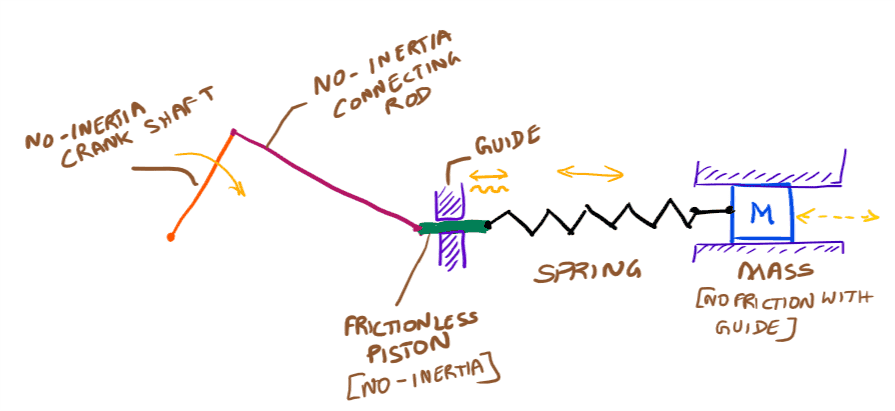
242383


How to get the governing equation? With that I also want to find the resonance frequency of the system. To reduce complexity, I have not taken dampening into account. I will add it later. Pl. help.
 
Engineering news on Phys.org
The force in the spring is K*(deformation) where the deformation is the difference between the current length and the unstrained length. The slider-crank determine the location of the left end if the spring, and the right end is the current location of the mass. Its not a hard problem at all.
 
Dr.D said:
The force in the spring is K*(deformation) where the deformation is the difference between the current length and the unstrained length. The slider-crank determine the location of the left end if the spring, and the right end is the current location of the mass. Its not a hard problem at all.

Thank you Dr. Do you know any elaborate lecture or derivation available on the internet to understand further details?
 
No, I don't know of any such.

Are you given dimensions and a coordinate system? If not, you will need to assign some. Do you know the free length of the spring (length with no force in the spring)? This is neccasary because deformation is measured from this state.
 
  • Like
Likes   Reactions: k.udhay
k.udhay said:
Thank you Dr. Do you know any elaborate lecture or derivation available on the internet to understand further details?
One of the best lessons I learned in engineering school is the ability to derive my own equations to adapt to the actual problem. I wager that you already have all the fundamentals needed to derive your own equations for this problem. You should try. Try hard.

Courses sometimes fail to mention that derivation skills are as important as solving skills.
 
  • Love
Likes   Reactions: k.udhay
Dr.D said:
No, I don't know of any such.

Are you given dimensions and a coordinate system? If not, you will need to assign some. Do you know the free length of the spring (length with no force in the spring)? This is neccasary because deformation is measured from this state.
I am more interested in the time dimension. As the speed of the crank changes, the acceleration input to the spring changes. At some speed(s) it is going to resonate. Hence, time is what is more a challenging parameter for me.
 
Most of this problem is in the kinematics. You cannot describe the kinematics as a function of time until you assign some time varying coordinates. If you need further help, I suggest you contact me by PM to discuss it.
 
  • Like
Likes   Reactions: k.udhay

Similar threads

  • · Replies 2 ·
Replies
2
Views
2K
Replies
17
Views
3K
  • · Replies 5 ·
Replies
5
Views
2K
  • · Replies 11 ·
Replies
11
Views
2K
  • · Replies 4 ·
Replies
4
Views
3K
  • · Replies 7 ·
Replies
7
Views
4K
Replies
3
Views
14K
  • · Replies 10 ·
Replies
10
Views
3K
  • · Replies 20 ·
Replies
20
Views
4K
  • · Replies 3 ·
Replies
3
Views
2K