Visual proof log(ab) = log a + log b

  • Context: MHB 
  • Thread starter Thread starter Ppp1
  • Start date Start date
  • Tags Tags
    Log Proof Visual
Click For Summary
SUMMARY

The discussion centers on providing a visual proof for the logarithmic identity log(ab) = log a + log b. The proof utilizes the properties of the logarithmic function and the area under the curve of y = 1/x. By demonstrating that the area corresponding to ln a and ln b can be combined to form the area under the curve from 1 to ab, the identity is established. The participants also explore the unique property of logarithmic functions where f(xy) = f(x) + f(y), emphasizing the intuitive understanding of logarithms through graphical representation.

PREREQUISITES
  • Understanding of logarithmic functions and their properties
  • Familiarity with the concept of area under a curve in calculus
  • Basic knowledge of integral calculus, specifically the integral of 1/x
  • Experience with visual representations of mathematical concepts
NEXT STEPS
  • Explore the properties of logarithmic functions in depth, focusing on their unique characteristics
  • Learn about integral calculus and the significance of the area under curves
  • Investigate other mathematical functions that exhibit similar additive properties
  • Study visual proofs in mathematics to enhance understanding of complex concepts
USEFUL FOR

Mathematicians, educators, students studying calculus, and anyone interested in deepening their understanding of logarithmic functions and their graphical interpretations.

Ppp1
Messages
4
Reaction score
0
Hi,

I'm looking for a visual proof log(ab) = log a + log b

I've seen diagrams where the values are measured out, but it's not immediately obvious why this holds. Is there an intuitive way to illustrate this? Also, are there other functions with this property.
 
Last edited by a moderator:
Mathematics news on Phys.org
Suppose we have:

$$y=\log_r(ab)$$

This is equivalent to:

$$ab=r^y$$

Now, this may be written as:

$$r^{\log_r(a)}\cdot r^{\log_r(a)}=r^y$$

Or:

$$r^{\log_r(a)+\log_r(b)}=r^y$$

And so equating exponents (and utilizing the one-to-one correspondence of the exponential function), we obtain:

$$y=\log_r(a)+\log_r(b)$$

Which means we conclude:

$$\log_r(ab)=\log_r(a)+\log_r(b)$$

As far as I know, only the logarithmic function has the property:

$$f(xy)=f(x)+f(y)$$
 
Nice, but very bourbaki ;)
Seems there is no immediate way to visualize this.
 
Let's start with the area under the curve $y=\frac 1x$ from $1$ to $a$.
That area is defined as $\color{red}\ln a$.
See the area marked in red.
\begin{tikzpicture}[scale=2]
\draw[->] (0,0) -- (4.4,0) node[above] {$x$-axis};
\draw[->] (0,0) -- (0,1.2) node
{$y$-axis};
\draw[red] (1,0) node[below] {$1$}
-- (1,1) node[above right] {$1$} [domain=1:1.8, variable=\x, ultra thick] plot ({\x}, {1/\x}) node
{$\frac 1a$}
-- (1.8,0) node[below] {$a$}
-- (1,0);
\node[red] at (1.4,0.35) {$\ln a$};
\end{tikzpicture}

Now suppose we multiply the x coordinates with $b$.
To keep the area the same, we need to divide the y coordinates by $b$.
The result is the following red area, which still has area $\color{red}\ln a$.
\begin{tikzpicture}[scale=2]
\draw[->] (0,0) -- (4.4,0) node[above] {$x$-axis};
\draw[->] (0,0) -- (0,1.2) node
{$y$-axis};
\draw[red] (1.6,0) node[below] {$b$}
-- (1.6,{1/1.6}) node[above right] {$\frac 1b$} [domain=1.6:2.88, variable=\x, ultra thick] plot ({\x}, {1/\x}) node
{$\frac 1{ab}$}
-- (2.88,0) node[below] {$ab$}
-- (1.6,0);
\node[red] at (2.24,0.25) {$\ln a$};
\end{tikzpicture}

Now we put the area belonging to $\color{blue}\ln b$ next to it in blue.
\begin{tikzpicture}[scale=2]
\draw[->] (0,0) -- (4.4,0) node[above] {$x$-axis};
\draw[->] (0,0) -- (0,1.2) node
{$y$-axis};
\draw[blue] (1,0) node[below] {$1$}
-- (1,1) node
{$1$} [domain=1:1.6, variable=\x, ultra thick] plot ({\x}, {1/\x})
-- (1.6,0)
-- (1,0);
\node[blue] at (1.3,0.35) {$\ln b$};
\draw[red] (1.6,0) node[below] {$b$}
-- (1.6,{1/1.6}) node[above right] {$\frac 1b$} [domain=1.6:2.88, variable=\x, ultra thick] plot ({\x}, {1/\x}) node
{$\frac 1{ab}$}
-- (2.88,0) node[below] {$ab$}
-- (1.6,0);
\node[red] at (2.24,0.25) {$\ln a$};
\end{tikzpicture}
The result is $\ln b + \ln a = \ln(ab)$.​
 
I like Serena said:
Let's start with the area under the curve $y=\frac 1x$ from $1$ to $a$...

Now that's clever. (Yes)
 
Nifty.
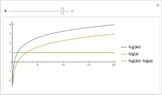
More basic, you could also argue multiplying the argument of a log just shifts the curve in the y-axis by the log of the multiplicator: log(b) = log(ab) - log(a), here with constant b = e, a on the x axis.
 

Attachments

  • log.jpg
    log.jpg
    11.7 KB · Views: 142
Ppp said:
Nifty.
More basic, you could also argue multiplying the argument of a log just shifts the curve in the y-axis by the log of the multiplicator: log(b) = log(ab) - log(a), here with constant b = e, a on the x axis.

The visual proof I gave corresponds to the definition of the logarithm and substitution:
$$
\ln a + \ln b \overset{\small\text{def}}= \int_1^a \frac {dx}x + \int_1^b \frac{du}u
= \int_1^a \frac {d(u/b)}{u/b} + \int_1^b \frac{du}u
= \int_b^{ab} \frac {du}{u} + \int_1^b \frac{du}u
= \int_1^{ab} \frac {du}{u}
\overset{\small\text{def}}= \ln(ab)
$$

How would that argument be a visual proof?
 
Well, to be precise, I didn't claim it was a rigorous proof ;) - it's more to gain intuition.
 

Similar threads

  • · Replies 3 ·
Replies
3
Views
2K
  • · Replies 12 ·
Replies
12
Views
2K
  • · Replies 6 ·
Replies
6
Views
4K
Replies
9
Views
2K
  • · Replies 1 ·
Replies
1
Views
2K
  • · Replies 4 ·
Replies
4
Views
1K
  • · Replies 10 ·
Replies
10
Views
2K
  • · Replies 8 ·
Replies
8
Views
3K
  • · Replies 24 ·
Replies
24
Views
4K
  • · Replies 3 ·
Replies
3
Views
3K