Voltage Null Points of a Mechanical Meter Bridge

Join the discussion
Registration is free. Ask a follow-up in this thread, or start your own.
2 replies · 2K views
Shreya
Messages
187
Reaction score
64
Homework Statement
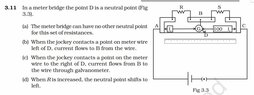
The answers of this question is mentioned to be A & C. My question is why isn't B true?
Please be kind to help
Relevant Equations
-
My reasoning is that the wire has a resistance/unit length. The resistance of AD must equal that of AB for D to be called a null point. If we move jockey to the left, the resistance of AD decreases, thereby decreasing the potential drop across it. This means that the V of D is more than that of B causing a current to flow from D to B. So according to me B should be an answer, while the textbook says.
 

Attachments
  • SmartSelect_20220220-150850_Drive.jpg
    SmartSelect_20220220-150850_Drive.jpg
    31.9 KB · Views: 160
Last edited:
Physics news on Phys.org
when jockey is connect to the left of D no current in the wire B. that is why its wrong
 
Reply
  • Like
Likes   Reactions: Shreya
salmanshu322 said:
when jockey is connect to the left of D no current in the wire B. that is why its wrong
I cannot understand why it is so. Could you please explain? According to my reasoning the resistance of AD< that of AB. Therefore, the V drop across AD is lower making D at a higher potential than B, causing a current to flow from D to B.