Volume of a Roof: Find Attic and Surface Area

  • Topic:
  • Thread starter Thread starter Poly1
  • Start date Start date
  • Tags Tags
    Volume
Join the discussion
Registration is free. Start your own thread to ask a follow-up.
4 replies · 5K views
Poly1
Messages
32
Reaction score
0
My house has an attic consisting of a horizontal rectangular base of length $2q$ and breadth $2p$ (where $p < q$) and four plane roof sections each at angle length $\theta$ to the horizontal. Show that the length of the roof ridge is independent of $\theta$ and find the volume of the attic and the surface area of the roof.

I'm struggling with this problem mainly because I can't visualize what's going on. Thanks.
 
Last edited:
Physics news on Phys.org
The best I can figure, the attic is in the shape of a pyramid having a rectangular base and two pairs of congruent isosceles triangles as the other sides.

However, if the roof ridge is composed of the lines of intersection between the 4 sections of roof, then this certainly is a function of the angle $\theta$.

So, I am just as confused by this problem as you are.(Drunk)
 
There is a workout for it given in here. I don't understand it though.
 
Okay, now I understand.

The attic is a triangular prism with a half-pyramid (the whole pyramid with square base) at each end.

The roof ridge R is then the length of the prism, which will be the length minus the breadth:

$\displaystyle R=2q-2p=2(q-p)$

This does not depend upon $\displaystyle \theta$ and so is independent of the angle.

Now, using some trigonometry, can you find the altitude of the ridge above the base? We will need this to find the volume of the attic.
 
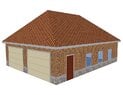
This is what is called a hip roof, which looks like this:
The ends slope at the same angle as the sides. My advice is to draw a front elevation and a side elevation of this building. That should help you to visualise the geometry of the structure. Denote by $h$ the vertical height of the roof ridge above its base. You should be able to see from the side elevation that $h/p = \tan\theta$. Then use the front elevation to see that $R = 2(q-p)$, as MarkFL says.
 
Attachments
  • hip_roof_lr.jpg
    hip_roof_lr.jpg
    63.9 KB · Views: 108