TrickyDicky said:
In the end the key point is: no matter how crackpot an idea may be, does it work? and another very important point , does it fit in the general working model in cosmology?
The latter isn't very important. The standard model could be very wrong in some areas. It's not that astrophysicists are against weird ideas in general, but people have a strong reaction to particular weird ideas because they just don't match what people see.
It's fine to say that the Loch Ness monster exists, but you will get some strange looks if you insist that it lives in Times Square.
The specific problem in cosmology is that many hypothesis can be neither experimentally tested nor directly observed, so basically there is not really a good way to know if they work or not.
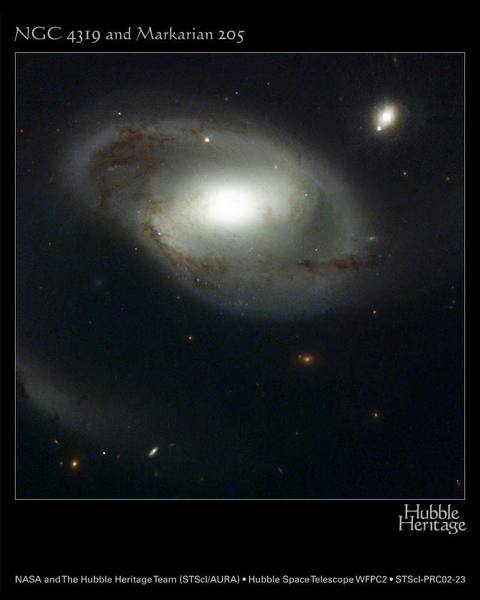
That's not a problem, and one of the big misconceptions is that we are in the dark. We have tons and tons and tons of observations. One reason almost no one believes that quasars are nearby is that we can use VLBI observations to zoom in on them and see what they are, and they appear to be massive black holes.
People look at quasars every day. They aren't mysterious objects.
The default mode is to declare valid only those ideas that fit in the general working model
Not true. If you insist that general relativity is wrong, then no one is going to think that you are weird.
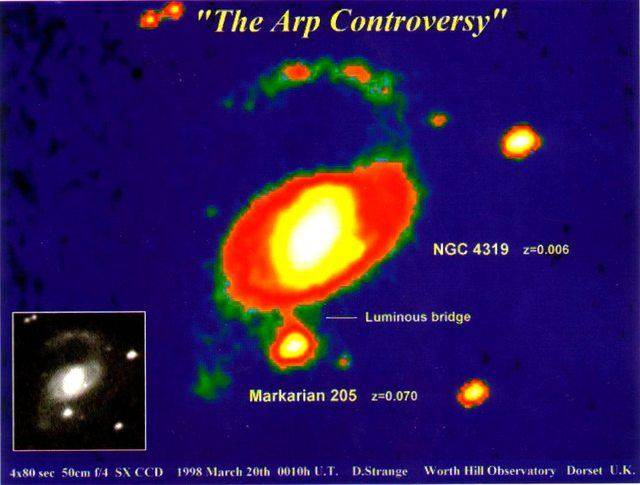
In this sense probably the way Arp carried himself about his insights on quasars and redshift was not very clever, he might have kept his telescope time just by being more diplomatic and first and foremost he should have developed a general model that worked in order to fit in his "observations".
The problem is that Arp's views weren't that unusual for 1965, and they are quite reasonable if you limit yourself to what was known about quasars in 1965. Part of the problem is that in 1965, no one could come up with a way of generating the type of energy that you need to power them. The current idea of gas falling into a black hole works nicely. Trouble is that the idea of a black hole was invented in 1968.
Also people somehow assume that Arp is some creative genius when in fact what has happened is that he has stuck to some old ideas long, long, long after the data convinced pretty much everyone else that those ideas were wrong. People will cut you a lot of slack for coming up with nutty ideas if they are *new* nutty ideas. Arp's ideas aren't.
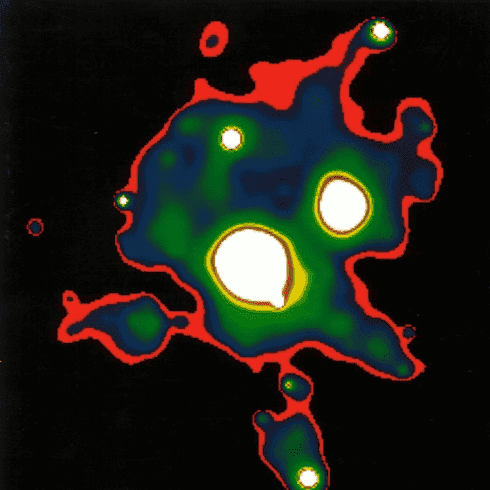
The reality is that Arp's pictures can be explained in different ways and the most practical thing to do is picking the interpretations that fit in the general working model.
No. That's not true.
The problem is that if I show you a blurry picture of Times Square, then I can't prove that this isn't the Loch Ness monster. The reason I don't think the Loch Ness monster lives in Times Square is that people pass there every day, and there ain't no monster.
The sad thing is that if you are obsessed with looking for the Loch Ness monster, you'll miss the UFO and Bigfoot that was there. I'm pretty sure that if you put me into a time machine and traveled back to 1965 and had me a debate with Arp based only on the evidence that existed in 1965, I'd lose badly, and people there would think that I'm was a lunatic.
Q: So what powers these quasars?
Me: Black holes.
Q: What's a black hole?
Me: Well there are these million solar mass objects which are so massive that light can't escape...
Q: Oh... And what evidence do you have that these so called "black holes" can exist?
Me: Well, if you point a VLBI, oh... Hasn't been invented yet. Well if you take space based gamma ray... Oh... Hasn't been invented either... Well they are like pulsars... But people haven't seen those... Well, you can simulated them with supercomputers that ... Oh. You don't have supercomputers... Ummmm...