Water and saline fluid mechanics

Join the discussion
Ask a follow-up here, or get your own question answered by working scientists, mathematicians and engineers — people, not an autocomplete.
Real named experts · corrections over time · the nuance an AI answer skips
1 reply · 2K views
illogical_Eric
Messages
1
Reaction score
0
Hey Guys,
i have a system that I'm pumping with water/ saline. as illustrated below.

At the inflow i hooked up a pressure gage to my pump and read 120mmHg (closed system), and at the outflow I am reading 400ml/min ( I did this by disconnecting the system and timed filling a beaker). I'm trying to work out what the relative flow rate,pressure and velocity of the water/saline will be in the 6mm ID and 10mm ID tubes respectively.

Do i have enough information to do this? I think i need to hook my pressure gage up to the outflow and calculate the head drop across the system, but I'm not so sure.
Thanks for any help, i didn't take any fluid mechanics modules in college.
Eric
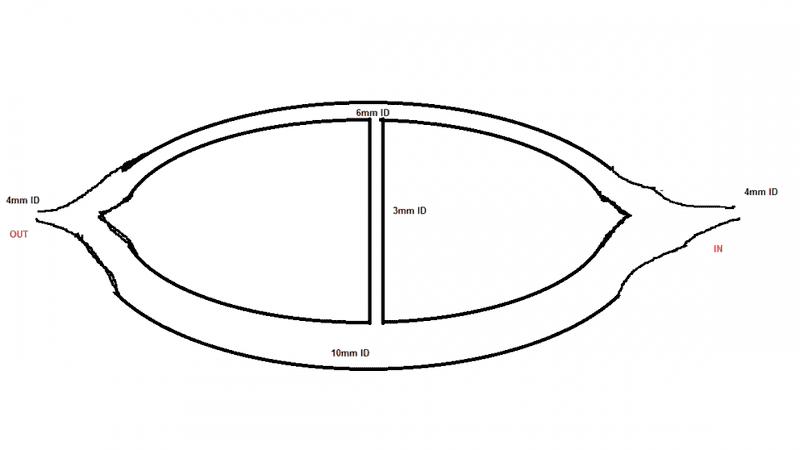
physicsforum.png
 
Not enough information. At bare minimum you would to provide the lengths of the five sections. From there you may be able to draw on the available engineering data for the fluid and types of pipe, plug the data for each section into the Hagen–Poiseuille equation to get the effective resistances, and then do something analogous to a KVL/KCL analysis (that layout looks similar to a Wheatstone Bridge). That's assuming you ignore the Bernoulli effect around the ends of the 3mm section, which would complicate the math horrendously. (disclaimer: I haven't studied fluid mechanics either).

It sounds like this is not just an academic theoretical question. And since no one in the real-world would devise such a strange layout for simply moving fluid from point A to point B, I'm inclined to suspect that the fluid if doing something along the way, such as passing through valves or heat exchangers, which would change the situation significantly.

Even if you were to compile all of the basic data, the non-ideal effects from whatever-the-fluid-is-doing-along-the-way would likely swamp the accuracy of any simple mathematical model. It's not worth trying to figure it out from base principles.

At this point I would proclaim, "Ahh, @#$% it," and just go out and buy some https://www.amazon.com/b?node=3206433011&tag=pfamazon01-20 and pressure gauges and whack them in where I needed real, reliable data. I wouldn't be confident in anything else, anyway. And it sounds like this may be important (your use of the word "saline" rather than "salt water" or "sea water" is a clue...).

Fluid velocity is simple: AvgVelocity = FlowRate / CrossSectionalArea. Just keep you units consistent.
 
Last edited by a moderator: