fog37
- 1,566
- 108
Hello,
I recently got interested in wavelets. The main idea seems clear: we compute the inner product between the signal ##x(t)## and a chosen wavelet for different scale factors and translations of the wavelet over the signal. The inner product provides the coefficient for a wavelet with a specific scale factor ##a##, which is inversely related to the wavelet frequency ##f##, as we translated the wavelet over ##x(t)##.
Apparently, given a discrete signal ##x(t)##, we can calculate either its continuous wavelet transform CWT and its discrete wavelet transform (DWT). Both are transforms are discrete in the sense that the scale parameter and translation parameter have a finite numbers of values...
My question: the DWT can be represented as a bank of low-pass and high-pass filters. We send the signal ##x(t)## into the first pair of filter and then pass its downsampled low-pass versions into subsequent filter pairs This process apparently produces approximation and detail coefficients...I am not clear on this process...What do we do with the approximation and detail coefficients? Is the signal decomposed into a weighted sum of wavelet functions plus a weighted sum of scaling functions?
We end up with a single downsampled low-pass version of the input signal and two downsampled high-pass versions....How does that relate to obtaining a spectrogram ##F(\omega, t)## of the input signal ##x(t)##?
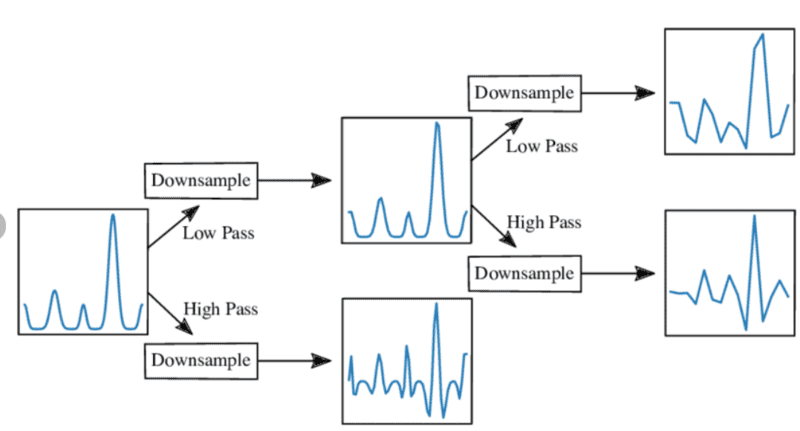
Thank you!
I recently got interested in wavelets. The main idea seems clear: we compute the inner product between the signal ##x(t)## and a chosen wavelet for different scale factors and translations of the wavelet over the signal. The inner product provides the coefficient for a wavelet with a specific scale factor ##a##, which is inversely related to the wavelet frequency ##f##, as we translated the wavelet over ##x(t)##.
Apparently, given a discrete signal ##x(t)##, we can calculate either its continuous wavelet transform CWT and its discrete wavelet transform (DWT). Both are transforms are discrete in the sense that the scale parameter and translation parameter have a finite numbers of values...
My question: the DWT can be represented as a bank of low-pass and high-pass filters. We send the signal ##x(t)## into the first pair of filter and then pass its downsampled low-pass versions into subsequent filter pairs This process apparently produces approximation and detail coefficients...I am not clear on this process...What do we do with the approximation and detail coefficients? Is the signal decomposed into a weighted sum of wavelet functions plus a weighted sum of scaling functions?
We end up with a single downsampled low-pass version of the input signal and two downsampled high-pass versions....How does that relate to obtaining a spectrogram ##F(\omega, t)## of the input signal ##x(t)##?
Thank you!