enorbet
- 484
- 85
Greetings
Recently I read that radio jets from Quasars and Radio Galacies exhibit a behavior similar to shock diamonds which reopened a creaky old door in my mind because i first started reading about Shock Diamonds as a child of about 8 which may be part of my difficulties in understanding this phenomena. IIRC it was in a book about White Sands Proving Grounds written by G.Harry Stine who participated in testing V2, Aerobee Hi, and Viking rockets and engines (in other words, both on test stands and in flight). He stated that they were also called "Mach Diamonds" because they were only associated with supersonic exhaust velocities and could be used as a rough estimate of that velocity by counting the diamonds. eg: 5 diamonds = mach 5
Many years later I brought this up in Physics class while we were discussing DeLaval and was told that if there was a relationship it was very rough because their formation is quite dynamic.
The distance from the nozzle to the first shock diamond can be approximated by:
x = 0.67 D_0\sqrt{\frac{P_0}{P_1}}<br />
where x is the distance, D0 is the nozzle diameter, P0 is flow pressure and P1 is atmospheric pressure.
The extreme variable is P_0 since it is related to exhaust velocity which commonly starts as subsonic, becomes sonic as the nozzle converges and then supersonic as it diverges. Ideally exhaust translates from a high pressure-low velocity to a low pressure-hi velocity in such a manner as to get as close to ambient pressure as possible. or at least this was the thinking before computer modeling became a reality. I also have questions about modern understanding of the design of nozzles but I'll save that for another thread. At any rate, I haven't seen them but assume there exists formulae for the entire progression in systems exhibiting multiple diamonds.
What I am looking for today is a better understanding of Shock Diamonds, why and how they propagate with hopefully special attention to the relationship with velocity, so while I encourage discussion I probably need a reference or link to modern papers on this subject, if indeed any exist
Any help?
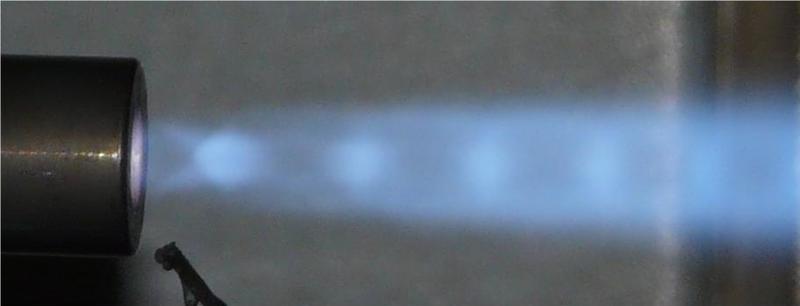
Below is a nice photo so nobody assumes we are talking about minerals :)
Recently I read that radio jets from Quasars and Radio Galacies exhibit a behavior similar to shock diamonds which reopened a creaky old door in my mind because i first started reading about Shock Diamonds as a child of about 8 which may be part of my difficulties in understanding this phenomena. IIRC it was in a book about White Sands Proving Grounds written by G.Harry Stine who participated in testing V2, Aerobee Hi, and Viking rockets and engines (in other words, both on test stands and in flight). He stated that they were also called "Mach Diamonds" because they were only associated with supersonic exhaust velocities and could be used as a rough estimate of that velocity by counting the diamonds. eg: 5 diamonds = mach 5
Many years later I brought this up in Physics class while we were discussing DeLaval and was told that if there was a relationship it was very rough because their formation is quite dynamic.
The distance from the nozzle to the first shock diamond can be approximated by:
x = 0.67 D_0\sqrt{\frac{P_0}{P_1}}<br />
where x is the distance, D0 is the nozzle diameter, P0 is flow pressure and P1 is atmospheric pressure.
The extreme variable is P_0 since it is related to exhaust velocity which commonly starts as subsonic, becomes sonic as the nozzle converges and then supersonic as it diverges. Ideally exhaust translates from a high pressure-low velocity to a low pressure-hi velocity in such a manner as to get as close to ambient pressure as possible. or at least this was the thinking before computer modeling became a reality. I also have questions about modern understanding of the design of nozzles but I'll save that for another thread. At any rate, I haven't seen them but assume there exists formulae for the entire progression in systems exhibiting multiple diamonds.
What I am looking for today is a better understanding of Shock Diamonds, why and how they propagate with hopefully special attention to the relationship with velocity, so while I encourage discussion I probably need a reference or link to modern papers on this subject, if indeed any exist
Any help?
Below is a nice photo so nobody assumes we are talking about minerals :)