What Are Some Questions About the Universe That a Newbie May Have?

  • Context: High School 
  • Thread starter Thread starter n0vadeath
  • Start date Start date
Click For Summary

Discussion Overview

The discussion revolves around various questions regarding the universe, including the observable universe's limits, the nature of the big bang, and the implications of space expansion. Participants explore theoretical concepts and personal curiosities related to cosmology and physics.

Discussion Character

  • Exploratory
  • Debate/contested
  • Conceptual clarification

Main Points Raised

  • Damien questions the observable universe's limits, suggesting a diagram to illustrate the curvature of space and whether it accurately represents what can be seen.
  • Damien wonders about the existence of other big bangs and whether more universes could be forming, questioning the nature of space and time as they relate to the big bang.
  • Some participants note that space itself can expand faster than light, which does not violate relativity, as there is no reference point for such expansion.
  • There is a discussion about the universe's size, with some asserting it is believed to be about 180 billion light years across, complicating the understanding of distance in cosmological terms.
  • Concerns are raised about the assumptions made regarding the existence of time and space before the big bang, with some participants arguing that different models may lead to different interpretations.
  • Participants express curiosity about the limits of observation, questioning whether the line of sight in a spherical universe would be straight or curved and what lies beyond observable limits.
  • There is acknowledgment that we observe light from the past, which raises further questions about the nature of observation in cosmology.

Areas of Agreement / Disagreement

Participants express a range of views on the nature of the universe, the big bang, and the implications of space expansion. There is no clear consensus, as some questions remain unresolved and participants hold differing interpretations of theoretical concepts.

Contextual Notes

Participants highlight the complexities of cosmological models and the limitations of current understanding regarding the conditions before the big bang and the nature of space and time. The discussion reflects ongoing uncertainties in the field.

Who May Find This Useful

Individuals interested in cosmology, theoretical physics, and the fundamental questions about the universe may find this discussion engaging and thought-provoking.

n0vadeath
Messages
9
Reaction score
0
I got a few questions to ask for fun. Some ideas I've been thinking about.

First I read that we cannot according to our present age of about 15 billion years see more than 15 billion llight years. I made a quick diagram to ask if this is the true line of site we would be able to see, the curvature, would that be correct?

Im not sure how to post it on here but I think it worked in the attachments.
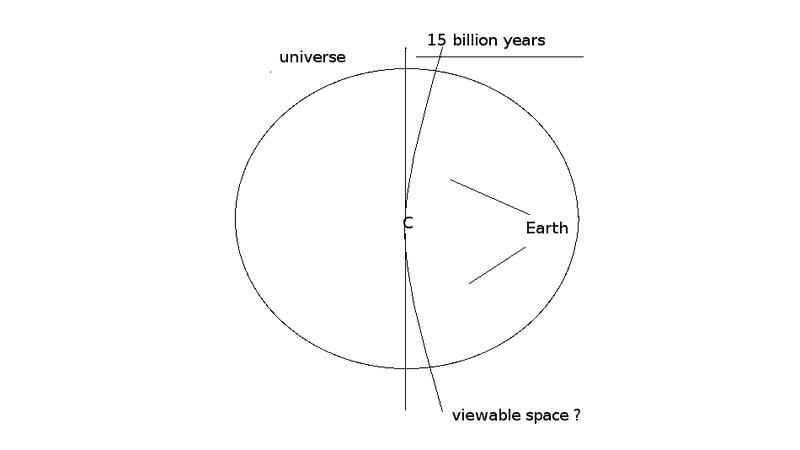
viewablespace.png


Another question. Why hasn't other big bangs came into our known existence? Could there be more universes within ours getting ready to blow? Is that possible?


Third according to theory within 1 second after the big bang happened, the size of the universe is said to be within the size of our solar system. What would propel the expansion of the universe faster than the speed of light?Wouldn't that prove it is possible to go faster than light? Maybe I am mistaken , the speed of light only exists within our universe?


Peace

Damien
 
Space news on Phys.org
Welcome to PF, Damien. I'll leave that first question for Space Tiger or one of his professional cohorts. It's actually more complicated than it first appears.
Your next two questions actually share the same answer. Space and time both came into existence with the big bang; neither existed before it happened. The expansion of the universe involves the space itself, not the contents of it. There is nothing in physics to prevent space from exceeding light speed, because there's nothing to use as a reference point. If there are indeed other big bangs, and there's no reason to say that there aren't, they are not within our universe; they create their own.
 
Alright that's awesome. Thanks for moving the thread, moderator, wasnt sure where to put it. Thanks for the welcome Danger. Ill come back and check out any responses for now I should get used to some of the other threads on here.

I got other questions Ill direct to the Academic section since I'm starting college the 21st as a freshman.I look forward to participating more as time and knowledge allow.
 
n0vadeath said:
I got a few questions to ask for fun. Some ideas I've been thinking about.

First I read that we cannot according to our present age of about 15 billion years see more than 15 billion llight years. I made a quick diagram to ask if this is the true line of site we would be able to see, the curvature, would that be correct?

Im not sure how to post it on here but I think it worked in the attachments.

View attachment 7474

Another question. Why hasn't other big bangs came into our known existence? Could there be more universes within ours getting ready to blow? Is that possible?


Third according to theory within 1 second after the big bang happened, the size of the universe is said to be within the size of our solar system. What would propel the expansion of the universe faster than the speed of light?Wouldn't that prove it is possible to go faster than light? Maybe I am mistaken , the speed of light only exists within our universe?


Peace

Damien


To 3) : We get this sort of question a lot, and as Danger pointed out it has to do with the fact that space is expanding. First, even when special relativity is valid, its only the relative velocities between objects that cannot exceed the speed of light. Second, special relativity isn't valid in the big bang because you are not dealing with falt spacetime. In fact quantum mechanics and GR do not even agree about what would have happened--so things are a bit complicated. Space Tiger can probably explain better.

To 2) : we don't know what conditions preceded the big bang, so that is an unanswerable question (at least in any definitive way). However, if the reality is anything like we think it is (certainly not a given), the answer would be no to all 3.

To 1) : Well, the universe is believed to be about 180 billion light years across for one, not 30. Again, this has to do with the stretching of space (as well as the definition of distance which becomes a lot fuzzier on cosmological scales). I'm not sure what your question is actually asking. Curvature of what? Space-time? The horizon of the visible universe? 'See'? I assume you mean the more general 'observe'.


Welcome to PF, and please don't feed the penguins.
 
Danger said:
Space and time both came into existence with the big bang; neither existed before it happened. ..

But but but...how do you know that, danger?

The professional researchers I know of that are studying the big bang
(making quantum models, doing computer simulations) do NOT assume that "neither existed before".

I rather think that what one assumes exists before the beginning of expansion (which used to be treated as a "singularity", i.e. a breakdown in theory) must depend on the model one is using.
 
Ah , sorry well on the diagram which was thrown together fast, the curve that appears on it. Would that be as far as we can observe?Now let's say it is about 180 billion years, and let's say we are about 80 billion light years from that point of creation(what ever that means , not to be secular or religously biased) would our line of site be the straight line(if the universe was spherical) or the curved line? Could we not see beyond that curved line?
 
n0vadeath said:
Ah , sorry well on the diagram which was thrown together fast, the curve that appears on it. Would that be as far as we can observe?Now let's say it is about 180 billion years, and let's say we are about 80 billion light years from that point of creation(what ever that means , not to be secular or religously biased) would our line of site be the straight line(if the universe was spherical) or the curved line? Could we not see beyond that curved line?
Our range of sight is limited to 15 billion light-years, since light can only have traveled 15 billions light-years in 15 billion years. However, the objects we see at the edge of that are currently something like 40 billion light-years away (remeber that we see them where they used to be, not where they are.).
 
right we see the past , which is an awesome concept. Wish we could get an up close look at a planet a few light years away(what ever is closest we know of) like we could look through a telescope at the moon. Would provide a lot of answers !
 

Similar threads

  • · Replies 20 ·
Replies
20
Views
3K
  • · Replies 8 ·
Replies
8
Views
3K
  • · Replies 33 ·
2
Replies
33
Views
8K
  • · Replies 1 ·
Replies
1
Views
770
  • · Replies 54 ·
2
Replies
54
Views
6K
  • · Replies 26 ·
Replies
26
Views
4K
  • · Replies 22 ·
Replies
22
Views
2K
  • · Replies 3 ·
Replies
3
Views
2K
  • · Replies 38 ·
2
Replies
38
Views
6K
  • · Replies 65 ·
3
Replies
65
Views
9K