What are the Characteristics of a Perfect Meteorite?

  • Context: Undergrad 
  • Thread starter Thread starter davenn
  • Start date Start date
  • Tags Tags
    Meteorite
Click For Summary
SUMMARY

The discussion centers on the characteristics of a perfect meteorite, emphasizing key features such as orientation, flow lines, regmaglypts, and a dark fusion crust. The participant, Dave, describes his 1.5 kg ordinary chondrite meteorite from NW Africa, which, despite lacking flow lines, exhibits notable lipping and regmaglypts. The conversation also touches on the identification of meteorites, including the importance of fusion crust and the differences between meteorites and Earth rocks, as well as the methods used for meteorite hunting.

PREREQUISITES
  • Meteorite identification techniques
  • Understanding of meteorite types: chondrites and achondrites
  • Knowledge of fusion crust characteristics
  • Familiarity with meteorite hunting methods
NEXT STEPS
  • Research the characteristics of ordinary chondrites and their formation
  • Learn about the process of meteorite hunting in desert regions
  • Explore the differences between stony meteorites and iron meteorites
  • Investigate the role of fusion crust in meteorite classification
USEFUL FOR

This discussion is beneficial for meteorite enthusiasts, collectors, geologists, and anyone interested in the identification and classification of meteorites.

davenn
Science Advisor
Gold Member
Messages
9,715
Reaction score
11,708
I have spent the last few months searching for my first meteorite over 1kg
I had a number of requirements that I wanted to fulfill as much as possible

1) Orientation - so it could be easily seen which "face" was the one being highly heated and melted
2) Flow lines
3) Regmaglypts - sometimes affectionally known as thumbprints - caused by the superheated air flowing around the sides of the stone
4) A dark fusion crust that isn't weathered too much.

The only thing the meteorite I got didnt have was flow lines but that was made up for by some fine "lipping" - where molten material
flowed around the edges away from the front face.

The meteorite is a 1.5 kg stone, an ordinary chondrite, from NW Africa, the Morocco region. It has some nice secondary fusion crust
and several patches where there is no crust and the interior of the meteorite can be seen

One of the sides with regmaglypts nd secondary fusion crust
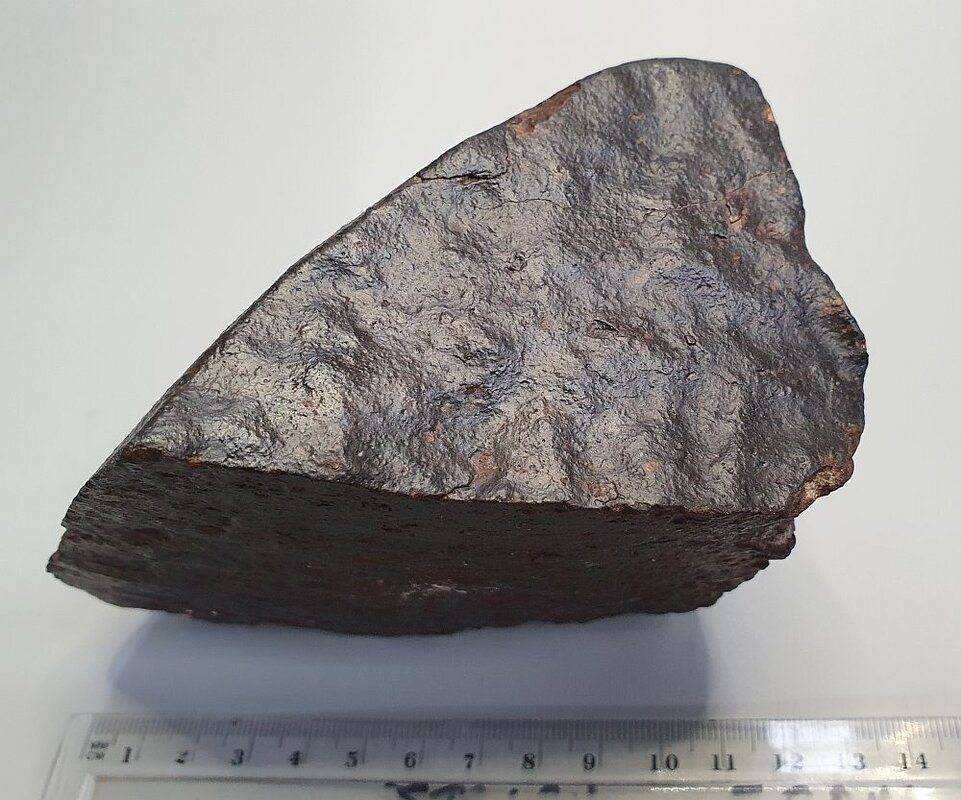
NWA 1.5kg b.jpg


A very weathered side with little fusion crust.
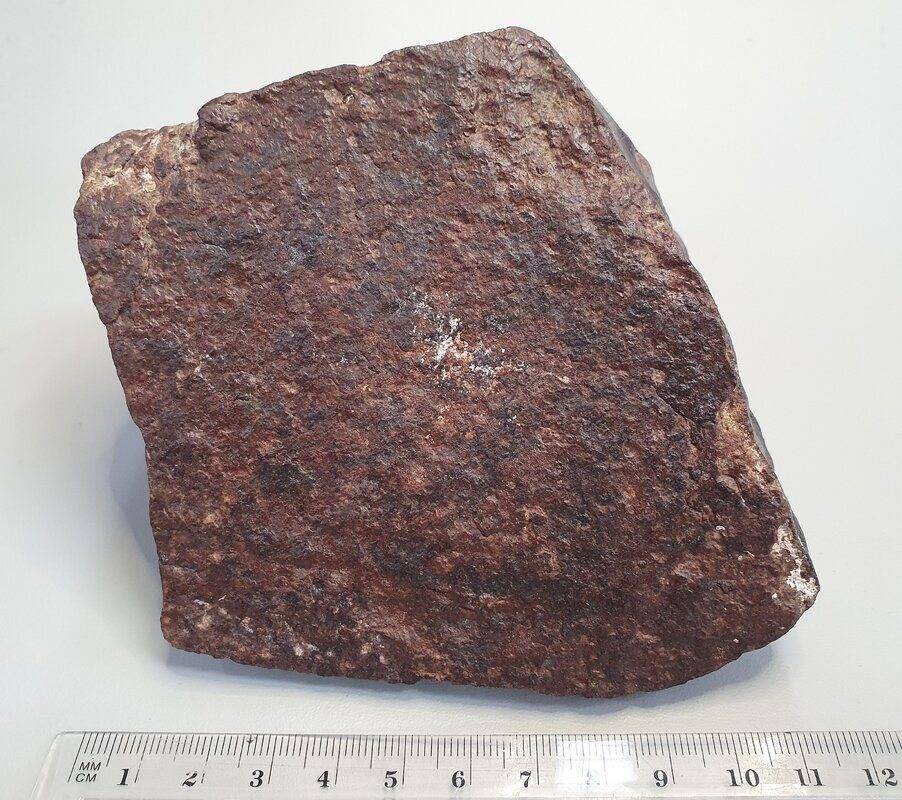
NWA 1.5kg c.jpg


Another side with regmaglypts and along the top and right edges you can see where molten material has flowed from the
front face and around onto the side
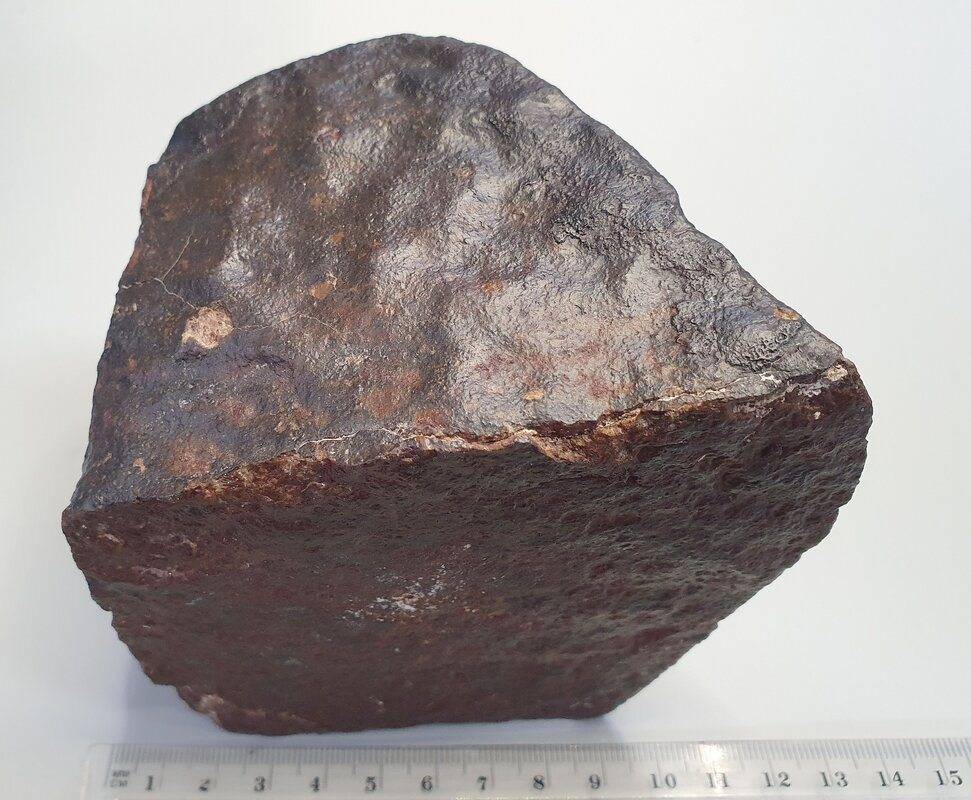
NWA 1.5kg d.jpg


A look into the inside and round/spherical chondrules can be seen
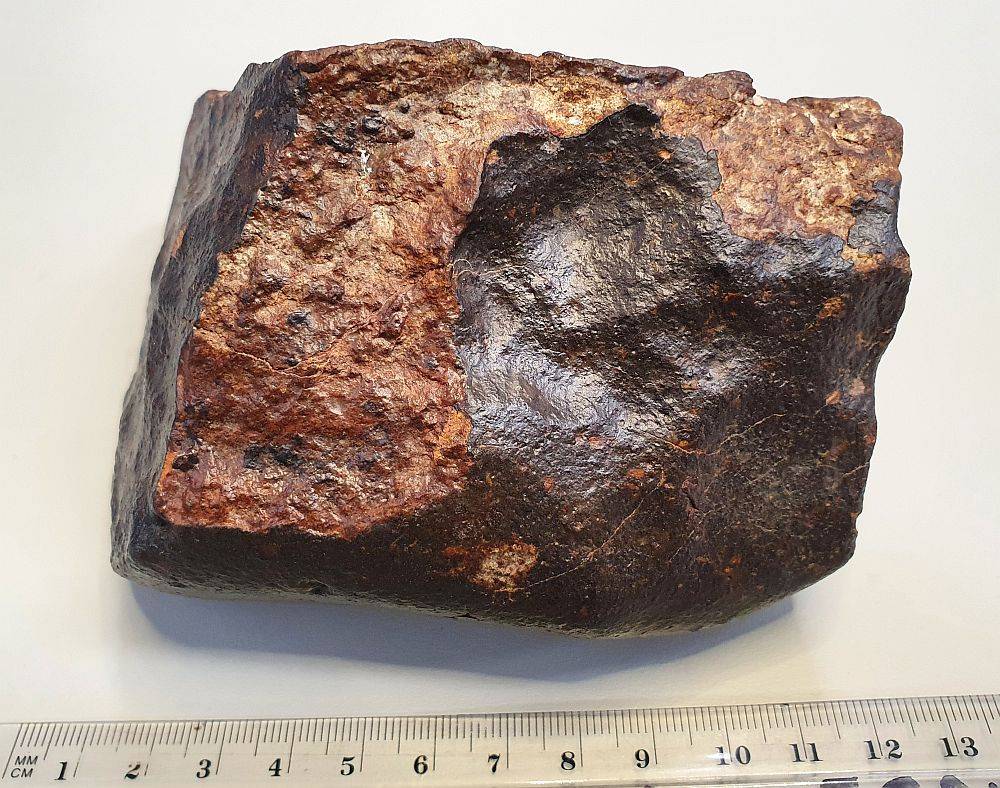
NWA 1.5kg e.jpg


This is the orientated side - It's the side that was facing into the atmosphere during its entry
NWA 1.5kg f.jpg
cheers
Dave
 
Last edited:
  • Like
  • Love
Likes   Reactions: chemisttree, Santiago24, sysprog and 7 others
Astronomy news on Phys.org
  • Love
  • Haha
Likes   Reactions: Klystron and davenn
These are great. Thanks.

Should this thread be Earth Science? Geology? It is only partly astronomy.

Maybe this model is why I said this:
The local university, UNM, has a meteorite museum.
http://meteorite.unm.edu/meteorites/meteorite-museum/
It is way cool, but the point here is: It is in the Dept of Meteoritics. v Whatever that encompasses...

Here are the current research projects:
http://meteorite.unm.edu/research/

Some are geology (planetary inner structure). Some are more astronomy / astrophysics.

Hmm. Cubby-hole placement failure. Mother Nature wins again.
@Bystander probably can add something...
 
  • Like
Likes   Reactions: davenn
jim mcnamara said:
Should this thread be Earth Science? Geology? It is only partly astronomy.
I pondered that, but with the other meteorite stuff I posted, it's a space rock rather than an Earth rock.
I agree, it's a fine line to tread :wink:
 
davenn said:
, it's a space rock rather than an Earth rock.

It's an Earth rock now. :oldbiggrin:

Is it an H, L or LL?
 
  • Like
Likes   Reactions: davenn and BillTre
Vanadium 50 said:
It's an Earth rock now. :oldbiggrin:
indeed ... an adopted rock :wink:

Vanadium 50 said:
Is it an H, L or LL?
I don't know, that was of least importance to me
I was purchasing it for its surface features :smile: It's too nice a looking meteorite to window it for an interior ID
There's plenty of "ugly" ( mite be a little unkind) looking met's out there that can be sliced up Dave
 
jim mcnamara said:
@Bystander probably can add something...
Vanadium 50 said:
It's an Earth rock now. :oldbiggrin:
 
davenn said:
I have spent the last few months searching for my first meteorite over 1kg
Excuse me, I'm new here. I only want to ask you: how did you find it? I think that you found it on Earth, and it is possible because, despite our atmosphere is strong, anyway we are hit by the the meteorites. But the real question is: how do you know that it is a piece of meteorite? When the stone is landed on Earth it becomes part of it, isn't possible to know its real nature. It is sure that I wrong, if you have found a meteorite, but where do I wrong?
 
vincenzosassone said:
I only want to ask you: how did you find it?
I think he bought it. I think some people look around places where meteors have been seen to fall and sell what they find.
vincenzosassone said:
But the real question is: how do you know that it is a piece of meteorite?
There are differences between rocks that cooled in zero g then got superheated as they fell through the atmosphere compared to rocks that formed on Earth. Some are listed in post #1 in this thread.
 
  • Love
Likes   Reactions: davenn
  • #10
Ibix said:
I think some people look around places where meteors have been seen to fall and sell what they find.

Actually seeing the fall is unusual. This meteorite, like many others, was found in the African desert. When you find a rock on top of that much sand, it's a good bet that it came from the sky.
 
  • Like
Likes   Reactions: Ibix, davenn and BillTre
  • #11
Two or more collaborating meteorite hunters of Morroco working a few clicks apart could gaze at the sky during an apparently nearby meteor shower, and upon seeing an especially bright and speedy-appearing one (suggesting a larger one, more likely than average to yield a meteorite, and of comparatively close proximity), aim instruments and note the direction, compare notes to find where the directions intersect, and go in the morning on a meteorite hunt with better than average prospects.
 
  • Like
Likes   Reactions: BillTre
  • #12
vincenzosassone said:
I'm new here.

Welcome to PF :smile:

vincenzosassone said:
I only want to ask you: how did you find it?

I didnt personally find this one. It was found by a fellow meteorite collector who travels from Spain down to Morocco
several times a year to hunt for meteorites and also buy them from local dealers.
This one cost me a significant amount of money

vincenzosassone said:
I think that you found it on Earth, and it is possible because, despite our atmosphere is strong, anyway we are hit by the the meteorites

There's approx. 15,000 tonnes of meteorites added to the Earth every year
Many survive their fiery trip through the atmosphere

vincenzosassone said:
But the real question is: how do you know that it is a piece of meteorite? When the stone is landed on Earth it becomes part of it,
isn't possible to know its real nature.

Some meteorites weather badly in the rain etc over 100's to 10's of 1000's of years and more and on the outside can look much
like some Earth rocks
V50 gave an excellent answer ...

Vanadium 50 said:
When you find a rock on top of that much sand, it's a good bet that it came from the sky.

But when they are found in some other places, it can be more difficult to find them unless they are recent falls, days to a few years,
where the fusion crust hasn't had a chance to erode away. The fusion crust on that one above isn't very fresh, I'm guestimating maybe
less than ~ 50 years. Ones from the desert regions loose their fusion crust reasonably quickly because of sand abrasion ( sand blasting) and end up with just a pale brownish gloss called a desert varnish.

other things include the points Ibix aimed you to in my first post ...

Ibix said:
There are differences between rocks that cooled in zero g then got superheated as they fell through the atmosphere compared to rocks that formed on Earth. Some are listed in post #1 in this thread.

Those four points are some of important ones to visually identify a rock as a meteorite in the field

Another common way to find meteorite in the field is with a rare Earth magnet on the end of a walking stick and also with a metal detector.
Irons, stones and stony irons all have metal in them that will cause them to stick to a magnet or detected by a metal detector.

Irons, as the name suggests, are ~ 80 - 95% iron with most of the rest nickel and usually around less than 1% other metals and occasionally a tiny amount of some silicates

This is a slice of an iron meteorite, from my collection, that has been polished and etched with acid.
It shows the Widmanstatten pattern of crystals of iron and nickel. This is only found naturally in meteorites
as it takes very slow cooling in the core of an asteroid for these crystals to become so large

#046 Muonionalusta, Sweden.jpg


Stony meteorites, as their name suggests, are ones that are primarily stone material.
There are two types, chondrites and achondrites
Chondrites are crustal material from asteroids and are identified by chondrules ( round/sub round spheres) throughout
the stone matrix They also have quite an amount of metal flakes throughout them, mainly iron and nickel.

#008 NWA L4 Chondrite.jpg


Achondrites are usually always breccias. A breccia is a rock that has angular clasts embedded in the matrix.
Achondrites originate from the Moon or from Mars and they are the result of large impacts on those bodies
by asteroids that smash up the rock that gets hit, it clumps together and gets ejected from the Moon or Mars
to sometimes end up on Earth.

EDIT: I should note that there are a few achondrites that come from asteroids, eg, the diogenites
they are also a breccia and are also usually formed by collisions

Here is a piece of Lunar achondrite ( breccia) from my collection ...

#052 NWA11421 Lunar Felspathic Breccia.jpg


NOTE:
Now, there are Earth breccias, that have two main sources, volcanic and sedimentary and they can look very similar
to meteorite breccias and often the source can only be confirmed by laboratory testing of the sample.

The last major group of meteorites are the stony irons and there are two sub-groups; Pallasites and mesosiderites.

Pallasites original from the core-mantle boundary of an asteroid, they are silicate and iron/nickel rich. The silicate is
primarily of olivine, a form of pyroxene. They produce beautiful meteorites, again from my collection ...

20200928 Sericho3 sm.jpg
Mesosiderites and theorized to form from an asteroid to asteroid impact where one of them has little to no crustal material.
That is, it is, mostly core or core/mantle material. the impact with a crusted asteroid produces an often fractured rock with
metal and silicates throughout and roughly in a 50/50% mix of iron and silicate.

#049 Huckitta, NT Australia a.jpg


Others are less fractured and just consist of a 50/50% mix ...

#104 NWA 12949 Mesosiderite Morocco.jpg
Hope that helps answer you question :smile:

Regards
Dave
 
Last edited:
  • Like
  • Informative
Likes   Reactions: Ibix, Bystander and BillTre
  • #13
Very cool @davenn!

So different samples from sources that got smashed up somehow.
The sources (planetoids?) seem to have differentiated into layers as liquids, before this happened.

How big do those bodies have to be to settle out different molten components?
How long would they take to form?

Any idea how old your rocks are?
 
  • Like
Likes   Reactions: davenn
  • #14
Thank you @Ibix and @davenn !
I didn't know about this meteorite hunters, I didn't know that the amount of matter that come from to the space was so large! Anyway, it is a very good collection Davenn!
 
  • Love
Likes   Reactions: davenn
  • #15
My ex-gf's whole family were museum curators and used to go on regular expeditions.
I went to England with them back in the 80s and she showed me how farmers' fields were often bordered with thousands of rocks and boulders that were cleared from their fields over centuries. These rock fences are good places to look for meteorites. (though we didn't find any)
 
  • Like
Likes   Reactions: davenn
  • #16
vincenzosassone said:
Thank you @Ibix and @davenn !
I didn't know about this meteorite hunters, I didn't know that the amount of matter that come from to the space was so large! Anyway, it is a very good collection Davenn!

thankyou that's just a few of my over 200 meteorites from more than 180 locations around the world

to see more about meteorite hunting, there are plenty of videos on youtube

There's two guys that did a TV series called Meteorite Men
Tho there the usual bit of TV hype that comes with reality shows, the info they present is very good
one of their episodes filmed in my country of Australia ...


cheers
Dave
 
  • Like
Likes   Reactions: vincenzosassone
  • #17
BillTre said:
Very cool @davenn!

Thanks :smile: meteorite collecting and learning about them has become a serious passion

BillTre said:
So different samples from sources that got smashed up somehow.

for the achondrite breccias and the mesosiderites, yes, tho different sources as stated :smile:
BillTre said:
The sources (planetoids?) seem to have differentiated into layers as liquids, before this happened.
How big do those bodies have to be to settle out different molten components?

good question and one I cannot answer
@Astronuc , @jim mcnamara any knowledge in this field ? for the size of a planet/planetoid to have a molten
core and have core, mantle, crust separation ?
BillTre said:
Any idea how old your rocks are?

Since the formation of the solar system :smile:Dave
 
  • Like
Likes   Reactions: BillTre
  • #18
Veritaseum did a recent video on meteors:

 
  • Like
Likes   Reactions: davenn

Similar threads

  • · Replies 9 ·
Replies
9
Views
3K
  • · Replies 21 ·
Replies
21
Views
5K
  • · Replies 19 ·
Replies
19
Views
3K
  • · Replies 16 ·
Replies
16
Views
7K
  • · Replies 1 ·
Replies
1
Views
4K
  • · Replies 8 ·
Replies
8
Views
6K
  • · Replies 9 ·
Replies
9
Views
5K
  • · Replies 4 ·
Replies
4
Views
10K