What Are the Consequences of the Iridium 33 and Cosmos 2251 Collision?

  • Thread starter Thread starter BobG
  • Start date Start date
  • Tags Tags
    Cosmos
Click For Summary

Discussion Overview

The discussion revolves around the collision between the Iridium 33 satellite and the Cosmos 2251 satellite, which occurred on February 10, 2009. Participants explore the implications of this event, including the generation of debris, potential risks to other satellites and the International Space Station, and the historical context of satellite collisions. The conversation includes technical details about the collision dynamics and speculative ideas for debris mitigation.

Discussion Character

  • Exploratory
  • Technical explanation
  • Debate/contested
  • Conceptual clarification

Main Points Raised

  • Some participants note the collision occurred at a high closing speed and angle, leading to significant debris generation.
  • There is speculation about the need for a dedicated spacecraft to clean up space debris, with humorous suggestions about its operation.
  • Concerns are raised about the lack of collision avoidance support for Iridium satellites, despite their ability to maneuver if given sufficient warning.
  • Participants express surprise at the collision's occurrence, likening it to a rare event.
  • Various ideas are proposed for debris mitigation, including using missiles, charged satellites, and high-power microwave arrays to alter debris orbits.
  • Some participants share links to external resources and simulations related to the collision and its implications.
  • There are references to historical incidents involving satellites, including the fallout from Cosmos 954, which adds context to the discussion.

Areas of Agreement / Disagreement

Participants express a range of views on the implications of the collision and potential solutions for debris management. There is no consensus on the best approach to mitigate space debris or the effectiveness of proposed methods.

Contextual Notes

Some discussions involve assumptions about the feasibility of proposed debris mitigation strategies, as well as the energy dynamics involved in satellite operations and deorbiting processes. The conversation reflects a mix of technical reasoning and speculative ideas without resolving the uncertainties involved.

Who May Find This Useful

This discussion may be of interest to those studying satellite technology, space debris management, and the implications of satellite collisions in orbital mechanics.

BobG
Science Advisor
Messages
364
Reaction score
87
An Iridium satellite and a dead Russian satellite collided on Feb 10 at 16:56:00 UST.

Debris From Satellites' Collision Said to Pose Small Risk to Space Station

They hit each other at an angle of 102.46 degrees, giving them a closing speed of about 11.65 km/sec (about 26,000 mph). That's going to leave a lot of debris.

It's not the first collision. An old Arianne rocket body hit the French Cerise satellite in 1996, plus there's been two or three suspected collisions between debris and dead satellites (there's a lot more dead satellites still in orbit than active satellites). It probably is the first satellite to satellite collision.

Cosmos 2251, a Strela 2M communications satellite (a really old satellite design - the first was launched in 1970, with the last launched in 1994.):
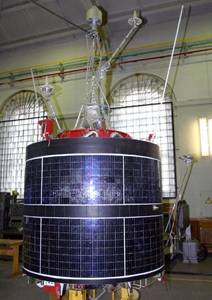
strela-2m__1.jpg


Iridium 33, a communications satellite:
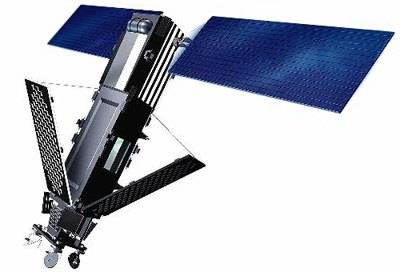
iridium__1.jpg
 
Last edited:
Computer science news on Phys.org
BobG said:
(there's a lot more dead satellites still in orbit than active satellites)
Perhaps we need a You Only Live Twice style ship (only, it would be a scavenger, not a predator) to clean up the mess.

Wouldn't it be awesome to hear a robotic Japanese voice, saying: "Bling out your dead"?
(and no wiseass remarks about sound propagating through a vacuum, thank you)
 
How depressing. Now I won't see the Iridium flare on March 25. Looking at old elsets, these have been on a collision course for quite a while. Iridium satellites can maneuver out of the way, given enough warning (it only takes a small orbit adjustment to avoid the collision). Evidently, they don't receive collision avoidance support from anyone.

A view of the orbit trajectories:

http://www.obsat.com/images/Ir33coll_top.gif

(Having a big picture is kind of annoying, so you'll have to link to it if you want to see it.)
 
Last edited:
Last edited by a moderator:
Gokul43201 said:
Perhaps we need a You Only Live Twice style ship (only, it would be a scavenger, not a predator) to clean up the mess.

Wouldn't it be awesome to hear a robotic Japanese voice, saying: "Bling out your dead"?
(and no wiseass remarks about sound propagating through a vacuum, thank you)

A satellite at that altitude is traveling 7400 m/sec. Size varies, but 750 kg isn't a bad estimate for a satellite. That's about 20.5 gigaJoules of energy (about the same as 5 tons of TNT). The only way you're going catch that satellite in a net is if you happen to be in the same orbit so you can get that relative velocity down. Then you have to change orbits to catch the next satellite, etc.

The only way to clean out an orbit is to deorbit the satellite at its end of life. That was actually the plan for the Iridium satellites when their company went bankrupt, but then the government bailed them out with a contract for their service.

Generally, deorbiting a satellite should take as much energy as it took to put it into that orbit in the first place. Fortunately, you don't have to bring it all the way in with satellite thrusters. Once the satellite is low enough, the atmosphere starts to suck energy out of the orbit and it decays on its own.

For higher orbits, deorbiting isn't even feasible (it would take way too much fuel). They put the satellite into a new orbit that's out of the way (supersynching geosynchronous comm satellites, for example).
 
Ahh - so that was the loud bang I heard. :biggrin:

Actually it was more of a 'disturbance in the force'.


That's amazing they hit as chemisttree observed.

Lots more debris to dodge - Crash of US, Russian satellites a threat in space
http://news.yahoo.com/s/ap/20090212/ap_on_sc/satellite_collision_22

http://news.yahoo.com/s/afp/20090212/ts_afp/usspaceaccidentsatellite_20090212204433

Ooops!
 
Last edited by a moderator:
That collision was like hitting a bullet with a bullet.
 
Picture of the collision. Edit: oops It's not. It's another incident mentioned in the article.
http://news.nationalgeographic.com/news/2009/02/photogalleries/satellite-collision-pictures/images/primary/090212-04-satellite-collision-pictures_big.jpg

From this article:
http://news.nationalgeographic.com/news/2009/02/photogalleries/satellite-collision-pictures/

Edit: An interesting read even if that picture isn't of the actual collision event.
 
Last edited by a moderator:
That's a 1978 photo of Cosmos 954, which, instead of achieving orbit, spread its radioactive fuel over Canada.
 
  • #10
BobG said:
That's a 1978 photo of Cosmos 954, which, instead of achieving orbit, spread its radioactive fuel over Canada.

Interesting story behind that.

http://gsc.nrcan.gc.ca/gamma/ml_e.php"

They never found the thing. They flew a gamma spectrometer hooked up to a huge DEC for real-time data analysis. And they dropped condoms filled with dyes to mark locations from the air.
 
Last edited by a moderator:
  • #11
BobG said:
A satellite at that altitude is traveling 7400 m/sec. Size varies, but 750 kg isn't a bad estimate for a satellite. That's about 20.5 gigaJoules of energy (about the same as 5 tons of TNT). The only way you're going catch that satellite in a net is if you happen to be in the same orbit so you can get that relative velocity down. Then you have to change orbits to catch the next satellite, etc.

I'm sure something could be figured out.

Maybe: send up missiles tipped with pressurized nitrogen tanks, timed to rapidly vent right in front of the debris clouds, at high relative velocity. The diffuse gas cloud could cause enough delta-v to perturb their orbits, pushing them into the upper atmosphere.

Or, nuclear weapons for the same effect. They effectively vaporize themselves, though the ion radiation might present a problem for living satellites.

Or, satellites charged up to extremely high voltages. (How?) They would attract conductive metal debris, accumulating it into a ball.

Or maybe giant electrified nets.

Or space-directed high-power microwave arrays. You could use a phased array to focus a beam on a small region, enough to heat up small projectiles until they vaporize. This is made easier by the insulating properties of a vacuum: the only heat loss mechanism is radiative.
 
  • #12
Those NASA guys certainly do have a lot of fun.
 
  • #13
Here's a link to AGI's website: http://www.agi.com/corporate/mediaCenter/news/iridium-cosmos/

They have some simulations, which can be viewed as a movie or by downloading the free AGI viewer. The viewer is pretty cool, since there's some nice STK simulations done for things like the Chinese ASAT test a couple years ago.

The viewer works in power point presentations and provides a really nice touch.
 
Last edited by a moderator:
  • #14
BobG said:
That's a 1978 photo of Cosmos 954, which, instead of achieving orbit, spread its radioactive fuel over Canada.

I see. I didn't pick that up when I read it. I thought it was a screen capture of something at the time. Thanks for straightening it out.
 

Similar threads

  • · Replies 2 ·
Replies
2
Views
10K