Bolter
- 262
- 31
- Homework Statement
- See below
- Relevant Equations
- None
Ok so here are a few multiple choice questions that I have been given to me and these are what my selected options turned out to be
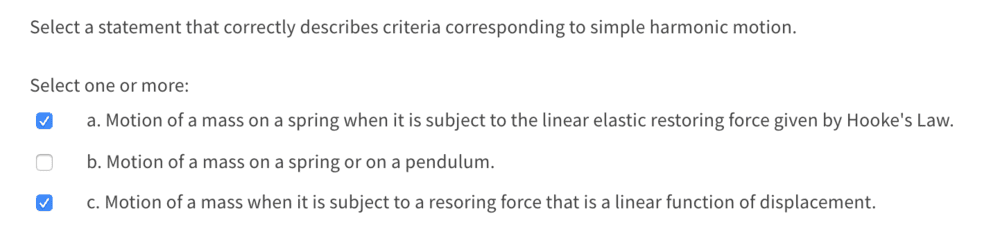
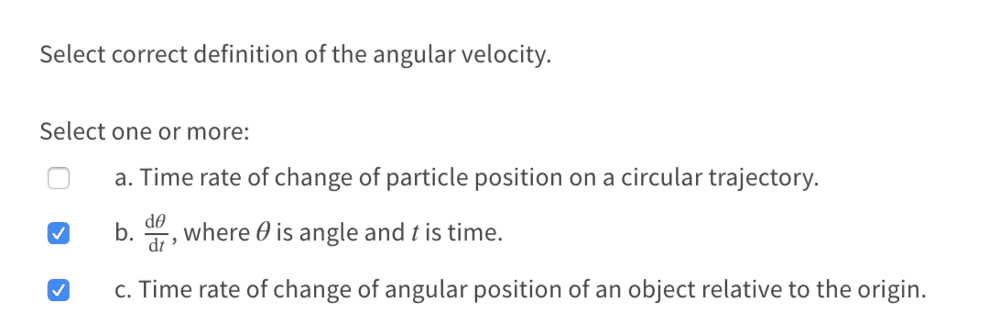
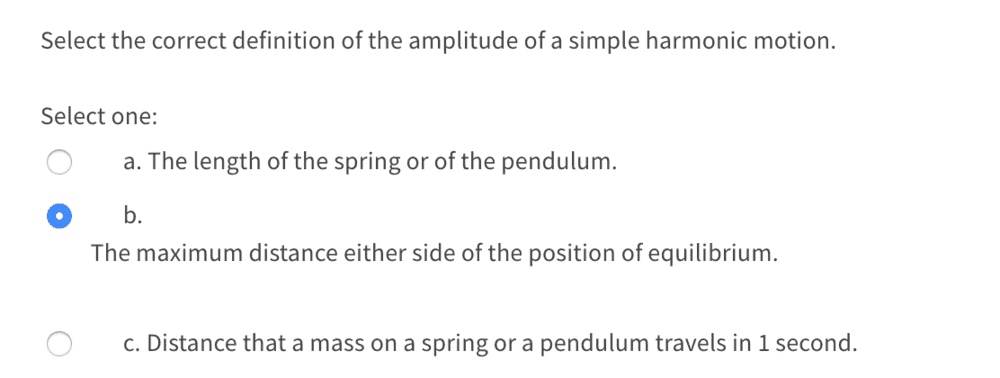
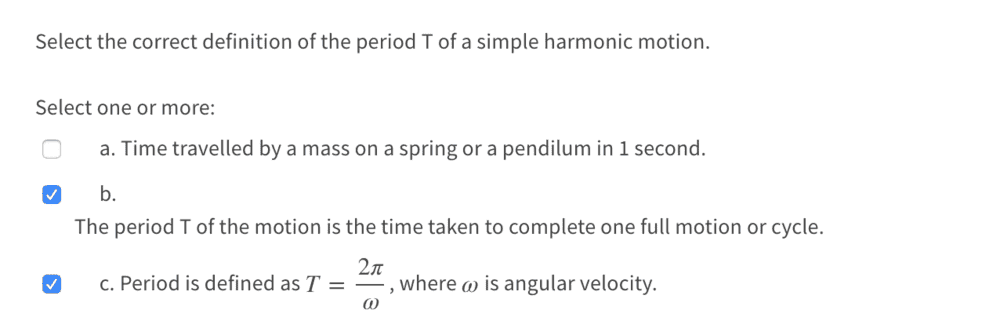
Do they seem right?
I am rather confused on the wording of the first question?
Is it asking to state the conditions of SHM for it be in SHM?
I know that from the definition in my head SHM is a type of periodic motion or oscillation motion where the restoring force is directly proportional to the displacement and acts in the direction opposite to that of displacement
I know it must be option C as that matches in with the above definition I had given. Cannot be option B as it simply just says motion on a pendulum or spring but does not describe any features of SHM. But option A is describing Hooke's law and says nothing about the displacement or how acceleration is directly proportional to its displacement from equilibrium position?
Any help would be appreciated! Thanks
Do they seem right?
I am rather confused on the wording of the first question?
Is it asking to state the conditions of SHM for it be in SHM?
I know that from the definition in my head SHM is a type of periodic motion or oscillation motion where the restoring force is directly proportional to the displacement and acts in the direction opposite to that of displacement
I know it must be option C as that matches in with the above definition I had given. Cannot be option B as it simply just says motion on a pendulum or spring but does not describe any features of SHM. But option A is describing Hooke's law and says nothing about the displacement or how acceleration is directly proportional to its displacement from equilibrium position?
Any help would be appreciated! Thanks