What Are the Different Types of Numbers and How Can You Determine Them?

Join the discussion
Registration is free. Ask a follow-up in this thread, or start your own.
8 replies · 2K views
nycmathguy
Homework Statement
Determine whether the number is a natural number, an integer, a rational number, or an irrational number.
Relevant Equations
None
Determine whether the number is a natural number, an integer, a rational number, or an irrational number. (Some numbers fit in more than one category.) The following facts will be helpful in some cases: Any number of the form sqrt{n}
where n is a natural number that is not a perfect square, is irrational. Also, the sum, difference, product, and quotient of an irrational number and a nonzero rational are all irrational.

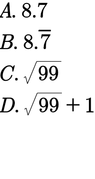
See attachment.

For A, I will say rational.

For B, I'm not sure because 8.(bar)7 means 8.777777...

For C, I will say irrational.

For D, I will also say irrational.

You say?
 

Attachments
  • 1624030598706.png
    1624030598706.png
    3 KB · Views: 220
  • Like
Likes   Reactions: Delta2
Physics news on Phys.org
A, C and D are correct. What about B?

Hint: infinite series.
 
  • Like
Likes   Reactions: Delta2
PeroK said:
Hint: infinite series.
I don't think he knows about infinite series.
His textbook probably has an explanation in terms of whether the decimal representation terminates (i.e., ends with a zero) or repeats a specific, fixed-length pattern.
 
  • Like
Likes   Reactions: nycmathguy
Mark44 said:
I don't think he knows about infinite series.
His textbook probably has an explanation in terms of whether the decimal representation terminates (i.e., ends with a zero) or repeats a specific, fixed-length pattern.
Perhaps some lateral thinking based on shifting digits? Is this Ron Larson again?
 
  • Like
Likes   Reactions: nycmathguy
Hint: what if you multiply 8.7777... by 9?
I'd guess there's a 50% chance the guy that wrote this quiz doesn't know about part B either. I think this video will help:
 
  • Like
Likes   Reactions: nycmathguy
PeroK said:
A, C and D are correct. What about B?

Hint: infinite series.
For B. I think the decimal is actually 8.777777777777777777777777777, and it is a rational number. Can this by written as 79/9?
 
Last edited by a moderator:
nycmathguy said:
For B. I think the decimal is actually 8.777777777777777777777777777, and it is a rational number. Can this by written as 79/9?
If you do long division for 79/9, you get ##8.777 \dots##. That would be good enough for me.

Have you studied (infinite) geometric series?

PS can you show that any repeating decimal is some whole number divided by ##9, 99, 999## etc?
 
nycmathguy said:
For B. I think the decimal is actually 8.777777777777777777777777777
Note that ##8.777777777777777777777777777## and ##8.777777777777777777777777777\dots## are different numbers. The latter can be written as ##8.777\dots## to mean exactly the same thing. The dots (called an ellipsis) mean that the pattern continues indefinitely.
 
  • Like
Likes   Reactions: nycmathguy
Mark44 said:
Note that ##8.777777777777777777777777777## and ##8.777777777777777777777777777\dots## are different numbers. The latter can be written as ##8.777\dots## to mean exactly the same thing. The dots (called an ellipsis) mean that the pattern continues indefinitely.
Very cool.