What Are the Directional Angles for Electric Forces in an Equilateral Triangle?

Click For Summary
SUMMARY

The discussion centers on calculating the net electric forces acting on three positive particles, each with a charge of 11.0 µC, positioned at the corners of an equilateral triangle with a side length of 14.0 cm. The magnitude of the force between any two particles is determined using Coulomb's Law, yielding a force of 55.561 N for each particle. The angles of the forces acting on particles Q2 and Q3 are derived from the properties of the equilateral triangle, where each angle measures 60 degrees, thus establishing the directional angles for the electric forces.

PREREQUISITES
  • Understanding of Coulomb's Law (F = KQ_1Q_2/r^2)
  • Basic knowledge of geometry, specifically properties of equilateral triangles
  • Familiarity with vector addition in physics
  • Concept of electric force directionality
NEXT STEPS
  • Study vector addition in the context of electric forces
  • Explore the implications of charge configurations on force directions
  • Learn about the principles of electrostatics in equilateral arrangements
  • Investigate advanced topics in electric field theory
USEFUL FOR

Students studying physics, particularly those focusing on electrostatics, as well as educators seeking to enhance their understanding of electric forces in geometric configurations.

Bensky
Messages
82
Reaction score
0
Electric force angles problem :(

Homework Statement


Three positive particles of charges 11.0 µC are located at the corners of an equilateral triangle of side d = 14.0 cm (Fig. 16-38). Calculate the magnitude and direction of the net force on each particle.
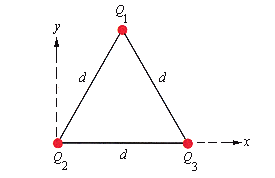
16-38alt.gif

Fig. 16-38

Homework Equations


F = KQ_1Q_2/r^2

The Attempt at a Solution


F = KQ_1Q_2/r^2
F = (9X10^9)(1.1X10^-5)^2/.14^2
F = 55.561 N for all points - Q1, Q2, and Q3 (correct)

Q1 angle = 90 degrees (correct)
Q2 angle = ?
Q3 angle = ?

I need to find the directional angle for particles Q2 and Q3 - I am unsure how to find these. I was thinking I might have to draw a triangle?

Thanks,
Bensky
 
Physics news on Phys.org
It's an equilateral triangle.

[tex]\angle Q_1=\angle Q_2=\angle Q_3[/tex]

[tex]\angle Q_1+\angle Q_2+\angle Q_3=180[/tex]
 
rocomath said:
It's an equilateral triangle.

[tex]\angle Q_1=\angle Q_2=\angle Q_3[/tex]

[tex]\angle Q_1+\angle Q_2+\angle Q_3=180[/tex]

I'm not looking for the interior angles, I'm looking for the angle of direction of force on Q2 and Q3.
 

Similar threads

Replies
3
Views
2K
Replies
9
Views
3K
Replies
2
Views
2K
  • · Replies 10 ·
Replies
10
Views
4K
Replies
2
Views
3K
Replies
3
Views
10K
  • · Replies 8 ·
Replies
8
Views
3K
  • · Replies 1 ·
Replies
1
Views
2K
  • · Replies 1 ·
Replies
1
Views
4K
  • · Replies 4 ·
Replies
4
Views
6K