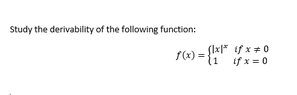
I think "differentiability" would be a better word than "derivability" since that might be confused with the ability to "derive" a formula. In any case, the first thing I would do is remove the "absolute value" by looking at x positive or negative separately.
If x is positive, then [tex]f(x)= x^x[/tex] and, taking the logarithm of both sides, log(f(x))= x log(x). Differentiating, [tex]f'(x)/f(x)= log(x)+ 1[/tex] so that [tex]f'(x)= (log(x)+ 1)f(x)= (log(x)+ 1)x^x[/tex]. That exists for all positive x so f(x) is differentiable for all positive x.
If x is negative, make the substitution y= -x. |x|= -x= y so that [tex]x^x= y^{-y}[/tex]. Again take the logarithm of both sides of [tex]f(y)= y^{-y}[/tex], [tex]log(f(y))= -ylog(y)[/tex]. Differentiating, [tex]f'(y)/f(y)= -log(y)- 1[/tex] so that [tex]f'(y)= -f(y)(log(y)+ 1)= -y^y(log(y)+ 1) and, since dy/dx= 0, [tex]f'(x)= (-x)^x(log(|x|)+ 1)[/tex]. That exists for all negative x so f(x) is differentiable for all negative x.<br />
<br />
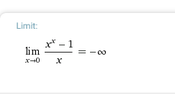
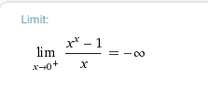
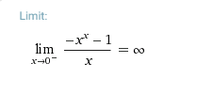
Finally, look at x= 0. The derivative of f(x) at x= 0 is [tex]\lim_{h\to 0} \frac{f(h)- f(0)}{h}= \lim_{h\to 0}\frac{h^h- 1}{h}[/tex]. Does that limit exist?[/tex]