What are the non-zero Christoffel symbols for 2D polar coordinates?

Click For Summary
SUMMARY

The discussion focuses on calculating the non-zero Christoffel symbols for 2D polar coordinates using differential geometry principles. The key non-zero symbols identified are: Γ^r_{φφ} = -r and Γ^φ_{rφ} = Γ^φ_{φr} = 1/r. Participants highlight that using the Euler-Lagrange equations can simplify the process of deriving these symbols compared to the traditional method involving the Levi-Civita connection. The conversation also touches on the potential complexity of calculating symbols for more complicated metrics, such as those of ellipsoids.

PREREQUISITES
  • Differential geometry fundamentals
  • Understanding of Christoffel symbols and their significance
  • Familiarity with Euler-Lagrange equations
  • Basic knowledge of polar and spherical coordinate systems
NEXT STEPS
  • Learn to derive geodesic equations from metrics in polar coordinates
  • Study the application of Euler-Lagrange equations in different coordinate systems
  • Explore the calculation of Christoffel symbols for ellipsoidal coordinates
  • Investigate the implications of non-zero Christoffel symbols in physical applications
USEFUL FOR

Students and professionals in mathematics and physics, particularly those specializing in differential geometry, general relativity, or anyone interested in the applications of Christoffel symbols in various coordinate systems.

flaticus
Messages
3
Reaction score
0
Just started self teaching myself differential geometry and tried to find the christoffel symbols of the second kind for 2d polar coordinates. I am checking to see if I did everything correctly.

With a line element of:

mathtex.cgi?ds^2%20=%20dr^2%20+%20r^2%20d\theta^2.gif
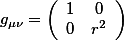
therefore the metric should be:
nu}%20=%20\[%20\left(%20\begin{array}{cc}%201%20&%200%20\\%200%20&%20r^2%20\end{array}%20\right).gif
The christoffel symbols of the second kind can be found by:

tex.cgi?\Gamma^{m}_{ij}%20=%20\frac{1}{2}%20g^{mk}%20(%20g_{ki,j}%20+%20g_{kj,i}%20-%20g_{ij,k}).gif
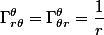
And the non-zero christoffel symbols I found:

mathtex.cgi?\Gamma^{r}_{\theta\theta}%20=%20r.gif

mathtex.cgi?\Gamma^{\theta}_{r\theta}%20=%20\Gamma^{\theta}_{\theta%20r}%20=%20\frac{1}{r}.gif


I noticed since
mathtex.cgi?g^{mk}.gif
is symmetric it is non-zero when m=k so summing over k is not needed, i do not know if I missed anything by doing this.
 
Last edited by a moderator:
Physics news on Phys.org
flaticus said:
i do not know if I missed anything by doing this.

You didn't miss any non-zero christoffel symbols, but you need to check the sign of ##\Gamma^r_{\theta \theta}##.
 
PeterDonis said:
You didn't miss any non-zero christoffel symbols, but you need to check the sign of ##\Gamma^r_{\theta \theta}##.

Ahh, I see was just looking at christoffel equation while doing derivatives in head and forgot to carry the negative. Thank you.
 
Just a quick note, there are easier ways of getting the Christoffel symbols than inserting the metric into the expression from the Levi-Civita connection.
 
Orodruin said:
Just a quick note, there are easier ways of getting the Christoffel symbols than inserting the metric into the expression from the Levi-Civita connection.
I'm curious - whenever I do one by hand, I do as the OP did. What are these easier ways?
 
PAllen said:
I'm curious - whenever I do one by hand, I do as the OP did. What are these easier ways?

I would start by deriving the geodesic equations for the metric and identify the Christoffel symbols from there. Perhaps you do not find that simpler?

Edit: In the case of polar coordinates, minimise
$$
S = \int (r^2 \dot \phi^2 + \dot r^2) d\tau
$$
Euler-Lagrange equations give:
\begin{eqnarray}
\ddot r - r \dot\phi^2 &=& 0 \\
\ddot \phi + 2\frac{1}{r} \dot r \dot \phi &=& 0
\end{eqnarray}
Identification with ##\ddot x^\mu + \Gamma^\mu_{\nu\rho} \dot x^\nu \dot x^\rho = 0## along with the zero torsion of the Levi-Civita connection gives
$$
\Gamma^r_{\phi\phi} = - r, \quad \Gamma^\phi_{r\phi} = \Gamma^\phi_{\phi r} = \frac 1r.
$$
 
Last edited:
  • Like
Likes   Reactions: PAllen and Dale
Good job! Now, go on to the sphere!

Actually, a bit harder would be for an ellipse or the surface of an ellipsoid.
 
Last edited by a moderator:
Orodruin said:
I would start by deriving the geodesic equations for the metric and identify the Christoffel symbols from there. Perhaps you do not find that simpler?

Edit: In the case of polar coordinates, minimise
$$
S = \int (r^2 \dot \phi^2 + \dot r^2) d\tau
$$
Euler-Lagrange equations give:
\begin{eqnarray}
\ddot r - r \dot\phi^2 &=& 0 \\
\ddot \phi + 2\frac{1}{r} \dot r \dot \phi &=& 0
\end{eqnarray}
Identification with ##\ddot x^\mu + \Gamma^\mu_{\nu\rho} \dot x^\nu \dot x^\rho = 0## along with the zero torsion of the Levi-Civita connection gives
$$
\Gamma^r_{\phi\phi} = - r, \quad \Gamma^\phi_{r\phi} = \Gamma^\phi_{\phi r} = \frac 1r.
$$
No, I just never thought of doing it that way. Since Euler-Lagrange are used to derive the general geodesic equation with Christoffel symbols, it really never occurred to me that for simple metrics their direct application would be simpler than the general definition.
 
PAllen said:
No, I just never thought of doing it that way. Since Euler-Lagrange are used to derive the general geodesic equation with Christoffel symbols, it really never occurred to me that for simple metrics their direct application would be simpler than the general definition.
To be honest I think it is even more simplifying for worse metrics (in particular off-diagonal ones), where otherwise you would have a large number of terms and partial derivatives of the metric to compute and keep track of. I have not done the counting, but I do believe that this approach significantly reduces the amount of necessary book keeping. Although you will still need to compute the same derivatives, it somehow feels lighter that you do not have to write them down more than once and the book keeping of knowing which derivative goes where is handled automagically.
 
  • #10
Orodruin said:
To be honest I think it is even more simplifying for worse metrics (in particular off-diagonal ones), where otherwise you would have a large number of terms and partial derivatives of the metric to compute and keep track of. I have not done the counting, but I do believe that this approach significantly reduces the amount of necessary book keeping. Although you will still need to compute the same derivatives, it somehow feels lighter that you do not have to write them down more than once and the book keeping of knowing which derivative goes where is handled automagically.
That makes a lot of sense. For transforming the metric from one set of coordinates to another, I basically never use the Jacobian definition; I substitute in the physicists metric short hand. It just never occurred to me that using Euler-Lagrange would avoid lots of bookkeeping for computation of Christoffel symbols. A years PF contribution is now paid for in saved computation.
 
  • Like
Likes   Reactions: Orodruin
  • #11
HallsofIvy said:
Good job! Now, go on to the sphere!

Actually, a bit harder would be for an ellipse or the surface of an ellipsoid.
For spherical coordinates this is what I found:
##ds^2 = dr^2 + r^2 d\theta^2 + r^2 sin\theta^2 d\phi^2##

##\Gamma^r_{\theta \theta} = -r \\
\Gamma^r_{\phi \phi} = -rsin^2 \theta \\
\Gamma^\theta_{r \theta} = \Gamma^\theta_{\theta r} = \frac{1}{r} \\
\Gamma^\theta_{\phi \phi} = -sin\theta cos\theta \\
\Gamma^\phi_{r \phi} = \Gamma^\phi_{\phi r} = \frac{1}{r} \\
\Gamma^\phi_{\theta \phi} = \Gamma^\phi_{\phi \theta} = cot\theta ##
 

Similar threads

  • · Replies 19 ·
Replies
19
Views
2K
  • · Replies 1 ·
Replies
1
Views
2K
  • · Replies 11 ·
Replies
11
Views
2K
  • · Replies 19 ·
Replies
19
Views
6K
  • · Replies 6 ·
Replies
6
Views
970
  • · Replies 6 ·
Replies
6
Views
3K
  • · Replies 6 ·
Replies
6
Views
6K
  • · Replies 4 ·
Replies
4
Views
4K
  • · Replies 47 ·
2
Replies
47
Views
7K
  • · Replies 2 ·
Replies
2
Views
1K