What Causes Peakes? Explanation for Non-Experts

  • Context: Graduate 
  • Thread starter Thread starter mythcism
  • Start date Start date
Click For Summary

Discussion Overview

The discussion focuses on the causes of peaks in photon absorption cross sections for different elements, specifically carbon and lead. Participants explore the underlying atomic processes and energy thresholds associated with these peaks, including resonance photon absorption and electron binding energies.

Discussion Character

  • Exploratory
  • Technical explanation
  • Debate/contested

Main Points Raised

  • One participant requests a detailed explanation of the causes of peaks in photon absorption cross sections, mentioning carbon and lead.
  • Another participant suggests that peak thresholds may relate to resonance photon absorption by internal atomic shells in lead.
  • A participant identifies that the sharp peaks correspond to the k-shell binding energies of electrons, approximately 13.6 Z² eV, which indicates the threshold for k-shell deep core photoejection.
  • Further clarification is requested regarding the relationship between photon energy and the opening of additional absorption channels once the energy exceeds the k-shell binding energy.
  • Questions arise about the number of peaks in lead compared to carbon, with one participant noting that lead has four peaks, while carbon has one, and seeks to identify what each peak represents.
  • Another participant lists the peaks in lead, identifying the highest energy peak as the K-shell edge (~90 KeV), followed by the L-edge (~25 KeV) and the M-edge (~10 KeV), while noting that lower Z elements may lack certain electron shells.
  • Participants express curiosity about a specific peak in the 200-600 eV range and seek clarification on its significance.
  • A link to a periodic table showing x-ray absorption edges is provided, along with the electron configuration for carbon, detailing the distribution of electrons across different shells.

Areas of Agreement / Disagreement

Participants express varying levels of understanding and seek clarification on specific points, indicating that the discussion remains unresolved regarding the exact causes and implications of the peaks in photon absorption cross sections.

Contextual Notes

Some participants express uncertainty about the terminology and concepts involved, indicating a potential gap in foundational knowledge that may affect the clarity of the discussion.

mythcism
Messages
4
Reaction score
0
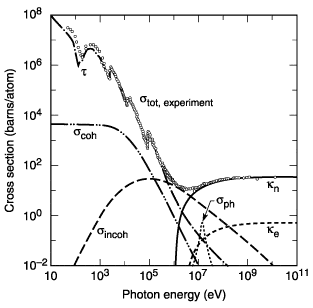
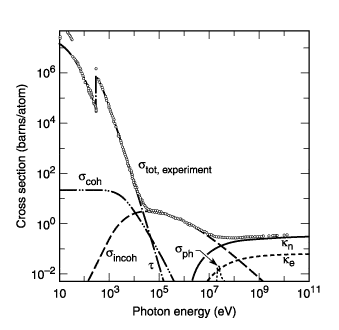
Can somebody explain in detail what causes the peakes.

this is carbon
Sec3135.gif


this is lead
Sec3150.gif


( Total photon cross section in carbon, as a function of energy, showing the contributions of different processes: t, atomic photo-effect (electron ejection, photon absorption); , coherent scattering (Rayleigh scattering—atom neither ionized nor excited); , incoherent scattering (Comp- ton scattering off an electron); , pair production, nuclear field; , pair production, electron field; , photonuclear absorption (nuclear absorption, usually followed by emission of a neutron or other particle).

thanks

(btw I am not really familiar with al these terms)
 
Physics news on Phys.org
I am not sure if I am right but peak thresholds may correspond to resonance photon absorption by internal atomic shells in lead.
 
Last edited:
The sharp peaks correspond the the k-shell binding energies of the electrons in atomic orbits, which is equal to about 13.6 Z2 eV (electron volts). This is the threshold for k-shell deep core photoejection.

Bob S
 
Thanks for the reply, but could you explain it in more detail please.
 
mythcism said:
Thanks for the reply, but could you explain it in more detail please.
The sharp peaks in the photon absorption cross section are the result of the photon energy exceeding the 1s (k-shell) binding energy of electrons in atoms. This is approximately

EZ =~13.6 Z2 eV

As soon as the photon energy exceeds this value (sometimes referred to as the K edge), additional channels open up to absorb the photons. The bound electrons are knocked out by the deep core photoelection process.

Bob S
 
Last edited:
But why does lead have 4 peaks and carbon 1. So what is every lead peak.
 
mythcism said:
But why does lead have 4 peaks and carbon 1. So what is every lead peak.
The highest energy peak in lead is the K-shell edge (~90 KeV), the next lower should be the L-edge (~25 KeV), and the next the M-edge (~10 KeV). Lower Z elements may not have 1s, 2s, and 3s electrons.
Bob S
 
but it is this all about the s
But what is the most left peak at 200-600ev or something in that range.
 
mythcism said:
but it is this all about the s
But what is the most left peak at 200-600ev or something in that range.
Here is the periodic table showing the x-ray absorption edges:
http://csrri.iit.edu/periodic-table.html
Click on carbon. The K-edge in carbon is about 284 eV.

The electron configuration in elements is

K-shell
1s(2)

L-shell
2s(2) 2p(6)

M-shell
3s(2) 3p(6) 3d(10) etc.,

where the number in ( ) is the number of electrons in a filled level.

Bob S
 

Similar threads

  • · Replies 0 ·
Replies
0
Views
2K
  • · Replies 1 ·
Replies
1
Views
2K
  • · Replies 21 ·
Replies
21
Views
5K
  • · Replies 7 ·
Replies
7
Views
5K
  • · Replies 5 ·
Replies
5
Views
514
  • · Replies 25 ·
Replies
25
Views
13K
Replies
1
Views
2K
  • · Replies 0 ·
Replies
0
Views
847
  • · Replies 9 ·
Replies
9
Views
5K
  • · Replies 3 ·
Replies
3
Views
5K