carlos125
- 13
- 0
Motional emf -easy question(re-edited)
Hi guys ,:
i'm learning about the motional emf , because i will have to take an exam soon, but I've found something really confusin for me well :
they say that when a conductor is moving in a direction perpendicular to the field with constant velocity under the influence of some external agent. The electrons in the conductor experience a force FB = qv x B that is directed along the length ℓ, perpendicular to both v and B . Under the influence of this force, the electrons move to the lower end of the conductor and accumulate there, leaving a net positive charge at the upper end. As a result of this charge separation, an electric field is produced inside the conductor.ok I understand all this (I'm talkin about the upper figure on the attachment)
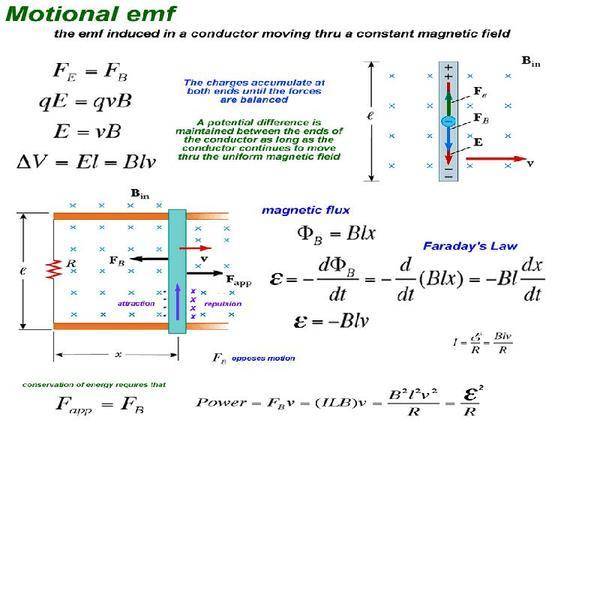
Question(lower figure on the attachment):
BUT when the conductor slides along two conducting rails they say that there is a magnetic field that goes to the left , Why? I mean they just said that it goes downwards and they now say that it goes to the left? it's really confusing , it would be great if anyone can help me please ..By the way I'm sorry for my bad english
Hi guys ,:
i'm learning about the motional emf , because i will have to take an exam soon, but I've found something really confusin for me well :
they say that when a conductor is moving in a direction perpendicular to the field with constant velocity under the influence of some external agent. The electrons in the conductor experience a force FB = qv x B that is directed along the length ℓ, perpendicular to both v and B . Under the influence of this force, the electrons move to the lower end of the conductor and accumulate there, leaving a net positive charge at the upper end. As a result of this charge separation, an electric field is produced inside the conductor.ok I understand all this (I'm talkin about the upper figure on the attachment)
Question(lower figure on the attachment):
BUT when the conductor slides along two conducting rails they say that there is a magnetic field that goes to the left , Why? I mean they just said that it goes downwards and they now say that it goes to the left? it's really confusing
, it would be great if anyone can help me please ..By the way I'm sorry for my bad english
Last edited: