What Determines the Minimum Height for a Marble to Complete a Loop-the-Loop?

Click For Summary

Homework Help Overview

The discussion revolves around determining the minimum height from which a marble must start to successfully complete a loop-the-loop track. The problem involves concepts from dynamics and rotational motion, particularly focusing on the relationship between the marble's radius and the loop's radius.

Discussion Character

  • Conceptual clarification, Assumption checking

Approaches and Questions Raised

  • Participants explore the significance of the radius of the marble in relation to the loop's radius, questioning the notation used and its implications for understanding the problem. There are inquiries about the conditions necessary for the marble to maintain contact with the track, particularly at the top of the loop.

Discussion Status

Some participants have provided clarifications regarding the relationship between the marble's radius and the loop's radius, suggesting that the notation is intended to help assess the situation. There appears to be a productive exchange of ideas, with participants working through the implications of the assumptions made in the problem.

Contextual Notes

Participants note that the radius of the marble is considered small compared to the radius of the loop, which raises questions about how this affects the calculations and assumptions in the problem.

MathewsMD
Messages
430
Reaction score
7
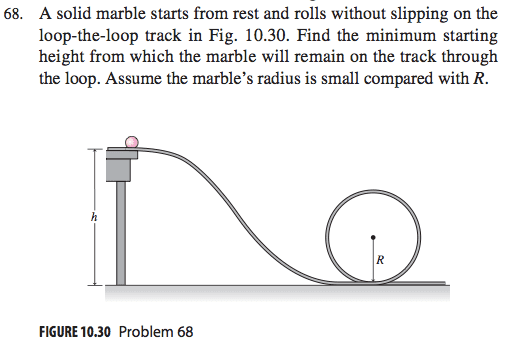
A solid marble starts from rest and rolls without slipping on the loop-the-loop track in Fig. 10.30. Find the minimum starting height from which the marble will remain on the track through the loop. Assume the marble’s radius is small compared with R.
y0EGBLp.png


Solution:
gDr9wl7.png


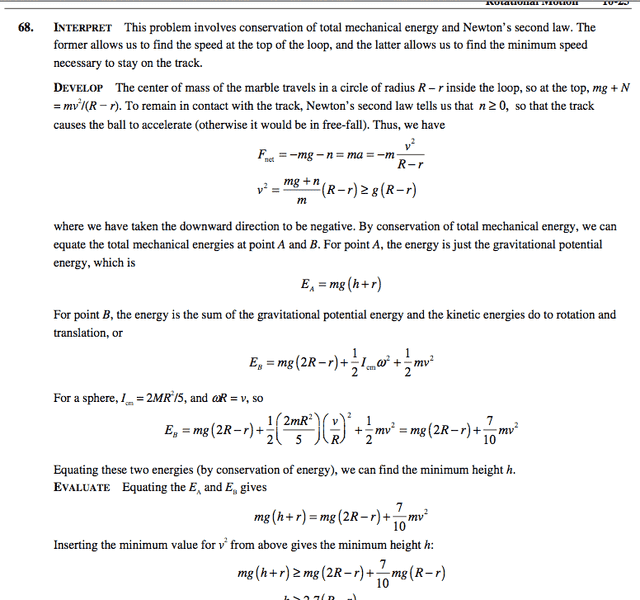
In the question, why is the radius of the circle referred to as R-r instead of just R? Is this common notation since I'm having a little bit of trouble understanding what exactly r is in this case and how this form helps us assess the situation. Also, why must v >= g (R-r)? I think this question stems from my previous one, but if the forces at the top must be at least Fn + mg, why isn't v >= (gr)0.5 since then v2/r >= g at the top for there to be a normal force still, correct?

Any help would be great! :)
 
Physics news on Phys.org
##r## is the radius of the ball, so the distance from the center of the loop-de-loop to the center of mass of the ball is just the full radius of the loop, ##R##, minus the distance the center of mass of the ball is raised up from the edge of the loop, ##r##. Make sense? And so the equation they arrive at for the minimum velocity, ##v^2 \geq \sqrt{g(R - r)}##, matches what you have, provided that you use ##R - r##.
 
  • Like
Likes   Reactions: 1 person
MuIotaTau said:
##r## is the radius of the ball, so the distance from the center of the loop-de-loop to the center of mass of the ball is just the full radius of the loop, ##R##, minus the distance the center of mass of the ball is raised up from the edge of the loop, ##r##. Make sense? And so the equation they arrive at for the minimum velocity, ##v^2 \geq \sqrt{g(R - r)}##, matches what you have, provided that you use ##R - r##.

Haha okay, wow that does make sense. They stated in the question r is small compared to R so I thought we did not consider it. Thanks for the clarification!
 
Yeah, sure thing! Actually, given that they said the radius of the ball is small, I would actually be very confused too if I hadn't been working backwards from the solution, so I don't blame you at all.
 

Similar threads

  • · Replies 12 ·
Replies
12
Views
13K
  • · Replies 13 ·
Replies
13
Views
2K
Replies
8
Views
4K
Replies
4
Views
4K
  • · Replies 5 ·
Replies
5
Views
2K
  • · Replies 1 ·
Replies
1
Views
2K
  • · Replies 9 ·
Replies
9
Views
16K
Replies
5
Views
2K
  • · Replies 10 ·
Replies
10
Views
7K