What Device Can Apply Constant Force Per Second for String Tension Experiments?

  • Thread starter Thread starter mindboggling
  • Start date Start date
  • Tags Tags
    Equipment
Click For Summary
SUMMARY

This discussion focuses on the need for a device that can apply a constant force per second (N/s) for string tension experiments. The key finding is that the breaking force of a string is influenced by the rate of force application, with higher N/s leading to higher breaking tension. The relationship between string properties, such as diameter and material, is crucial in determining the breaking point. The equation for calculating the breaking force is: Breaking Force = Breaking Stress x Cross-sectional Area, which provides a method to determine the necessary N/s to achieve string failure.

PREREQUISITES
  • Understanding of force measurement in Newtons (N)
  • Familiarity with string properties, including diameter and material composition
  • Knowledge of breaking stress and its calculation
  • Basic principles of graphing force over time
NEXT STEPS
  • Research devices that can maintain a constant force application, such as force gauges or tensile testing machines
  • Explore the relationship between material properties and breaking stress for various string types
  • Learn about graphing techniques for visualizing force versus time data
  • Investigate advanced equations related to tensile strength and material failure
USEFUL FOR

Researchers, engineers, and educators involved in materials science, physics experiments, or mechanical testing who require precise control over force application in tension experiments.

mindboggling
Messages
16
Reaction score
0
I'm looking for something that can pull on a string at a constant force per second

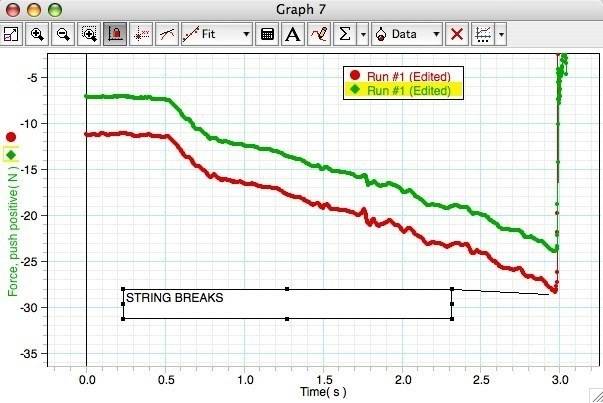
So that i can graph Force (n) over Time (s) just like that:
Picture 2.jpg


in this graph, the red line represents the tension of a string as i pull on it. However, i really need that slope to be constant.

By the I'm investigating how different force per second affects the breaking force of the string

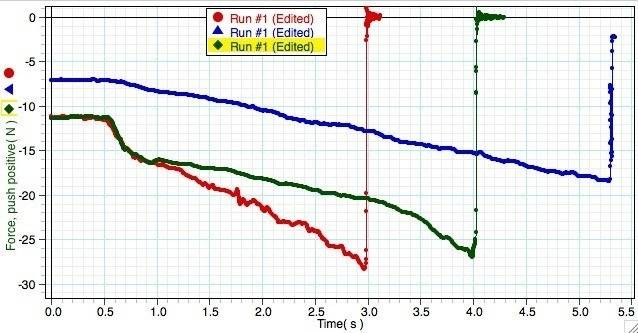
From preliminary experiments, i observed that that:
Picture 4.jpg


the trough of the graph is when the string breaks.

The larger N/s applied, the string breaks at a higher tension
The lower N/s applied, the string breaks at a lower tension

WHY IS THIS SO? which equations can i use?
 
Last edited:
Physics news on Phys.org
The answer to your question lies in the properties of the string itself. The type of string, the diameter, and the material used will all determine how much force it can handle before breaking. Generally, the thicker and stronger the material, the higher the tension it can tolerate before breaking.So when you apply a constant force per second (N/s) to the string, the tension increases over time until it reaches the breaking point. This is because the force is being applied consistently, meaning the tension on the string is constantly increasing. As the tension increases, it eventually reaches a point where the string can no longer withstand it and breaks.You can calculate the needed N/s to break the string by using the equation: Breaking Force = Breaking Stress x Cross-sectional Area. This equation basically tells us that the amount of force needed to break the string is equal to the stress the string can handle multiplied by the cross-sectional area of the string.So, if you know the breaking stress for the material and the cross-sectional area of the string, you can calculate the force per second (N/s) that will cause the string to break. This will allow you to accurately graph the Force (N) over Time (s) and see the correlation between the two.
 

Similar threads

Replies
2
Views
2K
Replies
1
Views
1K
  • · Replies 13 ·
Replies
13
Views
5K
  • · Replies 4 ·
Replies
4
Views
4K
Replies
44
Views
4K
  • · Replies 9 ·
Replies
9
Views
4K
  • · Replies 7 ·
Replies
7
Views
10K
  • · Replies 26 ·
Replies
26
Views
8K
  • · Replies 6 ·
Replies
6
Views
4K
  • · Replies 7 ·
Replies
7
Views
3K