What Does Commutation Mean for Matrices A and B?

  • Thread starter Thread starter member 731016
  • Start date Start date
  • Tags Tags
    Inverse
Join the discussion
Registration is free. Ask a follow-up in this thread, or start your own.
3 replies · 2K views
member 731016
Homework Statement
Please see below
Relevant Equations
Please see below
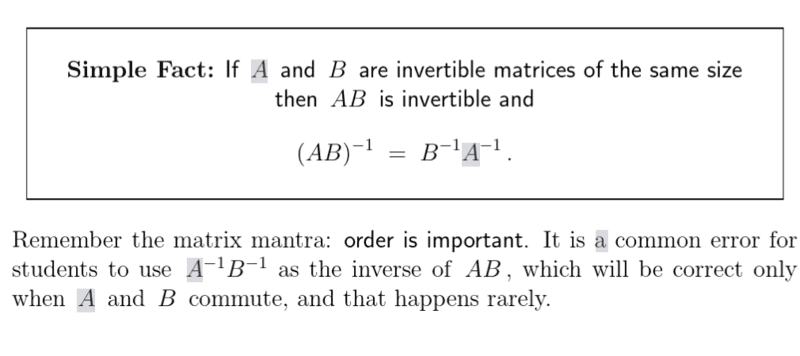
For this,
1682209044875.png

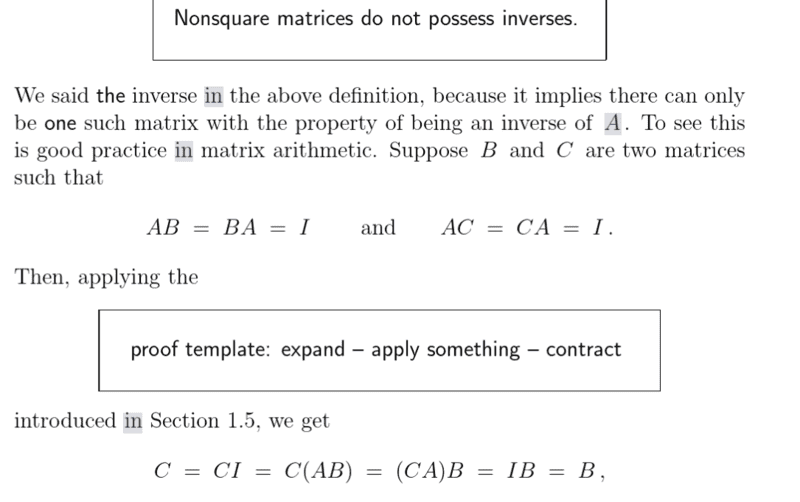
Dose someone pleas know where they get ##C = CI## from?

Also,
1682209425978.png

What dose it mean when A and B commute?

Many thanks!
 
Last edited by a moderator:
Physics news on Phys.org
ChiralSuperfields said:
Homework Statement: Please see below
Relevant Equations: Please see below

For this,
View attachment 325350
Dose someone pleas know where they get ##C = CI## from?

Also,
View attachment 325351
What dose it mean when A and B commute?

Many thanks!
Commuting matrices means that ##A\cdot B = B\cdot A.## Most matrices do not commute. That means
$$
(A\cdot B)^{-1} =B^{-1} \cdot A^{-1} \neq A^{-1}\cdot B^{-1} = (B\cdot A)^{-1}
$$

Inversion and transposition, too, change the order. You can see this by checking ##(A\cdot B)\cdot (A\cdot B)^{-1} =I.##
 
Reply
  • Like
Likes   Reactions: member 731016
fresh_42 said:
Commuting matrices means that ##A\cdot B = B\cdot A.## Most matrices do not commute. That means
$$
(A\cdot B)^{-1} =B^{-1} \cdot A^{-1} \neq A^{-1}\cdot B^{-1} = (B\cdot A)^{-1}
$$

Inversion and transposition, too, change the order. You can see this by checking ##(A\cdot B)\cdot (A\cdot B)^{-1} =I.##
Thank you for your reply @fresh_42 !

Is my checking correct ##A \cdot A^{-1} \cdot B \cdot B^{-1} = I_A \cdot I_B = I##?

Many thanks!
 
ChiralSuperfields said:
Thank you for your reply @fresh_42 !

Is my checking correct ##A \cdot A^{-1} \cdot B \cdot B^{-1} = I_A \cdot I_B = I##?

Many thanks!
Yes, but a bit short. The long version is:

\begin{align*}
(A\cdot B) \cdot (A\cdot B)^{-1}&=(A\cdot B) \cdot (B^{-1}\cdot A^{-1}) \\
&= A \cdot (B \cdot (B^{-1}\cdot A^{-1}))\\
&= A\cdot (( B\cdot B^{-1})\cdot A^{-1})\\
&= A\cdot (I\cdot A^{-1})\\
&= A \cdot A^{-1} \\
&= I
\end{align*}
This proves by using the associative law of multiplication that ##B^{-1}\cdot A^{-1}## is a inverse of ##(AB)^{-1}.##

I leave it to you to show that there cannot be more than one inverse, making ##B^{-1}\cdot A^{-1}## the inverse of ##(AB)^{-1}.## Same with the identity matrix. There can only be one so we do not need to distinguish between ##I_A## and ##I_B## or between left-identity ##I_L\cdot A=A## and right-identity ##A\cdot I_R=A.## Both are the same. This can also be proven.

These proofs are a bit like a puzzle playing around with the associative, possibly distributive law. A nice Sunday afternoon exercise. The trick is to proceed step by step and only use these laws plus the definitions, e.g. that ##I_L\cdot A=A## and ##A\cdot I_R=A.## Show that ##I_L=I_R\,!##
 
Reply
  • Informative
Likes   Reactions: member 731016