What does V1 mean when marked at a point in a circuit?

2 replies · 2K views · last reply
string
Messages
1
Reaction score
0
Is asking for the voltage of a point in a wire (before/after a resister) the same as asking for the voltage across that resister? I understand voltage is relative..

Here is the circuit:
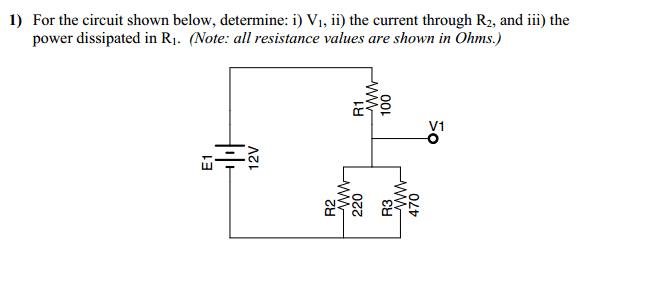
Circuit schematic: battery E1 labelled 12V on the left branch, with R1 (100 Ohm) and R2 (220 Ohm) and R3 (470 Ohm) in a network, and a node marked V1 with a circle symbol between R1 and R3.


I can't wrap my head around what V1 represents. Other questions in this assignment specifically ask for the voltage across some element of the circuit. I just don't know how to interpret the notation of V1 as it is drawn in this circuit as I've never encountered it before.

Any perspective on this would be appreciated.
 
string said:
Is asking for the voltage of a point in a wire (before/after a resister) the same as asking for the voltage across that resister? I understand voltage is relative..
Yes (at least I THINK that's what you are asking)
I can't wrap my head around what V1 represents. Other questions in this assignment specifically ask for the voltage across some element of the circuit. I just don't know how to interpret the notation of V1 as it is drawn in this circuit as I've never encountered it before.

It is standard to take the bottom horizontal wire in a circuit as ground, so V1 just means the voltage from the labeled node to ground, which is the voltage across R2 and R3
 
It's a badly worded question.

Voltages are indeed relative so to answer the question you will need to make an assumption. A reasonable assumption would be to choose 0V, Ground or battery -ve as the reference as Phinds suggests. Your answer should state that

"V1 is ?V w.r.t the battery -ve terminal"

In this case it's straightforward but in future watch out for exam questions that have the battery with the -ve terminal at the top.