Anchovy
- 99
- 2
I'm trying to build a vague understanding of what a sphaleron is (for context: I'm reading about baryon number asymmetry in the early universe and the word keeps cropping up). I've found a paragraph that seems to get me half way there but still leaves me feeling a bit  :
:
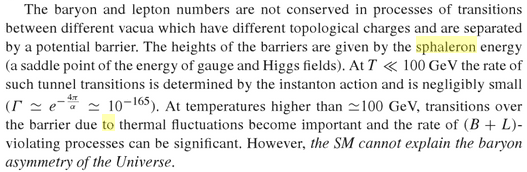
So first of all, what is meant by "vacua which have different topological charges"?
1) When it refers to 'different vacua', should I be picturing something like the circle around the base of the 'Mexican hat' potential often seen in discussions about the Higgs mechanism?
2) What does 'topological charge' refer to?
Anyway, it says there are vacua separated by an energy barrier "given by the spaleron energy (a saddle point of the energy of gauge and Higgs fields)".
--> This is the part that I'm most confused about. I know what a saddle point is... but I'm struggling to get from here to understanding how this means a baryon changes into something else. And which gauge fields is it referring to?
:So first of all, what is meant by "vacua which have different topological charges"?
1) When it refers to 'different vacua', should I be picturing something like the circle around the base of the 'Mexican hat' potential often seen in discussions about the Higgs mechanism?
2) What does 'topological charge' refer to?
Anyway, it says there are vacua separated by an energy barrier "given by the spaleron energy (a saddle point of the energy of gauge and Higgs fields)".
--> This is the part that I'm most confused about. I know what a saddle point is... but I'm struggling to get from here to understanding how this means a baryon changes into something else. And which gauge fields is it referring to?