What Is "Hello, I Found From Junk

  • Thread starter Thread starter jmex
  • Start date Start date
Click For Summary

Discussion Overview

The discussion revolves around identifying a component found in junk and exploring its potential use in building a small jet engine, specifically focusing on the feasibility of utilizing a turbocharger's impeller and compressor.

Discussion Character

  • Exploratory, Technical explanation, Conceptual clarification

Main Points Raised

  • One participant identifies the component as part of a turbocharger, specifically the "core" that compresses and expands air.
  • Another participant suggests that it is possible to use the turbocharger design for a small jet engine, noting that amateur turbojets exist.
  • Concerns are raised regarding the quality of the shaft bushing and the need for forced lubrication, as well as the importance of the rotor's outer casing for balancing forces on the center bearing.
  • It is mentioned that the materials used for turbines may differ between diesel and gasoline engines, and that exhaust temperatures must be managed to prevent damage.
  • A participant emphasizes the critical nature of engineering tolerances in building an efficient compressor, warning that poor tolerances could lead to air leakages and potential mechanical failure.
  • In contrast, the performance of a turbine is described as degrading in a stable manner, making it less critical to design compared to compressors.
  • A historical reference is made to a 1950s engine design featuring twin radial compressors, highlighting the complexity of the surrounding structure.

Areas of Agreement / Disagreement

Participants generally agree on the identification of the component as part of a turbocharger and the potential for its use in jet engines. However, there are differing views on the challenges and requirements for successfully implementing the design, indicating that multiple competing views remain.

Contextual Notes

Participants express uncertainty regarding the specific engineering tolerances required and the implications of using different materials for turbines, as well as the necessity of the outer casing for effective operation.

Who May Find This Useful

Individuals interested in amateur jet engine design, turbocharger applications, and those exploring engineering challenges related to compressor and turbine functionality.

jmex
Messages
59
Reaction score
3
Hello,

I found this from junk. Can you tell me what this is?
uploadfromtaptalk1403523304561.jpg
uploadfromtaptalk1403523312385.jpg
 
Engineering news on Phys.org
Turbocharger? One impeller compresses air, the other impeller expands it.
 
Yes, it is part of a turbocharger. Called the "core" it sits inside a housing that ducts the air.
 
thanks for your help. I am willing to use impeller and compressor in a jet engine out of it. Is it possible to use this existing design?
 
I mean a small one.
 
Possibly yes, turbochargers are used to make amateur turbojets. There are many out there. Search the web for sites.

The problems you will have is the quality of the shaft bushing and the provision of forced lubrication. The shape of the outer case of the rotor balances the forces on the centre bearing. You will have to design for that axial pressure.

The material used for the turbines is often different for a diesel or a gasoline engine. You will need to keep your exhaust temperature cool enough, and with the right oxygen level to prevent corrosion or melting of the turbine.
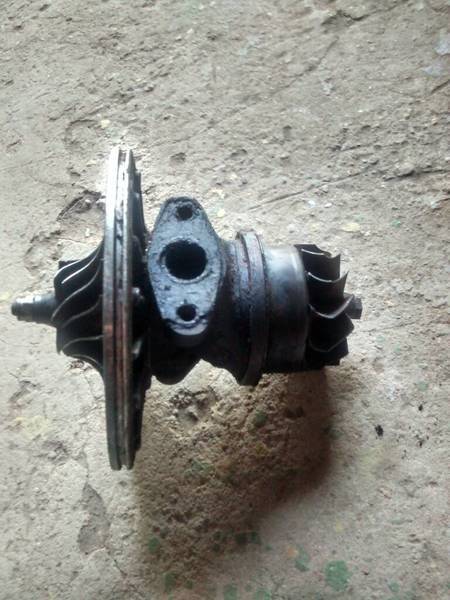
 
There are plenty of jet engine designs on the web that use a turbocharger as the compressor. But if you don't have the outer casing of the turbo as well as the rotor you showed in the pictures, that rather defeats the reason for using it, which is that building a small efficient compressor needs a "Swiss watchmaking" level engineering tolerances to be successful, otherwise air leakages between the rotor and casing will make it liable to stall and/or surge, or mechanically self-destruct if the rotor touches the casing at high RPM.

Making a turbine that is "good enough" for a working engine is much less critical. Unlike compressors, the performance of a badly designed or inefficient turbine usually degrades in a "stable" manner, rather than catastrophically.

Here's a cut-away "real world" engine from the 1950s with twin radial compressors. Note, most of the structure "in front of" the compressors (at the left of the picture) is the reduction gearbox to drive the aircraft propeller, not part of the engine itself.

748px-Rolls_royce_dart_turboprop.jpg
 
Last edited:
That's a very good picture! Thanks for sharing!
 

Similar threads

  • · Replies 20 ·
Replies
20
Views
6K
  • · Replies 7 ·
Replies
7
Views
1K
Replies
3
Views
3K
  • · Replies 7 ·
Replies
7
Views
2K
  • · Replies 5 ·
Replies
5
Views
2K
  • · Replies 13 ·
Replies
13
Views
3K
  • · Replies 5 ·
Replies
5
Views
1K
  • · Replies 2 ·
Replies
2
Views
2K
  • · Replies 7 ·
Replies
7
Views
625
Replies
10
Views
2K