KiranKai
- 12
- 0
In my new diagrams I have considered space Time and space itself is flat. which starts from Quantum fluctuation like Nasa version.Faradave said:Kiran,
Your English seems fine to me, I wouldn’t worry about it. I am not an expert but I have had questions similar to yours.
The NASA illustration is very nice but there are a few points to remember, since no illustration can get everything right. (You probably know many of these already.)
1) I think the time line at the bottom should be an arrow pointing right ([itex]\rightarrow[/itex]), not a double arrow ([itex]\leftrightarrow[/itex]). The Big Bang event (called "quantum fluctuations" in this illustration) at the left, is the beginning of time.
2) The illustration stops at time = now on the right side. Nothing comes out the right side. instead the right side continues to grow as time goes on into the future. A good guess is that it grows as fast as light can get there. Some would say it already goes on forever and contains all future events. (This is called a “deterministic” view). But the illustration, for convenience, stops at what we consider to be the present time.
3) If you consider any cross-section of the spacetime, at a particular moment in time. The cross-section from this illustration would be a flat disk but it represents all three spatial dimensions. The cross-section could be called a “3-disk”.
4) Inside the 3-disk is space and all its contents. Because the objects are flattened dimensionally, they would not be recognizable.
5) Your main question seems to be, “What is on the outside of these disks?” The answer can be simple.
Suppose I tell you that there are two points A and B, with no space between them. What could you say about the points?
You could say that A and B are “in contact” or “adjacent” or “touching” or “continuous”, etc.
Now consider a cross-section from the NASA drawing, with A and B on opposite sides of the 3-disk. Across the inside (like a diameter), there is space between A and B. But from the outside, there is nothing, not even space. A and B can be said to be “in contact” or “continuous”, etc.
The NASA illustration makes it look like the spacetime is embedded in some kind of space or dimension, but we have no evidence of this. This is the simple way to illustrate their spacetime.
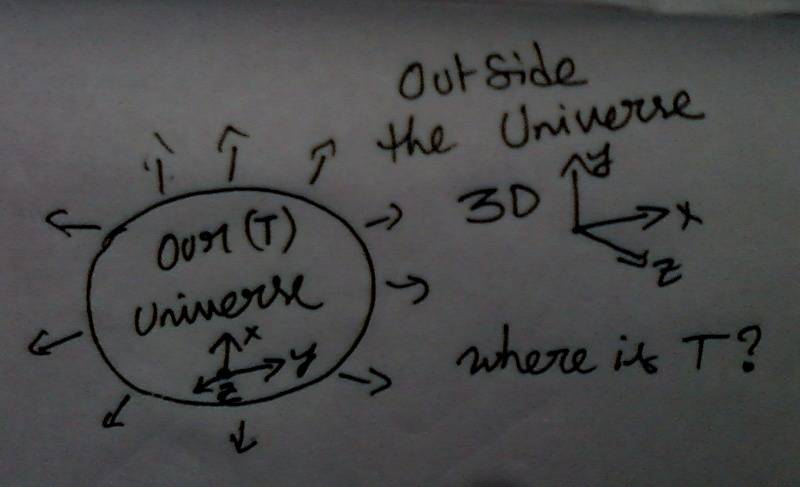
In your first post, you drew a 3-disk with arrows all around pointing out (above). It is the same as the 3-disk at the right end of the NASA illustration, our present time. If you stretch the 3-disk so that it curves into a sphere, the bases of all the arrows will touch. That would make the 3-disk into a 3-sphere. The 3-sphere grows bigger, like a balloon as time passes. This is how the “balloon analogy” (BA) models the expansion of space.
I consider the Big Bang event at the center of the balloon with time as the radius, pointing out in all directions. Some people would see it differently. There are FAQs and many threads here on the balloon analogy.
Say Point A at the time of Quantum fluctuation, say point B, started to exist at 13.7 billion years 2011 Jan 20 time 20:12.
You can ask me what is the distance according to the diagram, The distance can only measured in time since space flattened in 2d like flatland. Time as third dimension.
Distance is time itself. 13.7 years difference. my problem is that I say space (Dimensions) always existed and it is infinite not universe as space (flattened 2d world in Nasa's and mine)
the Nasa's Image shows time line of our universe. but when there is nothing before bigbang no quantum particles no mass (enegry can't be created so always existed ). How come energy existed in nothing ? if Bigbang created spacetime. Energy should exist always even with or without bang or our universe. we should have dimensions only space even without bigbang.
Last edited:
