What is the Area of a Quadrilateral with Given Coordinates?

  • Context: MHB 
  • Thread starter Thread starter Ilikebugs
  • Start date Start date
  • Tags Tags
    Area
Click For Summary
SUMMARY

The area of a quadrilateral defined by the coordinates (1,0), (3,5), (9,8), and (13,0) can be calculated using both triangular decomposition and trapezoidal methods. The vertex form of a quadratic equation, specifically $$y=-\frac{1}{4}(x-7)^2+9$$, was utilized to determine the necessary points for area calculation. The area was confirmed to be 60 square units through multiple methods, including the calculation of two triangles and a trapezoid. The final area computation involved the formula for the area of a trapezoid and the area of triangles, leading to consistent results.

PREREQUISITES
  • Understanding of coordinate geometry
  • Familiarity with the vertex form of quadratic equations
  • Knowledge of area calculation for triangles and trapezoids
  • Ability to solve quadratic equations
NEXT STEPS
  • Study the derivation and applications of the vertex form of quadratic equations
  • Learn how to calculate areas of polygons using the Shoelace theorem
  • Explore advanced techniques for area calculation in coordinate geometry
  • Investigate the properties of trapezoids and their area formulas
USEFUL FOR

Mathematicians, educators, students studying geometry, and anyone interested in computational geometry and area calculations of polygons.

Ilikebugs
Messages
94
Reaction score
0
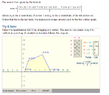
View attachment 6570 I think I got 4 points of (1,0) (3,5) (9,8) (13,0) but I don't know how to get the area
 

Attachments

  • potw 8 2.png
    potw 8 2.png
    23 KB · Views: 115
Mathematics news on Phys.org
Using the vertex form for a quadratic, we may state:

$$y=-a(x-7)^2+9$$

To determine $a$, we may use the other known point:

$$8=-a(9-7)^2+9\implies a=\frac{1}{4}$$

Hence:

$$y=-\frac{1}{4}(x-7)^2+9$$

To determine the $x$-coordinates of points $C$ and $D$, we solve:

$$0=-\frac{1}{4}(x-7)^2+9$$

$$(x-7)^2=6^2$$

$$x-7=\pm6$$

$$x=7\pm6$$

To find $b$, we solve:

$$5=-\frac{1}{4}(x-7)^2+9$$

$$(x-7)^2=4^2$$

Take the smaller root:

$$x=7-4=3$$

So, I agree with all of the coordinates you found. Now, how about we find the areas of $$\triangle{BCD}$$ and $$\triangle{ABD}$$ and add them together.

Or, you can drop vertical lines down from points $A$ and $B$ to the $x$-axis, and draw the segment $\overline{AB}$, and you have two right triangles and a trapezoid.

Can you proceed?
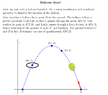
 
(12*5)/2=30

()/2=30

30+30=60?
 
Ilikebugs said:
(12*5)/2=30

()/2=30

30+30=60?

That's different than the value I got using the second method I suggested (which I found simpler to do).
 
T1=13.5
T2=16
Trapezoid=height 8, b1= 6 b2=sqr(45) 1/2(6+sqr(45))*8= 24+4(sqr(45))

43.5+4(sqr(45))?

I got 60 through View attachment 6571
 

Attachments

  • fff.png
    fff.png
    14.5 KB · Views: 109
Yeah...I used a wrong value in one of the computations. It is 60.
 

Similar threads

Replies
21
Views
3K
  • · Replies 4 ·
Replies
4
Views
2K
  • · Replies 2 ·
Replies
2
Views
1K
  • · Replies 17 ·
Replies
17
Views
3K
  • · Replies 1 ·
Replies
1
Views
2K
Replies
4
Views
2K
  • · Replies 10 ·
Replies
10
Views
2K
Replies
2
Views
2K
  • · Replies 7 ·
Replies
7
Views
2K
  • · Replies 2 ·
Replies
2
Views
2K