excellent video on spring stress i n spring design
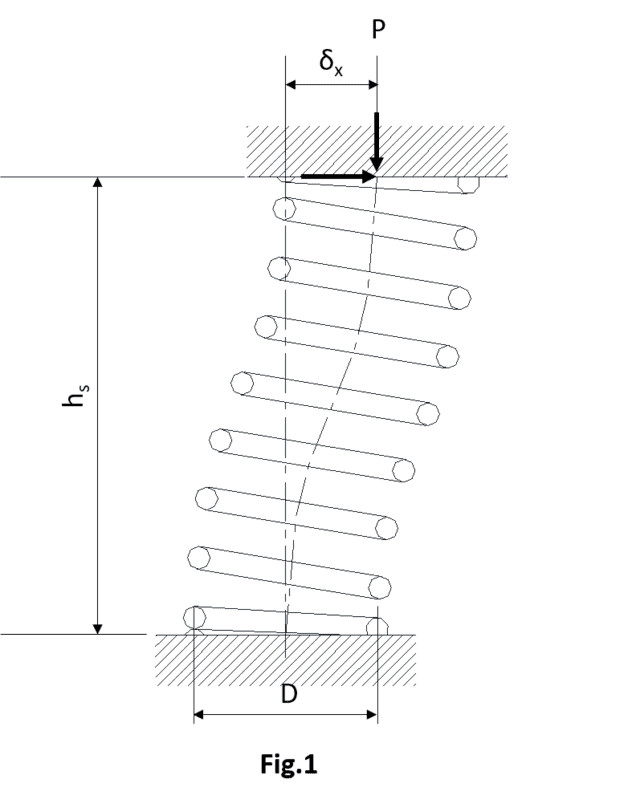
As far as I can tell from my limited research, coil springs will rotate while being compressed in the vertical direction. I know this from experience over decades of auto racing. This rotation or twist is known as "indexing".
The usual method is to mechanical fix one end of the spring if it becomes a major problem. The deeper you ding into this you find it is not "indexing" it is called "Ratcheting" and lots of things effect it. Are both ends of the spring parallel ground and flat? Is one end fixed? Is the free end riding on bearings?
I have found three solutions to find out how much the spring ratchets.
Hot rodder method - Take a random sampling of 10 springs and mark one of the coil's OD. Then compress the spring and measure how far around the coil it travels. My question is “Why Bother”. In racing ideally you want the spring to compress without any side thrust and minimum of friction at the spring ends when compressing. That’s why we use hydraulic spring perches and worry about other handing aspects. Look carefully at the video of the hyperco perch above. You can see the coil spring twist during compression. Look just below the E and note the white spot moving side to side. It looks like 1/8" but you can see it move laterally.
Solve for Unwinding Method - Spring Design by Wahl as reference to rotation during compression and gives the formula. The angular deflection (unwinding) of the ends for compression spring due to axial loading is given in page 249 of Mechanical Springs, A. M. Wahl 2nd Edition 1963. Therefore, the maximum torque will be the torque to prevent it. For this you need to treat the spring as a torsion spring and calculate the torque that will create/negate this deflection. However, the axial force, coefficient of friction and spring diameter create a moment that may be smaller than the maximum moment.
Solve for Alpha Method - As close as I can figure this is about the Spring end condition (Alpha) for spring buckling evaluation.
see video below at 45 minutes
This is as far as I can take this subject without looking like a complete fool so hopefully the real Engineers here will provide more insight.