What is the best resource for information on mechanical springs?

  • Thread starter Thread starter hermano
  • Start date Start date
  • Tags Tags
    Spring Stiffness
Click For Summary

Discussion Overview

The discussion revolves around resources and methods for understanding mechanical springs, particularly focusing on the calculation of lateral stiffness in compression springs and the dynamics involved during compression. Participants explore various references, practical experiences, and technical considerations related to spring design and performance.

Discussion Character

  • Exploratory
  • Technical explanation
  • Debate/contested

Main Points Raised

  • One participant inquires about a formula for calculating the lateral stiffness of a compression spring with parallel ends.
  • Another suggests the SMI Fundamentals of Spring Design as a valuable resource, highlighting its affordability and relevance.
  • A participant discusses the twisting and rotating behavior of springs under compression, mentioning the benefits of hydraulic spring perches in reducing bending loads on shocks.
  • One contributor shares insights from their experience in auto racing, noting that coil springs can rotate during compression, introducing the concepts of "indexing" and "ratcheting." They propose methods to measure and address these effects.
  • Another participant references a specific book, Mechanical Springs by A. M. Wahl, as a definitive resource for spring design, asserting its comprehensive nature.
  • There is mention of spring washers with ball and socket pivots used in precision applications to minimize resistance to end rotation.

Areas of Agreement / Disagreement

Participants express varying opinions on the best resources for spring design, with some advocating for specific books while others share practical experiences. The discussion includes multiple competing views on the behavior of springs under compression, particularly regarding twisting and the effectiveness of different solutions.

Contextual Notes

Participants reference various methods and assumptions related to spring behavior, including the conditions under which springs operate and the effects of friction and axial loading. There are unresolved aspects regarding the precise calculations and definitions of terms like "indexing" and "ratcheting."

Who May Find This Useful

Individuals interested in mechanical engineering, automotive design, and spring mechanics may find this discussion beneficial, particularly those seeking practical insights and references for spring design.
hermano
Messages
38
Reaction score
0
Hi,

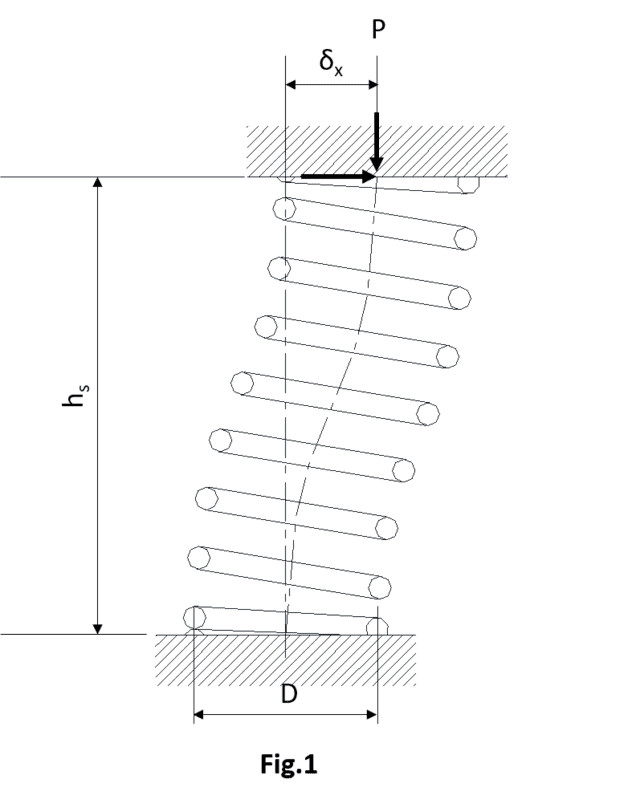
Is there a simple formula to calculate the lateral stiffness of a compression spring when both ends stay in parallel (see figure)?
244775
 
Engineering news on Phys.org
Get a copy of the SMI Fundamentals of Spring Design, or an older edition titled Handbook of Spring Design. It has a plot showing exactly what you need. Buy a copy for only $25.00: https://smihq.org/store/ViewProduct.aspx?id=8088348.

It's a worthwhile addition to your library, and dirt cheap compared to projects like a square meter of vacuum plate.
 
  • Like
Likes   Reactions: ChemAir
Thanks. I will take a look at it.
 
There is another dynamic typically not apparent. The spring tries to twist and rotate on both ends when compressed. These things work even if only used on one end. They can tilt and they have a row of needle bearings to permit rotation and no binding.
Hyperco Hydraulic Spring Perch
1872.jpg


These precision devices allow the spring end coils to tilt up to 4 degrees as the spring is compressed, reducing the bending loads on your shocks by as much as 96%. This reduction in side force and friction allows more force and energy to be directed to the car's mechanical grip while reducing wear on your shocks.
This model has a special 1.5" x 16 tpi female thread to fit the eyelet (shaft end) on Penske 8760 racing shocks. It is designed to replace the spring perch to minimize bulk. Installing a hydraulic perch at one end of the spring will reduce shock bending loads significantly; however, hydraulic perches at both ends of the spring will provide optimum performance.

 
Last edited:
excellent video on spring stress i n spring design

As far as I can tell from my limited research, coil springs will rotate while being compressed in the vertical direction. I know this from experience over decades of auto racing. This rotation or twist is known as "indexing".
The usual method is to mechanical fix one end of the spring if it becomes a major problem. The deeper you ding into this you find it is not "indexing" it is called "Ratcheting" and lots of things effect it. Are both ends of the spring parallel ground and flat? Is one end fixed? Is the free end riding on bearings?

I have found three solutions to find out how much the spring ratchets.

Hot rodder method - Take a random sampling of 10 springs and mark one of the coil's OD. Then compress the spring and measure how far around the coil it travels. My question is “Why Bother”. In racing ideally you want the spring to compress without any side thrust and minimum of friction at the spring ends when compressing. That’s why we use hydraulic spring perches and worry about other handing aspects. Look carefully at the video of the hyperco perch above. You can see the coil spring twist during compression. Look just below the E and note the white spot moving side to side. It looks like 1/8" but you can see it move laterally.

Solve for Unwinding Method - Spring Design by Wahl as reference to rotation during compression and gives the formula. The angular deflection (unwinding) of the ends for compression spring due to axial loading is given in page 249 of Mechanical Springs, A. M. Wahl 2nd Edition 1963. Therefore, the maximum torque will be the torque to prevent it. For this you need to treat the spring as a torsion spring and calculate the torque that will create/negate this deflection. However, the axial force, coefficient of friction and spring diameter create a moment that may be smaller than the maximum moment.


Solve for Alpha Method -
As close as I can figure this is about the Spring end condition (Alpha) for spring buckling evaluation.
see video below at 45 minutes
This is as far as I can take this subject without looking like a complete fool so hopefully the real Engineers here will provide more insight.
 
Last edited:
  • Like
Likes   Reactions: jrmichler
For precision spring function applications such as high performance pressure relief safety valves there are spring washers with a ball and socket center pivots installed on both ends of the spring to minimize resistance to the above discussed end rotation.
 
Ranger Mike said:
Mechanical Springs, A. M. Wahl 2nd Edition 1963
This book is THE reference for springs. If it's not in this book, you will not find it anywhere. And it's still in print. If the SMI book does not answer your questions, get this book.
 
  • Like
Likes   Reactions: Ranger Mike

Similar threads

  • · Replies 1 ·
Replies
1
Views
3K
  • · Replies 1 ·
Replies
1
Views
2K
  • · Replies 9 ·
Replies
9
Views
2K
Replies
4
Views
2K
  • · Replies 7 ·
Replies
7
Views
2K
  • · Replies 23 ·
Replies
23
Views
10K
  • · Replies 3 ·
Replies
3
Views
3K
  • · Replies 2 ·
Replies
2
Views
2K
  • · Replies 4 ·
Replies
4
Views
5K
  • · Replies 9 ·
Replies
9
Views
3K