What is the Center and Radius of a Circle?

Join the discussion
Registration is free. Start your own thread to ask a follow-up.
9 replies · 2K views
mathdad
Messages
1,280
Reaction score
0
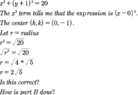
A. Determine the center and radius of circle.

B. Also, find the y-coordinates of the points (if any) where the circle intersects the y-axis.

View attachment 7462
 
Attachments
  • MathMagic171103_1.png
    MathMagic171103_1.png
    18.2 KB · Views: 170
Last edited by a moderator:
Mathematics news on Phys.org
If the circle were to intersect the y-axis, then what would x be?
 
Joppy said:
If the circle were to intersect the y-axis, then what would x be?

If the circle intersects the y-axis, the value of x is 0. True?
 
RTCNTC said:
If the circle intersects the y-axis, the value of x is 0. True?

No. If the circle intersects the y-axis, the value of x is 0 at the point(s) of intersection.

We must be absolutely clear.
 
Re: Center & Radius of Circle

Joppy said:
No. If the circle intersects the y-axis, the value of x is 0 at the point(s) of intersection.

We must be absolutely clear.

How is part B found?

- - - Updated - - -

Is my work for part A correct?
 
Yes, part A is correct.

Part B asks you to find the coordinates of the points where the circle intersects the y-axis. Joppy led you to the conclusion that those points must have x= 0. Now put x= 0 in the equation of the circle to determine what y is.
 
Part B

Let x = 0

x^2 + (y + 1)^2 = 20

(0)^2 + (y + 1)^2 = 20

(y + 1)^2 = 20

sqrt{(y + 1)^2} = sqrt{20}

y + 1 = 2•sqrt{5}

y = 2•sqrt{5} - 1

The y-coordinate is 2•sqrt{5} - 1.

Yes?

Is one the points of intersection for the circle
(0, 2•sqrt{5}-1)?
 
At the point:

$$(y+1)^2=20$$

Your next step should be:

$$y+1=\pm\sqrt{20}=\pm2\sqrt{5}$$

Hence:

$$y=-1\pm2\sqrt{5}$$

And so the points of intersection of the given circle and the $y$-axis are:

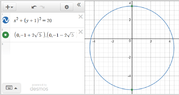
$$\left(0,-1+2\sqrt{5}\right),\,\left(0,-1-2\sqrt{5}\right)$$

View attachment 7485
 
Attachments
  • rtcntc_circle_2.png
    rtcntc_circle_2.png
    13.7 KB · Views: 168
We should be able to convince ourselves that given the circle:

$$(x-h)^2+(y-k)^2=r^2$$

We then know these points are on the circle:

$$(h+r,k),\,(h-r,k),\,(h,k+r),\,(h,k-r)$$
 
MarkFL said:
We should be able to convince ourselves that given the circle:

$$(x-h)^2+(y-k)^2=r^2$$

We then know these points are on the circle:

$$(h+r,k),\,(h-r,k),\,(h,k+r),\,(h,k-r)$$

Cool notes. Check your PM.