What is the difference between a type IIP and type IIL supernova?

  • Context: Stargazing 
  • Thread starter Thread starter davenn
  • Start date Start date
  • Tags Tags
    Galaxy Supernova
Click For Summary

Discussion Overview

The discussion revolves around the classification of supernovae, specifically the differences between type IIP and type IIL supernovae, in the context of a recent supernova event in the galaxy M66. Participants explore the criteria used for classification based on spectral observations and the timing of peak brightness.

Discussion Character

  • Technical explanation, Debate/contested

Main Points Raised

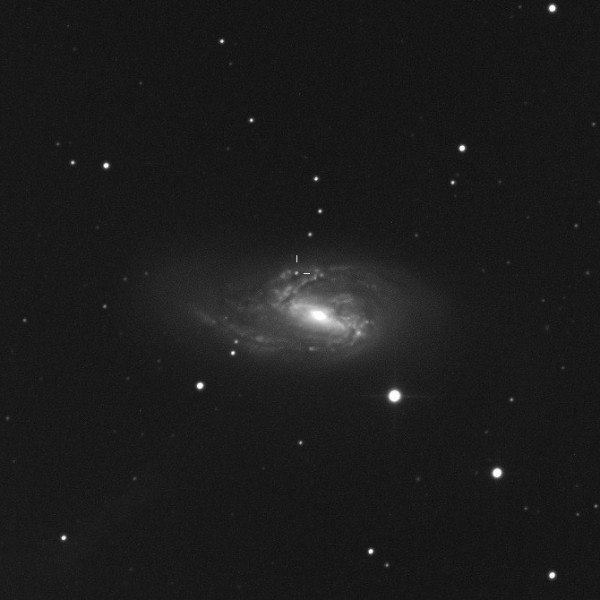
  • One participant shares an image of the supernova in M66 and notes its announcement date.
  • Another participant expresses a desire for better observational equipment to capture similar images.
  • A participant references the Astronomer's Telegram, stating that the classification as a type IIP supernova was made before peak brightness was reached, raising questions about the validity of this classification.
  • This participant details the spectral analysis conducted, mentioning the blue continuum and P-Cygni features of Balmer lines observed in the spectrum, which are consistent with type IIP characteristics.
  • There is a query about how the classification can be determined without observing the light curve after it begins to decline, suggesting that the criteria for distinguishing between type IIP and IIL supernovae may not have been fully met.
  • Another participant acknowledges the confusion and suggests that the answer may lie in the spectral differences between the two types, although they admit to not knowing the specifics.

Areas of Agreement / Disagreement

Participants express confusion and uncertainty regarding the classification process of the supernova, particularly about how conclusions can be drawn before peak brightness is observed. There is no consensus on the criteria or the implications of the spectral data presented.

Contextual Notes

Participants highlight the need for observations after peak brightness to differentiate between type IIP and IIL supernovae, indicating that the current classification may rely on assumptions or incomplete data.

davenn
Science Advisor
Gold Member
Messages
9,726
Reaction score
11,822
Supernova in M66 in Leo, announced 30/5/2016: https://Earth'sky.org/todays-image/supernova-erupts-in-m66

160530 Supernova in M66 in Leo, announced.jpg


cheers
Dave
 
  • Like
Likes   Reactions: DennisN, 1oldman2, Drakkith and 4 others
Astronomy news on Phys.org
just wish I had a scope that could produce a pic like that
 
  • Like
Likes   Reactions: 1oldman2
Thanks for the image, but I am a bit confused. According to the Astronomer's Telegram they have already come to the conclusion that it is a type IIP SN even before it has reached peak brightness.
We obtained an optical spectrum (range 350-910 nm) of ASASSN-16fq/SN 2016cok (ATel#9091) on UT May 28.63 2016 with the 2.4-m telescope (+YFOSC) at LiJiang Gaomeigu Station of Yunnan Astronomical Observatories (YNAO). The spectrum is consistent with a type IIP supernova at a few days before the maximum light, showing a blue continuum and prominent P-Cygni features of Balmer lines. Cross-correlation with a library of supernova spectra using the "Supernova Identification" code (SNID; Blondin and Tonry 2007, Ap.J., 666, 1024) shows that it matches with SN 1999em at t = -3 days from the maximum light. After correcting for a redshift of 0.002 for its host galaxy M66, an expansion velocity of about 9000 km/s can be derived from the absorption minimum of Ha line.

Source: http://www.astronomerstelegram.org/?read=9093
In order to determine the difference between a type IIL and a type IIP SN one has to observe the light after it begins to decline. So how are they able to come to the conclusion that it is a type IIP if the SN has not even reached peak brightness yet? :confused:
 
|Glitch| said:
Thanks for the image, but I am a bit confused. According to the Astronomer's Telegram they have already come to the conclusion that it is a type IIP SN even before it has reached peak brightness.

In order to determine the difference between a type IIL and a type IIP SN one has to observe the light after it begins to decline. So how are they able to come to the conclusion that it is a type IIP if the SN has not even reached peak brightness yet? :confused:

the answer is in the quote you posted.
I personally don't know the different in the spectrum between the two types, presumably they do and that is how they have drawn their conclusionDave
 

Similar threads

  • · Replies 4 ·
Replies
4
Views
2K
  • · Replies 2 ·
Replies
2
Views
2K
  • · Replies 9 ·
Replies
9
Views
3K
  • · Replies 30 ·
2
Replies
30
Views
7K
  • · Replies 4 ·
Replies
4
Views
3K
  • · Replies 5 ·
Replies
5
Views
3K
  • · Replies 14 ·
Replies
14
Views
2K
  • · Replies 5 ·
Replies
5
Views
2K
  • · Replies 8 ·
Replies
8
Views
12K
Replies
4
Views
1K