What is the geometric interpretation of a \centerdot c = 0?

  • Context: MHB 
  • Thread starter Thread starter GreenGoblin
  • Start date Start date
  • Tags Tags
    Vector
Click For Summary
SUMMARY

The discussion centers on solving the vector equations \( r \times a = b \) and \( r \cdot c = \alpha \) under the condition that \( a \cdot b = 0 \) and \( a \neq 0 \). Participants clarify that \( a \) and \( b \) are orthogonal, and \( r \) can be expressed as a linear combination of \( a \) and \( (a \times b) \). The geometric interpretation hinges on the value of \( a \cdot c \); if \( a \cdot c = 0 \), \( r \) cannot be uniquely determined, while if \( a \cdot c \neq 0 \), a unique solution for \( r \) exists. The discussion emphasizes the importance of understanding the relationships between these vectors for proper interpretation.

PREREQUISITES
  • Understanding of vector operations, specifically cross products and dot products.
  • Familiarity with linear combinations of vectors.
  • Knowledge of orthogonal vectors and their properties.
  • Basic concepts of geometric interpretation in vector spaces.
NEXT STEPS
  • Study the properties of vector cross products and their geometric implications.
  • Learn about linear combinations and their role in vector spaces.
  • Explore the geometric interpretation of dot products in relation to angles between vectors.
  • Investigate the implications of orthogonality in vector equations and their solutions.
USEFUL FOR

Mathematicians, physics students, and anyone involved in vector calculus or linear algebra who seeks to deepen their understanding of vector relationships and geometric interpretations.

GreenGoblin
Messages
68
Reaction score
0
I am assigned the following problem,

"Solve the simultaneous vector eqs. for r:

r \times a = b, r \centerdot c = \alpha
given that a \centerdot b = 0 and a \neq 0
Distinguish between a \centerdot c equal 0 and not equal 0, and give geometrical interpretation on this."

OK then. First problem.. is it not obvious a \centerdot b = 0? Since b is the cross-product of r and a. We know already that a and b are perpendicular.

SO. Main problem.. I don't know what I am actually looking to solve here. Should I be aiming to isolate r as a function of these assorted other things? IS that the form of the solution required?

AS WELL. What does distinguish mean in a mathematical context? How can I, in a formal manner, 'distinguish' something?

Gracias,
Green Goblin

TESTTESTTESTTESTTESTTESTTESTTESTTESTTEST
 
Last edited:

Physics news on Phys.org
Hi GreenGoblin! :)

GreenGoblin said:
I am assigned the following problem,

"Solve the simultaneous vector eqs. for r:

r \times a = b, r \centerdot c = \alpha
given that a \centerdot b = 0 and a \neq 0
Distinguish between a \centerdot c equal 0 and not equal 0, and give geometrical interpretation on this."

OK then. First problem.. is it not obvious a \centerdot b = 0? Since b is the cross-product of r and a. We know already that a and b are perpendicular.

Yep. You're right.

SO. Main problem.. I don't know what I am actually looking to solve here. Should I be aiming to isolate r as a function of these assorted other things? IS that the form of the solution required?

Yep. That would be the form of the solution required.

There is something funny with your problem though.
The vector c is hanging in the air.
It is not properly connected to the rest of the problem.
Can it be that there is more information for the problem?
Or that there is a typo?
Perhaps c is supposed to be the third vector in a basis or something like that?

AS WELL. What does distinguish mean in a mathematical context? How can I, in a formal manner, 'distinguish' something?

They mean that you should distinguish 2 cases.
First assume that a \centerdot c = 0, and try to find r from there.
Then assume that a \centerdot c \ne 0, and try to find r from there.
 
Hi, there is no further information. Does this problem not have a chance to be solved then? I don't know if there is a chance of a typo. I have no opportunity to correspond with the problem setter.
 

Attachments

  • solve.png
    solve.png
    5.4 KB · Views: 99
Ah well, it can still be solved.

Let's see what we have.
[1] $\mathbf r \times \mathbf a = \mathbf b$
[2] $\mathbf r \cdot \mathbf c = \alpha$​

We have 1 variable, which is $\mathbf r$.
All other symbols are considered known constants.

From [1] we know that the vectors $\mathbf a$ and $\mathbf b$ are orthogonal.
To get a complete orthogonal basis we need a 3rd vector perpendicular to both a and b.
That would be $(\mathbf a \times \mathbf b)$.
So our known orthogonal basis is: $\{\mathbf a,\mathbf b, (\mathbf a \times \mathbf b) \}$.

From [1] we already know that $\mathbf r$ is perpendicular to $\mathbf b$.
That means that $\mathbf r$ is a linear combination of the other 2 basis vectors $\mathbf a$ and $(\mathbf a \times \mathbf b)$.
Let's introduce the new unknown variables $\lambda$ and $\mu$ and say that:
[3] $\mathbf r = \lambda \mathbf a + \mu (\mathbf a \times \mathbf b)$​

Can you substitute [3] in [1] and deduce something about $\lambda$ and/or $\mu$?

And substitute [3] in [2] and again deduce something about $\lambda$ and/or $\mu$?

If we have both $\lambda$ and $\mu$, we have $\mathbf r$.$\qquad \blacksquare$
 
Thanks,

If we plug (3) into (1), \lambda(a\times a) + \mu(a \times b)\times a=b. The first term dies. But then I don't know what to do with the following. Am I missing an important identity? I don't see that there's anything to work with that I can make the next step. If \mu (a \times b)\times a = b how can you find \mu. And then if you stick that into (2), like you said, c and \alpha are unrelated to anything else so how can it be solved? If \mu = \frac{1}{|a|^{2}} then I can make sense of it. If not I am back to square one. Either way I am at a brick wall for finding lambda
 
Last edited:
GreenGoblin said:
Thanks,

If we plug (3) into (1), \lambda(a\times a) + \mu(a \times b)\times a=b. The first term dies. But then I don't know what to do with the following. Am I missing an important identity? I don't see that there's anything to work with that I can make the next step. If \mu (a \times b)\times a = b how can you find \mu. And then if you stick that into (2), like you said, c and \alpha are unrelated to anything else so how can it be solved? If \mu = \frac{1}{|a|^{2}} then I can make sense of it. If not I am back to square one. Either way I am at a brick wall for finding lambda

The vector $(\mathbf a \times \mathbf b)\times \mathbf a$ is in the same direction as $\mathbf b$, since they form an orthogonal basis.
Since all vectors are orthogonal, its length is just the product of the lengths involved.

In other words, yes, \mu = \frac{1}{|a|^{2}}.

What did you get when you substituted [3] in [2]?
 
Thanks a lot. Thanks a lot.
ILikeSerena said:
What did you get when you substituted [3] in [2]?
A complete mess..
and nothing really meaningful at all. Other putting it in directly, \lambda(a \centerdot c) + \frac{1}{|a|^{2}}(a \times b) \centerdot c = \alpha. I can't go further.
 
GreenGoblin said:
Thanks a lot. Thanks a lot.

A complete mess..
and nothing really meaningful at all. Other putting it in directly, \lambda(a \centerdot c) + \frac{1}{|a|^{2}}(a \times b) \centerdot c = \alpha. I can't go further.

You could do
$$\lambda \, | \mathbf{a}| \, | \mathbf{c}|\,\cos(\varphi)
= \alpha- \frac{| \mathbf{b}| \, | \mathbf{c}|}{| \mathbf{a}|}\, \cos( \theta) \, \sin( \psi),$$
where $\theta$ is the angle between $\mathbf{a}\times\mathbf{b}$ and $\mathbf{c}$, $\psi$ is the angle between $\mathbf{a}$ and $\mathbf{b}$, and $\varphi$ is the angle between $\mathbf{a}$ and $\mathbf{c}$. Then solve for $\lambda$. Naturally, you'd like to have a better handle on those angles. I suppose you do know that $\psi=\pi/2$. So it simplifies down to
$$\lambda \, | \mathbf{a}| \, | \mathbf{c}| \, \cos(\varphi)
= \alpha- \frac{| \mathbf{b}| \, | \mathbf{c}|}{| \mathbf{a}|}\, \cos( \theta).$$
 
GreenGoblin said:
Thanks a lot. Thanks a lot.

A complete mess..
and nothing really meaningful at all. Other putting it in directly, \lambda(a \centerdot c) + \frac{1}{|a|^{2}}(a \times b) \centerdot c = \alpha. I can't go further.

What's the problem? They are all constants. ;D

\lambda(a \centerdot c) + \frac{1}{|a|^{2}}(a \times b) \centerdot c = \alpha

\lambda = {\alpha - \frac{1}{|a|^{2}}(a \times b) \centerdot c \over (a \centerdot c)}

It is already given that $a \ne 0$, so what's left is $(a \cdot c)$, which is either non-zero in which case you have your solution, or it is zero, and then you have to figure out what that means geometrically...
 
  • #10
ILikeSerena said:
What's the problem? They are all constants. ;D

\lambda(a \centerdot c) + \frac{1}{|a|^{2}}(a \times b) \centerdot c = \alpha

\lambda = {\alpha - \frac{1}{|a|^{2}}(a \times b) \centerdot c \over (a \centerdot c)}

It is already given that $a \ne 0$, so what's left is $(a \cdot c)$, which is either non-zero in which case you have your solution, or it is zero, and then you have to figure out what that means geometrically...
You know I have tendency to overcomplicate things. Sometimes I cannot accept the simplest answer because subconsciously maybe I suspect I am being asked a little more than I really am. Thank you very much you've been very helpful. I could get that far for sure, but I suspected I had to use a few identities and simplify things more. I'm spending time looking for things that aren't there. But I suppose that's a skill in itself one must hone.
Then again there is the question of the geometric interpretation. So in the case of a \centerdot c = 0 you are dividing by zero and you have that lambda is undefined (or simply \lambda a = 0 since you couldn't then divide through? In which case, r only has the mu term? What is giving a geometric interpretation really asking here? I can note a few consequences as I have done but I don't know what kind of answer is appropriate.
 
  • #11
GreenGoblin said:
You know I have tendency to overcomplicate things. Sometimes I cannot accept the simplest answer because subconsciously maybe I suspect I am being asked a little more than I really am. Thank you very much you've been very helpful. I could get that far for sure, but I suspected I had to use a few identities and simplify things more. I'm spending time looking for things that aren't there. But I suppose that's a skill in itself one must hone.
Then again there is the question of the geometric interpretation. So in the case of a \centerdot c = 0 you are dividing by zero and you have that lambda is undefined (or simply \lambda a = 0 since you couldn't then divide through? In which case, r only has the mu term? What is giving a geometric interpretation really asking here? I can note a few consequences as I have done but I don't know what kind of answer is appropriate.

Yep. For myself I have spent a lot of time learning how to make and keep things simple. :D

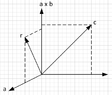
As for the geometrical interpretation, let's draw a picture.

http://www.mathhelpboards.com/attachment.php?attachmentid=605&stc=1

The vector r is a linear combination of a and (axb).
And if (a.c)=0, that means that c is perpendicular to a.
This means that c is a linear combination of b and (axb).

As we have seen, in that case it is impossible to find $\lambda$.
That is because no matter how much the vector a contributes to r, we get the same dot product $(r \cdot c)=\alpha$.

When c is not a linear combination of b and (axb), the contribution of a to r can be determined uniquely.
 

Attachments

  • Simultaneous_vector_equations.png
    Simultaneous_vector_equations.png
    3.1 KB · Views: 118

Similar threads

  • · Replies 3 ·
Replies
3
Views
2K
Replies
6
Views
4K
  • · Replies 4 ·
Replies
4
Views
4K
  • · Replies 5 ·
Replies
5
Views
3K
  • · Replies 3 ·
Replies
3
Views
3K
  • · Replies 4 ·
Replies
4
Views
2K
  • · Replies 10 ·
Replies
10
Views
3K
  • · Replies 3 ·
Replies
3
Views
1K
  • · Replies 16 ·
Replies
16
Views
4K
  • · Replies 9 ·
Replies
9
Views
3K