What is the H-R Diagram Method for Determining the Age of a Star Cluster?

  • Thread starter Thread starter bobo1455
  • Start date Start date
  • Tags Tags
    Diagram Star
Click For Summary
SUMMARY

The H-R Diagram Method is essential for determining the age of a star cluster by identifying the main sequence turnoff point. In this discussion, participants emphasized the importance of classifying stars using the OBAFGKM system, particularly focusing on G-type stars, which are indicative of the cluster's age. The suggested age range for the cluster based on the multiple-choice options provided is between 600 thousand years and 6 billion years, with a recommendation to consult "The Cosmic Perspective, 5th edition" for detailed diagrams and explanations. The main takeaway is that understanding the lifetimes of specific star classes is crucial for accurate age estimation.

PREREQUISITES
  • Understanding of the Hertzsprung-Russell (H-R) Diagram
  • Knowledge of stellar classification (OBAFGKM)
  • Familiarity with the concept of main sequence turnoff points
  • Basic astrophysics, particularly stellar lifetimes
NEXT STEPS
  • Study the H-R Diagram in detail to identify main sequence turnoff points
  • Research the lifetimes of G-type stars and their significance in age determination
  • Read "The Cosmic Perspective, 5th edition" by Bennet et al. for comprehensive insights
  • Explore additional resources on stellar evolution and classification systems
USEFUL FOR

Astronomy students, astrophysics enthusiasts, and educators seeking to deepen their understanding of star cluster age determination methods using the H-R Diagram.

bobo1455
Messages
33
Reaction score
0
Here's the question:

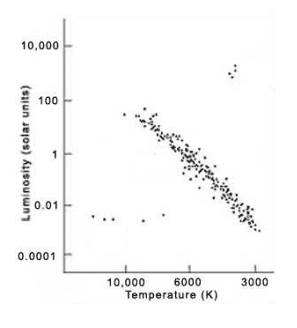
The following figure is the H-R diagram of a star cluster. Use this diagram to determine the age of the cluster.
wvW1FyO.png


The answers are multiple choice:

(A) 600 thousand years
(B) 6 million years
(C) 60 million years
(D) 600 million years
(E) 6 billion years

Here's my attempt:

I know that to determine the age of the cluster, we need to start by determining where in the graph the stars start changing from main sequence. And at that point, we find on the horizontal axis one of the following: OBAFGKM

And then the letter has 10 sub-groups, so I believe the classification to be G2 or G1. This is the part I'm stuck on, if it is G1 or G2 (or pretty much any sub-group of G in general), how do I get the age?

I read in my textbook that G1 is about the age of the Sun, but all of the multiple choice answers are 6-something and I don't understand how to get that, or at least something close to that.

I determined the answer to be 10^10, which is 10 billion, I believe. But it's really off and completely wrong.

Thanks in advance.
 
Physics news on Phys.org
AST201 UTM? :D

The best way to figure out this question is to look at the diagrams + text on p.326-27 and compare the cluster to the examples given. Finding the Main sequence turnoff point and reading up on the 'general' lifetimes of specific classes of stars given on these two pages as well will go a long way in helping to determine the most appropriate answer. GLHF
 
yeah, I figured it out. You go to UTM too?
 
yeah lol
 
:cry:
Hey you guys, 100 people have already looked at this thread in the hope to either be able to help or to learn something. And all you can utter is OBAFGKM, AST201 UTM? GLHF !​

And the only stuff left on the public part of the site is the 2009intro and the syllabus. But I could just about dig up a book The Cosmic Perspective, 5th edition, by Bennet, Donahue, Schneider and Voit which might have a p326-327 with diagrams+text. Right ? Or am I barking up the wrong UTM ?

BvU
 
We're talking about University of Toronto Mississauga lol

BvU are you attending UTM too? this is hilarious
 
BvU is in GMT+1 and it's bedtime there. You guys amuse yourself, Ok, but try to make this thread somewhat more informative for others, pls!
 
Well I don't want to just give the answer away

I've already given so much information
 
:-p
 
  • #10
BvU, You seem confused that the information mentioned exists only in the specifically mentioned source, but it just so happens to be be highly relevant in this situation and to the OP.

The idea of finding the main sequence turnoff point and reading up on the 'general' lifetimes of specific classes of stars (O,B,A,F,G,K & M) is extremely helpful towards solving this problem.

Please consider the broader implications of an answer rather then just focusing on specifics.
 

Similar threads

  • · Replies 2 ·
Replies
2
Views
3K
  • · Replies 5 ·
Replies
5
Views
2K
  • · Replies 5 ·
Replies
5
Views
3K
  • · Replies 3 ·
Replies
3
Views
2K
  • · Replies 7 ·
Replies
7
Views
3K
  • · Replies 11 ·
Replies
11
Views
2K
  • · Replies 6 ·
Replies
6
Views
3K
  • · Replies 3 ·
Replies
3
Views
2K
  • · Replies 1 ·
Replies
1
Views
2K
  • · Replies 1 ·
Replies
1
Views
2K