What is the H-R Diagram Method for Determining the Age of a Star Cluster?

  • Thread starter Thread starter bobo1455
  • Start date Start date
  • Tags Tags
    Diagram Star
Click For Summary

Homework Help Overview

The discussion revolves around determining the age of a star cluster using the H-R diagram. The original poster attempts to identify the main sequence turnoff point and classify stars based on their spectral types, specifically focusing on G-type stars.

Discussion Character

  • Exploratory, Conceptual clarification, Assumption checking

Approaches and Questions Raised

  • Participants discuss identifying the main sequence turnoff point and its significance in estimating the age of the star cluster. There are questions about the classification of stars, particularly whether to classify them as G1 or G2, and how this relates to the age determination. Some participants suggest consulting specific textbook pages for additional context.

Discussion Status

The discussion includes attempts to clarify the process of using the H-R diagram and the relevance of star classifications. Some participants express frustration over the lack of detailed responses, while others emphasize the importance of understanding the broader context of the problem without providing direct answers.

Contextual Notes

There is mention of specific textbook references that may contain relevant diagrams and information, indicating that participants are working within the constraints of their course materials. Additionally, there is a social element to the discussion, with participants identifying their shared educational background.

bobo1455
Messages
33
Reaction score
0
Here's the question:

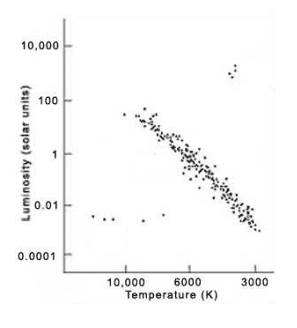
The following figure is the H-R diagram of a star cluster. Use this diagram to determine the age of the cluster.
wvW1FyO.png


The answers are multiple choice:

(A) 600 thousand years
(B) 6 million years
(C) 60 million years
(D) 600 million years
(E) 6 billion years

Here's my attempt:

I know that to determine the age of the cluster, we need to start by determining where in the graph the stars start changing from main sequence. And at that point, we find on the horizontal axis one of the following: OBAFGKM

And then the letter has 10 sub-groups, so I believe the classification to be G2 or G1. This is the part I'm stuck on, if it is G1 or G2 (or pretty much any sub-group of G in general), how do I get the age?

I read in my textbook that G1 is about the age of the Sun, but all of the multiple choice answers are 6-something and I don't understand how to get that, or at least something close to that.

I determined the answer to be 10^10, which is 10 billion, I believe. But it's really off and completely wrong.

Thanks in advance.
 
Physics news on Phys.org
AST201 UTM? :D

The best way to figure out this question is to look at the diagrams + text on p.326-27 and compare the cluster to the examples given. Finding the Main sequence turnoff point and reading up on the 'general' lifetimes of specific classes of stars given on these two pages as well will go a long way in helping to determine the most appropriate answer. GLHF
 
yeah, I figured it out. You go to UTM too?
 
yeah lol
 
:cry:
Hey you guys, 100 people have already looked at this thread in the hope to either be able to help or to learn something. And all you can utter is OBAFGKM, AST201 UTM? GLHF !​

And the only stuff left on the public part of the site is the 2009intro and the syllabus. But I could just about dig up a book The Cosmic Perspective, 5th edition, by Bennet, Donahue, Schneider and Voit which might have a p326-327 with diagrams+text. Right ? Or am I barking up the wrong UTM ?

BvU
 
We're talking about University of Toronto Mississauga lol

BvU are you attending UTM too? this is hilarious
 
BvU is in GMT+1 and it's bedtime there. You guys amuse yourself, Ok, but try to make this thread somewhat more informative for others, pls!
 
Well I don't want to just give the answer away

I've already given so much information
 
:-p
 
  • #10
BvU, You seem confused that the information mentioned exists only in the specifically mentioned source, but it just so happens to be be highly relevant in this situation and to the OP.

The idea of finding the main sequence turnoff point and reading up on the 'general' lifetimes of specific classes of stars (O,B,A,F,G,K & M) is extremely helpful towards solving this problem.

Please consider the broader implications of an answer rather then just focusing on specifics.
 

Similar threads

  • · Replies 2 ·
Replies
2
Views
3K
  • · Replies 5 ·
Replies
5
Views
2K
  • · Replies 5 ·
Replies
5
Views
3K
  • · Replies 3 ·
Replies
3
Views
2K
  • · Replies 7 ·
Replies
7
Views
3K
  • · Replies 11 ·
Replies
11
Views
2K
  • · Replies 6 ·
Replies
6
Views
3K
  • · Replies 3 ·
Replies
3
Views
2K
  • · Replies 1 ·
Replies
1
Views
2K
  • · Replies 1 ·
Replies
1
Views
2K