What is the impact of discontinuous potentials on quantum harmonic oscillators?

Click For Summary

Discussion Overview

The discussion revolves around the impact of discontinuous potentials on quantum harmonic oscillators, exploring the relationship between quantum mechanics and nuclear physics. Participants examine various potential energy functions, the applicability of harmonic oscillator models to different particles, and the implications of using approximations like square wells in quantum systems.

Discussion Character

  • Exploratory
  • Technical explanation
  • Debate/contested
  • Mathematical reasoning

Main Points Raised

  • Some participants question whether neutrons or electrons are the oscillating particles in the context of harmonic oscillators.
  • There is confusion about the separation of nuclear physics from quantum physics, particularly in relation to the strong force.
  • Participants discuss the determination of polynomials related to quantum numbers and their connection to electronic configurations versus the shell model.
  • One participant clarifies that the harmonic oscillator applies to the eigenvalues and eigenstates of a potential, not directly to particles, and can be applied to both neutrons and electrons depending on the chosen potential.
  • There is a discussion about the potential energy functions for different systems, including the harmonic oscillator and the hydrogen atom, with a request for clarification on the potential energy function for square wells related to nuclear forces.
  • Some participants argue that square wells are approximations that do not accurately reflect reality due to discontinuities, and discuss the implications of a step potential and its associated forces.
  • One participant notes that while the step potential is a useful toy model, it is unphysical and lacks considerations for other forces like Coulomb and centrifugal potentials.

Areas of Agreement / Disagreement

Participants express multiple competing views regarding the applicability of harmonic oscillators to different particles and the nature of potential energy functions. The discussion remains unresolved with no consensus on the best approach or model.

Contextual Notes

Limitations include the dependence on specific definitions of potentials, the approximation nature of square wells, and the unresolved mathematical implications of discontinuous potentials.
samgrace
Messages
27
Reaction score
0
The energy changes correspond to infrared, h_bar * w.

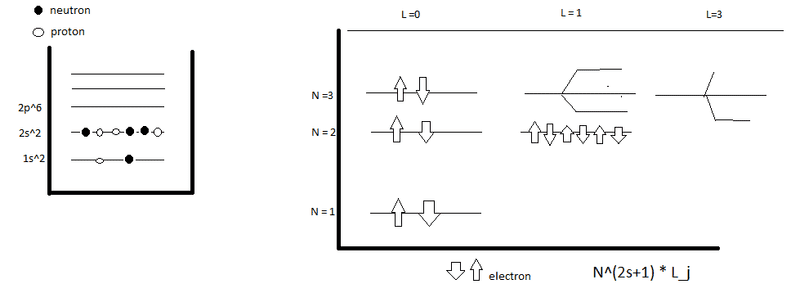
Which particles are actually oscillating? The neutrons or the electrons?

Is it the electrons that fill up the stationary states, electronic configuration, or is it the nucleons that fill up the states?

10n53eg.png
 
Physics news on Phys.org
I'm confused as to which facts of nuclear physics are separate from quantum physics? Due to strong force or something.
 
asking because the Legendre, laguerre polynomials or spherical harmonics and in the harmonic oscillator's case, Hermite polynomials are determined by the quantum numbers n, l and m. Are these numbers taken from the spectroscopic energy level numbers for the electronic configuration, or from the shell model?

The value of mass you put in for the oscillator is not a reduced mass.
 
The pictures that you have posted look like a Hydrogen atom, not a harmonic oscillator. In quantum mechanics, there is no shell model, you have orbitals that are the states with the quantum numbers n, l, m_l. There are not really taken from any experiment, but they are needed coefficients because the polynomials and spherical harmonics have those kind of numbers.
 
First of all, the harmonic oscillator does not apply on the particles, but on the problem of eigenvalues and eigenstates of an harmonic oscillator potential.
You can apply it both on a neutron as well as an electron, if you choose the interacting potential to be of such a form...
In that sense, you can always work with any particle and find the eigenvalues of the energy.

There are given evaluations in introductory books of nuclear physics, in which they deal the nucleons as particles being in a harmonic oscillator potential (or with a finite well potential or or or...). As an approximation it always works, because any potential which shows a minimum, can be approximated by taylor series around that minimum as an harmonic oscillator potential ... Because of that and because it's a solvable problem, HO is one of the most important studies in QM. Things that you learn out of it, can be applied in quantum field theory etc...
But it's not giving a satisfactory answer because it also forgets a lot of other stuff.
 
Thank you that clears it up quite a bit.

I have a further question to ask in regards to the potential energy function added to the operator in the equation.

Harmonic oscillator: V(x) = \frac{1}{2}kx^2 integral of hookes law

Hydrogen atom: V(r) = \frac{-e^2}{4πε_0r} coulombs from electromagnetism


My question is what is the potential energy function for square wells i.e the nuclear force
 
No1- The square wells are approximations, and in general don't show up in reality (reality doesn't like discontinuities).
No2- as an object V=V_{0} you can find that the force (being the gradient of the potential) would be something like F= 0. That is something normal, since a constant potential wouldn't make any difference (V=V_{0} or V=0 are exactly the same).
So the difference will come from the point of discontinuity, where the potential jumps to a given number...
A step potential for example would have to be like that:
V= V_{0} Θ(\frac{a}{2}-|x|)
where Θ(x-x_{0}) is the Heaviside step function, being +1 when x>x_{0} and 0 for x<x_{0}
So in fact, the gradient of it, will give you the delta functions at the points x=\pm \frac{a}{2}...
So it's like the particles withing the step potential will "feel" infinite forces when trying to leave it keeping them "inside"... (because we are speaking of a well)
Of course, once you get into QM you must start stop thinking about the "forces" and get used in reading potentials... That's why my calculations may be wrong, but the general idea doesn't change... If someone would sit and evaluate the -gradV, he'd eventually find a better result, which in QM is unnecessary
ALSO- the step potential in nuclear physics is unphysical- it's only a good toy and gives some approximate results- however it lacks other things (for example coulomb potential, centrifugal potential etc)
 

Similar threads

  • · Replies 3 ·
Replies
3
Views
2K
  • · Replies 2 ·
Replies
2
Views
2K
  • · Replies 1 ·
Replies
1
Views
2K
  • · Replies 4 ·
Replies
4
Views
1K
  • · Replies 5 ·
Replies
5
Views
4K
  • · Replies 7 ·
Replies
7
Views
2K
  • · Replies 15 ·
Replies
15
Views
4K
Replies
15
Views
3K
  • · Replies 4 ·
Replies
4
Views
3K
  • · Replies 9 ·
Replies
9
Views
4K