What is the latest research on humans and magnetoreception?

  • Thread starter Thread starter Dotini
  • Start date Start date
Click For Summary

Discussion Overview

The discussion centers on the latest research regarding human magnetoreception, exploring whether humans possess a subconscious ability to detect magnetic fields. The scope includes ongoing scientific investigations, hypotheses, and the need for peer-reviewed references to support claims.

Discussion Character

  • Exploratory
  • Debate/contested
  • Technical explanation

Main Points Raised

  • Some participants reference ongoing research by J. Kirshivink, suggesting that he is attempting to establish a hypothesis regarding human magnetoreception, which is not yet well documented.
  • Others express a belief that humans do receive magnetic signals, but there is uncertainty about the measurement methods employed by scientists.
  • A participant emphasizes the importance of providing peer-reviewed references to avoid speculation and personal theories in the discussion.
  • References to magnetoreception in other species, such as honey bees and dogs, are mentioned to illustrate the phenomenon in the animal kingdom.
  • Some participants highlight the complexity of magnetoreception and the various mechanisms being studied across different disciplines.

Areas of Agreement / Disagreement

Participants do not appear to reach a consensus on the existence or mechanisms of human magnetoreception, with multiple competing views and ongoing debates present in the discussion.

Contextual Notes

There are limitations regarding the definitions and methodologies used in the research, and the discussion reflects a reliance on ongoing studies rather than established facts.

Dotini
Gold Member
Messages
639
Reaction score
230
This subject has been broached here before but never accepted. Is now the time?

Center of attraction
Researchers are testing humans for a subconscious magnetic sense by putting them in a dark metal box and applying magnetic fields.
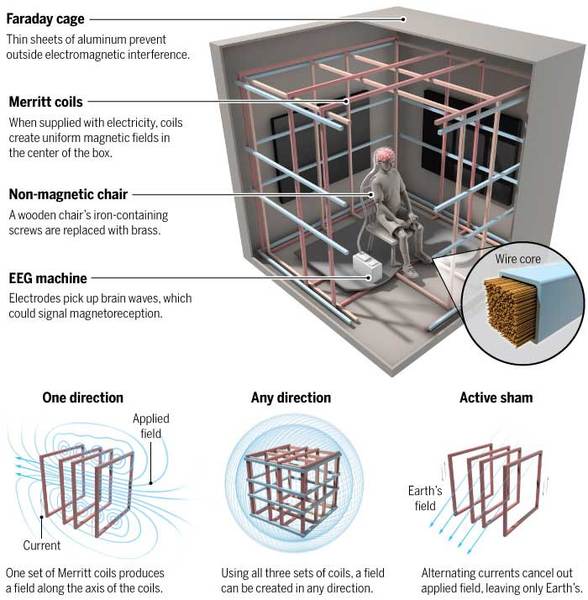
700x714_Final_explainer_Drupal_0.jpg

C. Bickel/Science

http://www.sciencemag.org/news/2016...he-has-discovered-magnetic-sixth-sense-humans
 
  • Like
Likes   Reactions: Fervent Freyja
Biology news on Phys.org
Wishing the subject will be accepted. It's a fact, we receive, but scientists are unable to measure how, because they don't change their scales.
 
Please cite a reference like a paper or a review of a paper from a scientific journal. Simply saying 'x is true' does not have any weight here on PF.
Thanks.

dotini's post is about ongoing research by J Kirshivink, and does not indicate that human magnetoreception is a well documented fact. Kirshivink is trying to establish a hypothesis using a defined methodology. He would not go to all that trouble and expense if magnetoreception were already well documented.
 
Since this is active research into the speculation that humans can detect magnetic fields, we must be careful to provide peer-reviewed references for what we post here otherwise we fall into the trap of personal theories and speculative science that we don't allow on PF.

Let the wild rumpus start again... (from Where the Wild Things Are by Maurice Sendak)
 
Last edited by a moderator:
  • Like
Likes   Reactions: Dotini
Magnetic sensing through the abdomen of the honey bee,
http://www.nature.com/articles/srep23657

Dogs are sensitive to small variations of the Earth's magnetic field
http://download.springer.com/static/pdf/318/art%253A10.1186%252F1742-9994-10-80.pdf?originUrl=http%3A%2F%2Ffrontiersinzoology.biomedcentral.com%2Farticle%2F10.1186%2F1742-9994-10-80&token2=exp=1467245017~acl=%2Fstatic%2Fpdf%2F318%2Fart%25253A10.1186%25252F1742-9994-10-80.pdf*~hmac=ce73be78837ba4d38113cb2958582fe0a5d5f54dc41a2a77883b2172a8cb4967

Researchers from various disciplines are homing in on the mechanics of magnetoreception, an enigmatic sense that some animals use to navigate the globe.
http://www.the-scientist.com/?articles.view/articleNo/36722/title/A-Sense-of-Mystery/

feature_pic13.jpg
ATTRACTIVE BUG: The bacterium Magnetobacterium bavaricumbiomineralizes large amounts of tooth-shaped magnetite crystals (each 100 nm long). Arranged in chains, the magnetite crystals all have consistent magnetic polarity, allowing the cell to swim along magnetic field lines.COURTESY OF MARIANNE HANZLIK

Globe400x357_1.jpg
MAP LINES: The Earth’s geomagnetic field has two poles—north and south—aligned approximately with the planet’s axis of rotation, much as if a bar magnet was embedded at a slight angle through the center of the Earth. The intensity of the field emanating from the Earth’s surface is strongest at the magnetic poles and weakest at the magnetic equator. The angle at which the field lines intersect the surface, known as the inclination, also varies continuously, from 0° at the magnetic equator to +/−?90° at the poles. Magnetism-sensing animals use these variations in the intensity and inclination of the Earth’s magnetic field for orientation and navigation.© CATHERINE DELPHIA

Final_Fig2.jpg
The Biology of Magnetoreception
View full size http://www.the-scientist.com/images/August2013/bird-infograph.jpg | http://www.the-scientist.com/images/August2013/bird-infograph.pdf© CATHERINE DELPHIA

bird-compass-crop.jpg
Compass Eyes
View full size http://www.the-scientist.com/images/August2013/compass-bird-full.jpg | http://www.the-scientist.com/images/August2013/compass-bird-full.pdf© CATHERINE DELPHIA
 

Similar threads

  • · Replies 0 ·
Replies
0
Views
2K
  • · Replies 1 ·
Replies
1
Views
4K
  • · Replies 3 ·
Replies
3
Views
7K
Replies
2
Views
3K
  • · Replies 8 ·
Replies
8
Views
3K
  • · Replies 2 ·
Replies
2
Views
4K
  • · Replies 6 ·
Replies
6
Views
4K
  • · Replies 1 ·
Replies
1
Views
3K
  • · Replies 18 ·
Replies
18
Views
8K
  • · Replies 10 ·
Replies
10
Views
4K