What is the maximum distance of P from point O during the motion?

Click For Summary
SUMMARY

The discussion centers on the motion of a particle P that starts and returns to point O after 100 seconds, with its velocity defined by the equation v(t) = 0.0001t^3 - 0.015t^2 + 0.5t. Key findings include that the particle's acceleration is zero at t = 21.1s (v = 4.81 m/s) and t = 78.9s (v = -4.81 m/s). The maximum distance from point O occurs at t = 50s, resulting in a distance of 156.25 meters. The participants clarify the velocity function and its implications for the particle's motion.

PREREQUISITES
  • Understanding of kinematics and motion equations
  • Familiarity with calculus concepts such as velocity and acceleration
  • Ability to interpret and sketch velocity-time graphs
  • Knowledge of polynomial functions and their properties
NEXT STEPS
  • Learn how to derive distance functions from velocity equations
  • Study the implications of acceleration being zero on motion
  • Explore the relationship between velocity, position, and time in physics
  • Investigate polynomial behavior and its graphical representation
USEFUL FOR

Students and educators in physics, particularly those focusing on kinematics, as well as anyone interested in understanding motion equations and their applications in real-world scenarios.

Shah 72
MHB
Messages
274
Reaction score
0
A particle moves on a straight line. It starts at a point O on the line and returns to O 100 s later. The velocity of P is v m/s at time t s after leaving O where v= 0.000t^3- 0.015t^2 +0.5t.
1) Find the values of v at the times for which the acceleration of P is zero
I got when t= 21.1s, V= 4.81m/s and when t= 78.9s v= -4.81m/s
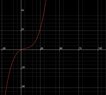
2) sketch the velocity time graph for Ps motion for 0<t<100
So I plotted for t=0 v=0, t= 21.1 v=4.81, t= 78.9, v= -4.81 and t=100, v=0. So it will be two curves with the curve going up between 0 and 50 and curve going down between 50 and 100.
Is this right??
3) Find the greatest distance of P from 0 for 0<t<100
I don't understand this part.
 
Physics news on Phys.org
Shah 72 said:
A particle moves on a straight line. It starts at a point O on the line and returns to O 100 s later. The velocity of P is v m/s at time t s after leaving O where v= 0.000t^3- 0.015t^2 +0.5t.
1) Find the values of v at the times for which the acceleration of P is zero
I got when t= 21.1s, V= 4.81m/s and when t= 78.9s v= -4.81m/s
2) sketch the velocity time graph for Ps motion for 0<t<100
So I plotted for t=0 v=0, t= 21.1 v=4.81, t= 78.9, v= -4.81 and t=100, v=0. So it will be two curves with the curve going up between 0 and 50 and curve going down between 50 and 100.
Is this right??
3) Find the greatest distance of P from 0 for 0<t<100
I don't understand this part.
Your problem statement has a typo. I used your answer to 1) to get that [math]v = 0.003t^3 - 0.015t^2 + 0.5t[/math]

Call s(t) the distance function and define s(O) = 0. What is the greatest value of s for 0 < t < 100?

-Dan
 
topsquark said:
Your problem statement has a typo. I used your answer to 1) to get that [math]v = 0.003t^3 - 0.015t^2 + 0.5t[/math]

Call s(t) the distance function and define s(O) = 0. What is the greatest value of s for 0 < t < 100?

-Dan
So the greatest distance is when t=50s which is 156.25m.
 
topsquark said:
Your problem statement has a typo. I used your answer to 1) to get that [math]v = 0.003t^3 - 0.015t^2 + 0.5t[/math]

Call s(t) the distance function and define s(O) = 0. What is the greatest value of s for 0 < t < 100?

-Dan
Thanks very much!
 
Shah 72 said:
It starts at a point O on the line and returns to O 100 s later.

topsquark said:
Your problem statement has a typo. I used your answer to 1) to get that [math]v = 0.003t^3 - 0.015t^2 + 0.5t[/math]

$v(t) \ge 0$ for all $t \ge 0$ ... this says the particle always moves in the positive direction away from the starting point O.

How, then, can it return to point O?
 
skeeter said:
$v(t) \ge 0$ for all $t \ge 0$ ... this says the particle always moves in the positive direction away from the starting point O.

How, then, can it return to point O?
No the question says that it moves in a straight line. It starts at point O and returns to point O 100s later
 
Shah 72 said:
No the question says that it moves in a straight line. It starts at point O and returns to point O 100s later

Velocity is a vector quantity ... if v(t) > 0 for all t > 0, then the particle moves in the positive direction only. To return to its starting position, it must have a negative velocity.

Check the given velocity function again ... the one you posted will not work.
 
skeeter said:
Velocity is a vector quantity ... if v(t) > 0 for all t > 0, then the particle moves in the positive direction only. To return to its starting position, it must have a negative velocity.

Check the given velocity function again ... the one you posted will not work.
Yeah I agree you are right. The velocity between 50 to 100 is negative so it comes back. I wasn't understanding the last question which asked for the greatest distance in the given time interval between 0 and 100. Since there are more time intervals in between which is 21.1 s where the velocity is positive and 78.9s where the velocity is negative, I was thinking whether I should take these intervals too when I calculate the greatest distance
 
Shah 72 said:
The velocity between 50 to 100 is negative so it comes back …

Once again, is the velocity function $v(t) = 0.003t^3 - 0.5t^2 + 0.5t$ ?

If so, look at the graph of velocity … if not, post the correct velocity function.

59EEA5A6-7C65-4D8B-A7EC-C0F2687655C3.jpeg
 
  • #10
skeeter said:
Once again, is the velocity function $v(t) = 0.003t^3 - 0.5t^2 + 0.5t$ ?

If so, look at the graph of velocity … if not, post the correct velocity function.

View attachment 11336
V=0.0001t^3-0.015t^2+0.5t
 
  • #11
Shah 72 said:
V=0.0001t^3-0.015t^2+0.5t

ok, I’ll buy that function.
 

Similar threads

  • · Replies 4 ·
Replies
4
Views
2K
  • · Replies 2 ·
Replies
2
Views
2K
  • · Replies 3 ·
Replies
3
Views
2K
  • · Replies 6 ·
Replies
6
Views
1K
  • · Replies 98 ·
4
Replies
98
Views
6K
  • · Replies 25 ·
Replies
25
Views
2K
  • · Replies 12 ·
Replies
12
Views
1K
Replies
6
Views
2K
  • · Replies 25 ·
Replies
25
Views
4K
  • · Replies 11 ·
Replies
11
Views
5K