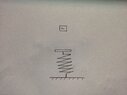
What is the maximum spring displacement?

Join the discussion
Ask a follow-up here, or get your own question answered by working scientists, mathematicians and engineers — people, not an autocomplete.
Real named experts · corrections over time · the nuance an AI answer skips
10 replies · 2K views
leafy
Messages
73
Reaction score
8
Homework Statement
A mass of 1kg is dropped at a height of 6m on an ideal spring. Calculate the maximum spring displacement. Spring constant k=20N/m. Spring length is 5m.
Relevant Equations
F=kx
E= .5kx^2
the mass will drop 1 m before it comes in contact with the spring. I’m stuck afterward. Please help.
The total energy of 1 m is mgh= 1kgx9.8m/ss x 1m = 9.8J
9.8J = .5 x 20N/m x x^2 ---> x = .99 m
the spring is compressed by .99 m ?
 

Attachments
  • 897E8D99-7507-43B6-BB6F-552C4ED9492E.jpeg
    897E8D99-7507-43B6-BB6F-552C4ED9492E.jpeg
    22.9 KB · Views: 146
Last edited:
Physics news on Phys.org
yes sorry, my attempt is not right, but i should take a shot.
 
leafy said:
Homework Statement:: A mass of 1kg is dropped at a height of 6m on an ideal spring. Calculate the maximum spring displacement. Spring constant k=20N/m. Spring length is 5m.
Relevant Equations:: F=kx
E= .5kx^2

the mass will drop 1 m before it comes in contact with the spring. I’m stuck afterward. Please help.
The total energy of 1 m is mgh= 1kgx9.8m/ss x 1m = 9.8J
9.8J = .5 x 20N/m x x^2 ---> x = .99 m
the spring is compressed by .99 m ?
Gravity does not switch off when the mass contacts the spring.
 
Thanks for the insight, so we must take gravity into account during the compression.

mg(1m) +mg(x) = .5k(x^2) ---> 0 = 10x^2 - 9.8x - 9.8

x=-.6; x = 1.6

So we take the positive one which is 1.6 m of spring compression? how can i double check this?
 
leafy said:
Thanks for the insight, so we must take gravity into account during the compression.

mg(1m) +mg(x) = .5k(x^2) ---> 0 = 10x^2 - 9.8x - 9.8

x=-.6; x = 1.6

So we take the positive one which is 1.6 m of spring compression? how can i double check this?
The only check I can think of is to substitute back into the quadratic. Looks right to me.
 
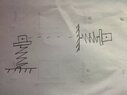
I don't feel comfortable about this answer. The solution should allows us to rotate the spring horizontally at maximum compression and it would yield the same result in term of energy. However, the horizontal position doesn't have a force of mg=10N pressing on it like the vertical position, so something is off. Thanks for helping though.
 
As the figure shown
 

Attachments

  • 29F24D0E-7AC8-4A56-AF39-A3E2D1D131D3.jpeg
    29F24D0E-7AC8-4A56-AF39-A3E2D1D131D3.jpeg
    48.1 KB · Views: 182
leafy said:
As the figure shown
I assume you are taking the speed at contact as the same in both orientations. With that axis, the horizontal version does not have any vertical movement of the mass thereafter, so the energy is different.
 
leafy said:
I don't feel comfortable about this answer. The solution should allows us to rotate the spring horizontally at maximum compression and it would yield the same result in term of energy. However, the horizontal position doesn't have a force of mg=10N pressing on it like the vertical position, so something is off. Thanks for helping though.
There is the deformation of the vertical spring due to the dead weight of that mass (that will be the neutral point of any subsequent oscillation), let's call it ##h_{weight}##.
And then the deformation due to the velocity of the mass impacting it (that will be the lowest point of any subsequent oscillation), let's call it ##h_{impact}##.

Just before you turn the compressed spring sideways, what h does it have, ##h_{weight}## only or ##h_{weight}+h_{impact}##?

CNX_Calc_Figure_17_03_001.jpg
 
Last edited: