What is the meaning of r' in the Multipole Expansion?

Click For Summary
SUMMARY

The discussion focuses on the multipole expansion in the context of calculating electric potential in spherical coordinates. The variable ##r'## represents the coordinates of charge particles within a sphere, while ##r## serves as a dummy variable for integration, which disappears after evaluation. The potential is evaluated at a point defined by ##r##, necessitating the use of ##r'## to avoid confusion during integration. The angle ##\alpha## is crucial as it relates to the Legendre polynomial ##P_{l}(cos\alpha)##, differentiating it from the angle ##\theta##, which is measured from the z-axis.

PREREQUISITES
  • Understanding of multipole expansion in electrostatics
  • Familiarity with spherical coordinates and their applications
  • Knowledge of integration techniques, particularly definite integrals
  • Basic grasp of Legendre polynomials and their significance in physics
NEXT STEPS
  • Study the derivation and application of multipole expansion in electrostatics
  • Learn about the properties and applications of Legendre polynomials
  • Explore the concept of dummy variables in integration
  • Investigate the relationship between spherical coordinates and electric potential
USEFUL FOR

Physicists, electrical engineers, and students studying electromagnetism or potential theory will benefit from this discussion, particularly those interested in advanced topics like multipole expansions and spherical coordinate systems.

Tony Hau
Messages
107
Reaction score
30
Homework Statement
A sphere of radius R, centred at the origin, carries charge density $$\rho(r,\theta) = k\frac{R}{r^{2}}(R-2r)sin\theta,$$
where ##k## is a constant. Find the approximate potential for points on the z axis, far from the sphere.
Relevant Equations
The multipole expansion: ##V(r)=\frac{1}{4\pi \epsilon_o}\sum_{l=0}^{\infty}\frac{1}{r^{l+1}}\int(r^{'})^{l} P_l (cos\alpha)\rho(r^{'})d\tau^{’}##
The diagram of the problem should look something like this:
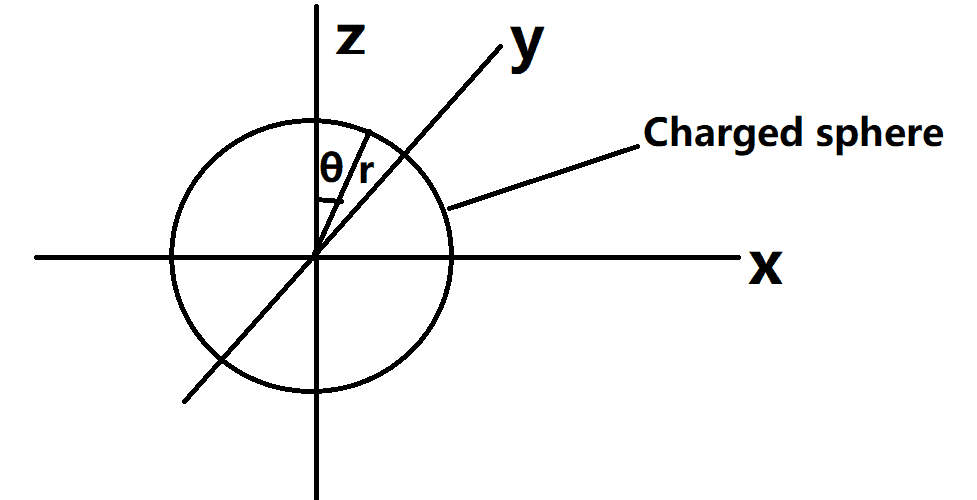
1598435599606.png
,which is just the normal spherical coordinate.To calculate the potential far away, we use the multipole expansion.

##I_o## in the expansion is ok, because ##(r^{'})^{0} = 1##.

However, I am wondering how I should calculate ##I_1##, because ##(r^{'})^{1} = r^{'}##; I have to care what ##r^{'}## actually means. I know ##r## is just the normal spherical coordinate ##r##.

Can anyone kindly explain? Thanks for your answer in advance because I have learned a great deal from the forum!
 

Attachments

  • 1598435547876.png
    1598435547876.png
    5.6 KB · Views: 184
Physics news on Phys.org
##r'## is the coordinate of charge particles inside sphere.
 
  • Like
Likes   Reactions: etotheipi
Abhishek11235 said:
##r'## is the coordinate of charge particles inside sphere.
Then what is ##r##?
 
It is called a dummy argument. It still represents the radial coordinate and should disappear after integration (which is a definite integral, don't forget the bounds). It is used so you don't confuse it with the ##r## that is outside the integral.
 
  • Like
Likes   Reactions: JD_PM, Tony Hau, Abhishek11235 and 1 other person
Tony Hau said:
Then what is ##r##?
To add perhaps a bit more detail:

That's the coordinate at which you are evaluating the potential. You have a potential that is a function of ##r##, and to evaluate it you must integrate over the region of space where there is non-zero charge density. You can't use ##r## for the dummy integration variable, so it's common to use ##r'## for this.
 
  • Like
Likes   Reactions: JD_PM, Tony Hau, Abhishek11235 and 1 other person
I think ##\vec r## refers to the direction of the radial distance of the potential at a general point from the centre of the coordinate system, whereas ##\vec r^{'}## is the direction from the centre of the coordinate system to the infinitesmal charge; the angle between them is ##\alpha##, which is also the variable in the Legendre polynomial ##P_{l}(cos\alpha)##.

##\alpha## is quite different from ##\theta## because ##\theta## is the angle from the z axis to ##\vec r##.
 
Tony Hau said:
I think ##\vec{r}## refers to the direction of the radial distance of the potential at a general point from the centre of the coordinate system

I don't know what a "direction of the radial distance" means. ##\vec{r}## is the position vector of the point at which you're evaluating the potential.
 
  • Like
Likes   Reactions: JD_PM, vanhees71, PhDeezNutz and 1 other person
etotheipi said:
I don't know what a "direction of the radial distance" means. ##\vec{r}## is the position vector of the point at which you're evaluating the potential.
My poor English, that's what I want to say.
 
  • Like
Likes   Reactions: etotheipi
Hint: Check your "relevant equation"!
 

Similar threads

  • · Replies 10 ·
Replies
10
Views
2K
  • · Replies 7 ·
Replies
7
Views
4K
  • · Replies 3 ·
Replies
3
Views
2K
Replies
6
Views
3K
  • · Replies 1 ·
Replies
1
Views
2K
  • · Replies 1 ·
Replies
1
Views
3K
  • · Replies 4 ·
Replies
4
Views
922
  • · Replies 4 ·
Replies
4
Views
1K
  • · Replies 8 ·
Replies
8
Views
2K
Replies
8
Views
3K