MHB What is the minimum value of $f(x)$ with positive real numbers $p,q,r$?

  • Thread starter Thread starter anemone
  • Start date Start date
  • Tags Tags
    Minimum
Click For Summary
The discussion revolves around finding the minimum value of the function f(x) = √(p² + x²) + √((q - x)² + r²) for positive real numbers p, q, and r. Participants explore methods for minimizing this function, likely involving calculus or geometric interpretations. The hints suggest that previous solutions or similar problems may provide insights into the approach. The focus is on deriving a clear mathematical solution to achieve the minimum value. Ultimately, the goal is to establish the conditions under which f(x) reaches its lowest point.
anemone
Gold Member
MHB
POTW Director
Messages
3,851
Reaction score
115
For positive real numbers $p,\,q,\,r$, determine the minimum of the function $f(x)=\sqrt{p^2+x^2}+\sqrt{(q-x)^2+r^2}$.
 
Mathematics news on Phys.org
anemone said:
For positive real numbers $p,\,q,\,r$, determine the minimum of the function $f(x)=\sqrt{p^2+x^2}+\sqrt{(q-x)^2+r^2}$.

Hint:

The proposed solution uses the geometry approach that solved it neatly and nicely.:)

Further hint:

Minimum $f(x)$ is $\sqrt{(p+r)^2+q^2}$.
 
Solution of other:

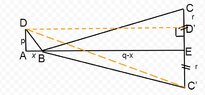
View attachment 4563

Let $AD=p,\,AE=q,\,EC=r$. Let $B$ be a point on $AE$ and let $x=AB$, so that $BE=q-x$. Then $f(x)=DB+BC$. To minimize $DB+BC$, we use the method of reflection. Let $C'$ be the reflection of $C$ in the line $AE$.

Since triangles $BEC$ and $BEC'$ are congruent, $BC=BC'$ and $f(x)=DB+BC'$.

As $x$ varies, $B$ changes its position. But the distance $DB+BC'$ will be a minimum when $B$ lies on the line $DC'$ (as shown in the orange line).

The minimum value of $f(x)$ is then $DB+BC'=DC'$. Let $DD'$ be the perpendicular from $D$ to the line $CC'$. From the right triangle DD'C',

$f(x)_{\text{minimum}}=DC'=\sqrt{DD'^2+D'C'^2}=\sqrt{q^2+(p+r)^2}$
 

Attachments

  • determine the min.JPG
    determine the min.JPG
    29.3 KB · Views: 94
Here is a little puzzle from the book 100 Geometric Games by Pierre Berloquin. The side of a small square is one meter long and the side of a larger square one and a half meters long. One vertex of the large square is at the center of the small square. The side of the large square cuts two sides of the small square into one- third parts and two-thirds parts. What is the area where the squares overlap?

Similar threads

  • · Replies 2 ·
Replies
2
Views
1K
  • · Replies 12 ·
Replies
12
Views
2K
  • · Replies 3 ·
Replies
3
Views
2K
  • · Replies 1 ·
Replies
1
Views
1K
  • · Replies 1 ·
Replies
1
Views
1K
  • · Replies 1 ·
Replies
1
Views
1K
  • · Replies 1 ·
Replies
1
Views
1K
  • · Replies 5 ·
Replies
5
Views
2K
  • · Replies 2 ·
Replies
2
Views
1K
  • · Replies 1 ·
Replies
1
Views
1K