What is the significance of neglecting the encircled sides in Ampere's law?

Click For Summary

Homework Help Overview

The discussion revolves around the application of Ampere's law in the context of a rectangular loop used to calculate the magnetic field. Participants are examining the significance of neglecting the encircled sides of the loop, particularly when one dimension is much smaller than the other.

Discussion Character

  • Conceptual clarification, Assumption checking

Approaches and Questions Raised

  • The original poster questions the reasoning behind neglecting the encircled sides of the loop, suggesting that an infinitesimal segment perpendicular to the magnetic field should contribute to the integral. Other participants reference external sources and reiterate the original poster's reasoning regarding the integral of the magnetic field along the encircled sides.

Discussion Status

The discussion is ongoing, with participants exploring the validity of the original poster's argument. Some guidance is provided through references to external sources, but there is no explicit consensus on the interpretation of the encircled sides in Ampere's law.

Contextual Notes

Participants are considering the implications of the assumption that one dimension of the loop is significantly smaller than the other, which may affect the application of Ampere's law.

JD_PM
Messages
1,125
Reaction score
156
Homework Statement
Magnetic field over a plane
Relevant Equations
##\int B dl = 0##
This is a very basic issue but really important as well.
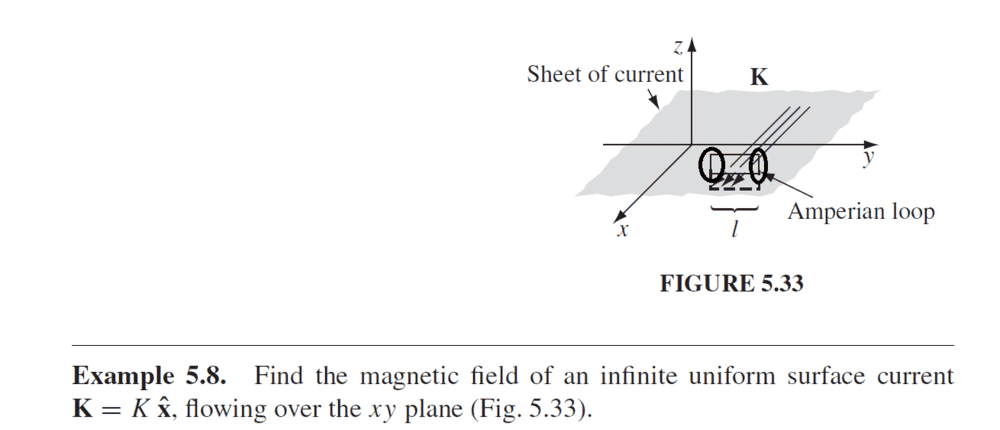
Screenshot (583).png


The rectangular loop has length ##l## and width ##h##. I have seen the argument of neglecting the encircled sides of the loop because ##h << 1## while using Ampere's law to calculate the magnetic field flowing over a plane.

I find this argument not convincing enough. What I think it happens is that an infinitesimal segment of ##h##, which is ##dl##, is perpendicular to ##B## (one can see that using the right hand rule). And thus on both encircled sides:

$$\int B dl = 0$$

Am I correct?

Thanks.
 
Physics news on Phys.org
Better keep to the vector notation, though...
 
$$\oint \vec B \cdot \vec {dl} = 0$$
 

Similar threads

  • · Replies 5 ·
Replies
5
Views
1K
  • · Replies 15 ·
Replies
15
Views
2K
Replies
4
Views
2K
Replies
1
Views
1K
Replies
4
Views
1K
  • · Replies 15 ·
Replies
15
Views
3K
Replies
10
Views
2K
  • · Replies 30 ·
2
Replies
30
Views
2K
  • · Replies 10 ·
Replies
10
Views
2K
Replies
2
Views
1K