What is the value of the inverse derivative at x=f(a)?

  • Context: MHB 
  • Thread starter Thread starter karush
  • Start date Start date
  • Tags Tags
    Derivative Inverse
Click For Summary
SUMMARY

The discussion focuses on finding the value of the inverse derivative at \( x = f(a) \) for the function \( f(x) = x^3 - 6x^2 - 3 \) with \( a = 3 \). Participants confirm that the inverse function can be derived using implicit differentiation and the formula \( \left[f^{-1}\right]'(a) = \frac{1}{f'\left(f^{-1}(a)\right)} \). The critical steps include verifying the one-to-one nature of \( f(x) \) on the interval \([4, \infty)\) and solving for \( f^{-1}(3) \), which yields approximately \( 6.1582 \). The final calculation of the inverse derivative results in \( \left[f^{-1}\right]'(3) \approx 0.02508 \).

PREREQUISITES
  • Understanding of implicit differentiation
  • Familiarity with inverse functions and their derivatives
  • Knowledge of polynomial functions and their properties
  • Ability to solve cubic equations
NEXT STEPS
  • Learn about the properties of one-to-one functions and their inverses
  • Study implicit differentiation techniques in calculus
  • Explore the application of the derivative of inverse functions
  • Practice solving cubic equations using numerical methods or graphing tools
USEFUL FOR

Mathematics students, educators, and professionals involved in calculus, particularly those focusing on inverse functions and their applications in real-world problems.

karush
Gold Member
MHB
Messages
3,240
Reaction score
5
find the value of $$df^{-1}/dx at $x=f(a)$$
$$f(x)=x^3-6x^2-3$$
$$x \ge 4$$
$$a=3$$

ok the inverse would be
$$x=y^3-6y^2-3$$

but don't see how to isolate $y$
or if we need to
 
Physics news on Phys.org
First, I would verify that the given function is one-to-one on $[4,\infty)$. Then I recommend following these steps:

1.) Implicitly differentiation the following:

$$f(x)=x^3-6x^2-3$$

With respect to $f$ and solve for $$\d{x}{f}$$.

2.) Solve (I am assuming $a=-3$):

$$f(x)=-3$$

Call the relevant (must be real and in the stated domain) root $x_r$.

3.) Then we have:

$$\left[f^{-1}\right]'(a)=\left.\d{x}{f}\right|_{x=x_r}$$
 

Attachments

  • Resized_20171123_102344_5233-2.jpg
    Resized_20171123_102344_5233-2.jpg
    3.3 KB · Views: 123
Last edited:
I'm thinking there's at least one typo in the problem...I think at the very least it should state:

$$x=f^{-1}(a)$$

Let's look at the standard formula:

$$\left[f^{-1}\right]'(a)=\frac{1}{f'\left(f^{-1}(a)\right)}$$

We know:

$$f\left(f^{-1}(a)\right)=a$$

Let:

$$u=f^{-1}(a)$$

And so we have:

$$f(u)=a$$

Using the given definition of $f$ and the given $a=3$, we have:

$$u^3-6u^2-3=3$$

As you can see, this would be much easier to solve if $a=-3$, but this can be solved. What do you get?
 
MarkFL said:
I'm thinking there's at least one typo in the problem...I think at the very least it should state:

$$x=f^{-1}(a)$$

Let's look at the standard formula:

$$\left[f^{-1}\right]'(a)=\frac{1}{f'\left(f^{-1}(a)\right)}$$

We know:

$$f\left(f^{-1}(a)\right)=a$$

Let:

$$u=f^{-1}(a)$$

And so we have:

$$f(u)=a$$

Using the given definition of $f$ and the given $a=3$, we have:

$$u^3-6u^2-3=3$$

As you can see, this would be much easier to solve if $a=-3$, but this can be solved. What do you get?

what is $f^{-1}(a)$
 
karush said:
what is $f^{-1}(a)$

Suppose we set:

$$f(x)=a$$

This is equivalent to:

$$x=f^{-1}(a)$$

This is what you'll find when solving:

$$x^3-6x^2-3=a$$
 
this?

$\text{so if $a=3$ then}$
$\displaystyle x^3-6x^2-3=3$
$\displaystyle x^3-6x^2=6$
$\text{$x=6.1582$ \, via W|A}$

$\text{or if $a=-3$ then}$
$\displaystyle x^3-6x^2-3=-3$
$\displaystyle x^3-6x^2=0$
$x^2(x-6)=0$
$x=0$
$x=6$
 
Last edited:
karush said:
this?

$\text{so if $a=3$ then}$
$\displaystyle x^3-6x^2-3=3$
$\displaystyle x^3-6x^2=6$
$\text{$x=6.1582$ \, via W|A}$

Yes, and the exact root is given as:

$$x=2+\sqrt[3]{11+\sqrt{57}}+\sqrt[3]{11-\sqrt{57}}$$

karush said:
$\text{or if $a=-3$ then}$
$\displaystyle x^3-6x^2-3=-3$
$\displaystyle x^3-6x^2=0$
$x^2(x-6)=0$
$x=0$
$x=6$

We would discard the root $x=0$ since we are told $4\le x$. Can you demonstrate the given function is one-to-one on this interval?

At any rate, once we have the value of $f^{-1}(a)$, can you proceed?
 
$\text{I'm not sure what $6.1582$ is supposed to plugged into}$
 
Last edited:
  • #10
karush said:
$\text{I'm not sure what $6.1582$ is supposed to plugged into}$

You could use this formula:

$$\left[f^{-1}\right]'(a)=\frac{1}{f'\left(f^{-1}(a)\right)}$$

where $a=3,\,f^{-1}(a)\approx6.1582$.
 
  • #11
MarkFL said:
You could use this formula:

$$\left[f^{-1}\right]'(a)=\frac{1}{f'\left(f^{-1}(a)\right)}$$

where $a=3,\,f^{-1}(a)\approx6.1582$.

$\displaystyle \left[f^{-1}\right]'(a)$
$=\frac{1}{f'\left(f^{-1}(a)\right)}$
$=\frac{1}{f'(6.1582)}$
$f'(6.1582)=3(6.11582)^2-12(6.11582)=38.8119$
$1/38.8119 =0.02576$
 
Last edited:
  • #12
karush said:
$\displaystyle \left[f^{-1}\right]'(a)$
$=\frac{1}{f'\left(f^{-1}(a)\right)}$
$=\frac{1}{f'(6.1582)}$
$f'(6.1582)=3(6.11582)^2-12(6.11582)=38.8119$

I get:

$$f'\left(f^{-1}(a)\right)\approx39.8722$$

W|A - (3(2 + (11 - sqrt(57))^(1/3) + (11 + sqrt(57))^(1/3))^2-12(2 + (11 - sqrt(57))^(1/3) + (11 + sqrt(57))^(1/3)))

And so:

$$\left[f^{-1}\right]'(a)\approx0.02508$$

W|A - 1/(3(2 + (11 - sqrt(57))^(1/3) + (11 + sqrt(57))^(1/3))^2-12(2 + (11 - sqrt(57))^(1/3) + (11 + sqrt(57))^(1/3)))
 
  • #13
I can post a graph of the function, derivative, inverse, and solution in graph forum from MATLAB if that helps anyone.

I must admit, the question is written in a very vague forum. It doesn't define everything how "most mathematicians" would. It leaves a lot of the problem open for interpretation.
 
  • #14
DrWahoo said:
I can post a graph of the function, derivative, inverse, and solution in graph forum from MATLAB if that helps anyone.

I must admit, the question is written in a very vague forum. It doesn't define everything how "most mathematicians" would. It leaves a lot of the problem open for interpretation.

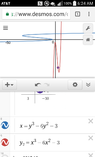
Sure
I did what I could with Desmos but
Could only do so much
 
  • #15
Over 100 views 😎
 
  • #16
karush said:
Sure
I did what I could with Desmos but
Could only do so much

Desmos allows you to plot a function and its inverse...first define the function and its domain:

$$f(x)=x^3-6x^2-3\,\{4\le x\}$$

Then define the inverse:

$$x=f(y)$$

[DESMOS=-37.36896540090182,93.61770297027579,-36.842231263227994,8.599804598412113]f\left(x\right)=x^3-6x^2-3\left\{4\le x\right\};x=f\left(y\right)[/DESMOS]
 
  • #17

Attachments

  • QuickMemo+_2017-11-27-06-24-37.png
    QuickMemo+_2017-11-27-06-24-37.png
    27.5 KB · Views: 108

Similar threads

  • · Replies 6 ·
Replies
6
Views
3K
Replies
5
Views
2K
  • · Replies 17 ·
Replies
17
Views
3K
  • · Replies 1 ·
Replies
1
Views
2K
  • · Replies 10 ·
Replies
10
Views
3K
  • · Replies 6 ·
Replies
6
Views
3K
  • · Replies 3 ·
Replies
3
Views
1K
  • · Replies 3 ·
Replies
3
Views
1K
  • · Replies 4 ·
Replies
4
Views
2K
  • · Replies 1 ·
Replies
1
Views
1K