Discussion Overview
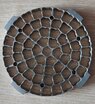
The discussion revolves around identifying a metal object that belonged to a participant's father, who worked at a nuclear research establishment. The object has been used as a coffee mug mat and is speculated to be a part of a nuclear system, possibly related to cooling or fuel rod assembly. Participants explore various hypotheses regarding its purpose and construction, with a focus on its design and material properties.
Discussion Character
- Exploratory
- Technical explanation
- Debate/contested
Main Points Raised
- Some participants question whether the object is radioactive, with one asserting it was never used in a radioactive context.
- There are suggestions that the object may resemble a drain grill, but its streamlined design implies it could be intended for high fluid flow, possibly within a coolant system.
- One participant notes the precision of the drilled holes and speculates on whether it was made by hand or machine, while another suggests it might be a one-off part for a specific purpose.
- Some participants propose that the object could be a fuel pin spacer grid, with discussions on its crude appearance suggesting it may be a prototype rather than a production piece.
- There are inquiries about the material composition, with speculation about it being stainless steel or zirconium, and discussions on how to determine its density.
- Participants discuss the dimensions of the object, noting its round shape and the size of the holes, which may relate to its function in a nuclear context.
- One participant humorously suggests the potential hazards of the object being made of potassium, emphasizing the need for caution in its use.
Areas of Agreement / Disagreement
Participants express multiple competing views regarding the object's purpose and material, with no consensus reached on its exact identity or function. The discussion remains unresolved as various hypotheses are explored.
Contextual Notes
Participants acknowledge limitations in their understanding of the object's purpose and material properties, with some relying on visual assessments and speculative reasoning. The discussion includes references to historical manufacturing techniques and the challenges of identifying materials without specialized equipment.