What is wrong with this proof? (divergence of the harmonic series)

Click For Summary
SUMMARY

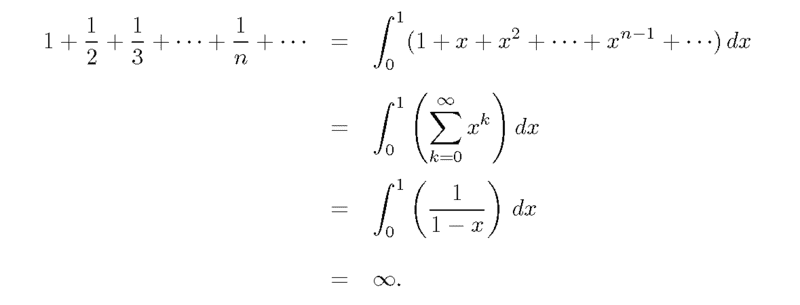
The discussion focuses on the divergence of the harmonic series and critiques a specific proof presented in a document from UCSC. The main issue identified is the improper treatment of the equality between summation and integral when both are infinite. To establish rigor, it is essential to demonstrate that the summation exceeds any positive number, M, by modifying the integral comparison. The use of the Monotone Convergence Theorem is also highlighted as a critical aspect in handling the limits of the integral.

PREREQUISITES
  • Understanding of harmonic series and its divergence
  • Familiarity with integrals and summations in mathematical analysis
  • Knowledge of the Monotone Convergence Theorem
  • Basic concepts of Lebesgue integration
NEXT STEPS
  • Study the rigorous proofs of the divergence of the harmonic series
  • Learn about Lebesgue integration and its applications
  • Explore the Monotone Convergence Theorem in detail
  • Investigate the relationship between summation and integration in mathematical analysis
USEFUL FOR

Mathematicians, students of analysis, and educators looking to deepen their understanding of series divergence and the rigor required in mathematical proofs.

BWV
Messages
1,618
Reaction score
1,969
Reading this piece with a number of proofs of the divergence of the harmonic series
http://scipp.ucsc.edu/~haber/archives/physics116A10/harmapa.pdf

and this example states: 'While not completely rigorous, this proof is thought-provoking nonetheless. It may provide a good exercise for students to find possible flaws in the argument.'
upload_2019-2-21_8-14-59.png


not being any good at proofs, curious what flaws or lack of rigor there is here
 

Attachments

  • upload_2019-2-21_8-14-59.png
    upload_2019-2-21_8-14-59.png
    5.3 KB · Views: 1,165
Physics news on Phys.org
IMHO, to be rigorous, the first equality between the summation and an integral is a problem. You should not say they are equal when one (or both) are infinite. In a formal proof, you probably should show that the summation is greater than any positive number, M. You can do that by comparing the summation to the integral, but modify it to allow it to be as large as you need.
 
  • Like
Likes   Reactions: BWV and member 587159
BWV said:
Reading this piece with a number of proofs of the divergence of the harmonic series
http://scipp.ucsc.edu/~haber/archives/physics116A10/harmapa.pdf

and this example states: 'While not completely rigorous, this proof is thought-provoking nonetheless. It may provide a good exercise for students to find possible flaws in the argument.'

View attachment 239116

not being any good at proofs, curious what flaws or lack of rigor there is here

If you compare the partial sums in all cases, the equality should hold up well.
 
  • Like
Likes   Reactions: FactChecker and BWV
FactChecker said:
IMHO, to be rigorous, the first equality between the summation and an integral is a problem. You should not say they are equal when one (or both) are infinite. In a formal proof, you probably should show that the summation is greater than any positive number, M. You can do that by comparing the summation to the integral, but modify it to allow it to be as large as you need.
If ##(f_k)_{k\in \mathbb{N}}## is a sequence of measurable functions ##f_k\, : \,\Omega \longrightarrow \mathbb{C}## then
$$
\int_\Omega \sum_{k=0}^\infty |f_k| = \sum_{k=0}^\infty \int_\Omega |f_k|
$$
In our case, we have ##\Omega = [0,1]\; , \;f_k(x)=|f_k(x)|=x^k## which is measurable on ##[0,1]##, so
$$
\sum_{k\in \mathbb{N}} k^{-1} =\sum_{k\in \mathbb{N}_0} \int_{[0,1]} x^k \,dx= \int_{[0,1]} \sum_{k=0}^\infty x^k \,dx = \int_{[0,1]} \dfrac{1}{1-x} \,dx
$$
and the proof is valid. The crucial point is, that the set ##\{\,x\in [0,1]\,|\,\sum_{\mathbb{N}_0} |f_k(x)| = \infty \,\} = \{\,1\,\}## is of measure zero. So if we read the integral as Lebesgue integral we're fine.
 
  • Like
Likes   Reactions: member 587159, Auto-Didact, QuantumQuest and 3 others
Cool, thanks for the responses
 
  • Like
Likes   Reactions: berkeman
Things are a little hairy at the end point of the integral. ##\sum_{k=0}^\infty x^k=\frac{1}{1-x}## for ##|x|\lt 1##. You need to handle the upper limit carefully.
 
Monotone Convergence theorem (adapted to this problem) says that if/since {##\Sigma x^n ##} is a pointwise increasing sequence of measurable (since continuous; partial sums are continuous in x) functions :

##Lim_{n \rightarrow \infty}\int \Sigma x^n = \int Lim_{n \rightarrow \infty} \Sigma x^n=
\int \frac {1}{1-x} ##
 
Last edited:

Similar threads

  • · Replies 13 ·
Replies
13
Views
5K
  • · Replies 4 ·
Replies
4
Views
4K
  • · Replies 2 ·
Replies
2
Views
5K
  • · Replies 10 ·
Replies
10
Views
3K
Replies
2
Views
670
  • · Replies 5 ·
Replies
5
Views
7K
  • · Replies 5 ·
Replies
5
Views
6K
  • · Replies 7 ·
Replies
7
Views
3K
  • · Replies 7 ·
Replies
7
Views
4K
  • · Replies 4 ·
Replies
4
Views
3K