What is "x" in this definition of a basis?

  • Context: Undergrad 
  • Thread starter Thread starter Hill
  • Start date Start date
Click For Summary

SUMMARY

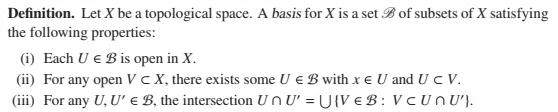
The discussion clarifies that in the definition of a basis for a topology, the element x in property (ii) refers to any point within an open set V ⊆ X, where there exists a basis element U ∈ 𝔅 such that x ∈ U ⊆ V. The original source, The Math You Need by Thomas Mack (2023), presents a confusing definition by mixing two characterizations: one for a base of an existing topology (properties 1 and 2) and one for a base generating a topology on a set (property 3 plus the union condition). Property 3 is redundant as it follows from property 2. The Wikipedia article on bases of topology provides a clearer explanation. The alternative book All the Math You Missed But Need to Know for Graduate School by Thomas A. Garrity (2021) offers a correct and reliable definition.

PREREQUISITES

  • Basic topology concepts: open sets, topological spaces
  • Definition and properties of a basis (base) for a topology
  • Set theory fundamentals: subsets, unions
  • Familiarity with formal mathematical definitions and notation

NEXT STEPS

  • Study the Wikipedia article on "Base (topology)" for standard definitions and examples
  • Review Thomas A. Garrity’s All the Math You Missed But Need to Know for Graduate School for rigorous topology foundations
  • Compare different characterizations of bases in topology textbooks to understand their equivalences and differences
  • Practice constructing bases for common topologies such as the standard topology on ℝ

USEFUL FOR

Undergraduate and graduate mathematics students studying topology, educators preparing teaching materials on topological bases, and self-learners seeking clear and accurate definitions of bases in topology.

Hill
Messages
857
Reaction score
658
TL;DR
The definition in the book appears to be missing something.
In this definition,
1780180214205.webp

what is ##x## in the property (ii)?

Did they mean, "(ii) For any open ##V \subset X## and any ##x \in V##, there exists some ##U \in \mathscr{B}## with ##
x \in U## and ##U \subset V##?
Or something else?
 
Last edited:
Physics news on Phys.org
yes they meant what you said. however this is a strange definition, as property 3 follows from property 2, so is not needed. The book seems to be confusing two different characterizations. Namely given a topology on X, one wants to define a base for that topology, which is properties 1 and 2.
Then given just a set X, without a topology, one also wants to define when a collection of subsets of X is a base for some topology, which is property 3 plus the property, unstated there, that X is the union of the subsets in the base. see the Wikipedia article on base of a topology, for a correct discussion. given this evidence, I would suggest possibly getting a different book.
 
  • Like
  • Informative
Likes   Reactions: bhobba, dextercioby and Hill
mathwonk said:
yes they meant what you said. however this is a strange definition, as property 3 follows from property 2, so is not needed. The book seems to be confusing two different characterizations. Namely given a topology on X, one wants to define a base for that topology, which is properties 1 and 2.
Then given just a set X, without a topology, one also wants to define when a collection of subsets of X is a base for some topology, which is property 3 plus the property, unstated there, that X is the union of the subsets in the base. see the Wikipedia article on base of a topology, for a correct discussion. given this evidence, I would suggest possibly getting a different book.
Thank you.

I see what you mean. But this is unexpected because the book is this:

The Math You Need: A Comprehensive Survey of Undergraduate Mathematics,
Thomas Mack,
©2023 Massachusetts Institute of Technology
 
mathwonk said:
yes they meant what you said. however this is a strange definition, as property 3 follows from property 2, so is not needed. The book seems to be confusing two different characterizations. Namely given a topology on X, one wants to define a base for that topology, which is properties 1 and 2.
Then given just a set X, without a topology, one also wants to define when a collection of subsets of X is a base for some topology, which is property 3 plus the property, unstated there, that X is the union of the subsets in the base. see the Wikipedia article on base of a topology, for a correct discussion. given this evidence, I would suggest possibly getting a different book.
Following your suggestion, I've got a different book:
"All the Math You Missed But Need to Know for Graduate School", Thomas A. Garrity, 2021.

At least, they have the definition right:
1780405723657.webp
 
I think your new book is probably a good choice.
 
Last edited:

Similar threads

  • · Replies 5 ·
Replies
5
Views
4K
  • · Replies 0 ·
Replies
0
Views
3K
  • · Replies 15 ·
Replies
15
Views
3K
  • · Replies 2 ·
Replies
2
Views
2K
  • · Replies 5 ·
Replies
5
Views
2K
Replies
2
Views
2K
  • · Replies 2 ·
Replies
2
Views
3K
  • · Replies 2 ·
Replies
2
Views
2K
  • · Replies 1 ·
Replies
1
Views
3K
  • · Replies 8 ·
Replies
8
Views
4K