What Secrets Does the Usselo Horizon in Dutch Moors Hold?

  • Thread starter Thread starter Andre
  • Start date Start date
  • Tags Tags
    Horizon
Click For Summary

Discussion Overview

The discussion centers on the Usselo horizon, a geological layer found in Dutch moors, with participants exploring its characteristics, origins, and implications. The conversation includes aspects of paleobotany, sedimentology, and potential historical events related to the Younger Dryas period.

Discussion Character

  • Exploratory
  • Technical explanation
  • Debate/contested

Main Points Raised

  • One participant describes the Usselo horizon as a dark sandy or peat layer, noting its variable thickness and unclear coloration.
  • Another participant suggests that the layer may consist of dune-sand, questioning its aeolian origin.
  • A different viewpoint claims that the layer is river sand, primarily delivered by the Rhine River, and discusses its relationship to younger cover sands.
  • Another participant mentions the North Sea basin as an additional source area for the coversands.
  • One participant proposes that the Usselo horizon corresponds to the Younger Dryas Boundary.
  • A later reply affirms the connection to the Younger Dryas but references a specific paper on Usselo horizons and nanodiamonds.
  • Another participant cautions against generalizing the black coloration of the layer to indicate anoxic conditions, emphasizing its organic-rich composition.

Areas of Agreement / Disagreement

Participants express differing views on the origins and characteristics of the Usselo horizon, with no consensus reached regarding its composition or implications related to the Younger Dryas.

Contextual Notes

There are unresolved questions about the nature of the dark coloration and the specific conditions that led to the formation of the Usselo horizon, as well as the implications of its organic content.

Andre
Messages
4,294
Reaction score
73
The Usselo horizon is a well known dark sandy or peat layer extending from west to central Europe. It's from Allerod age and it's described well here by some leading Dutch researchers. Unfortunately the nestor of Dutch Palaeobotany and Palynology reseach -specialist on the Usselo horizon - diseased last year.

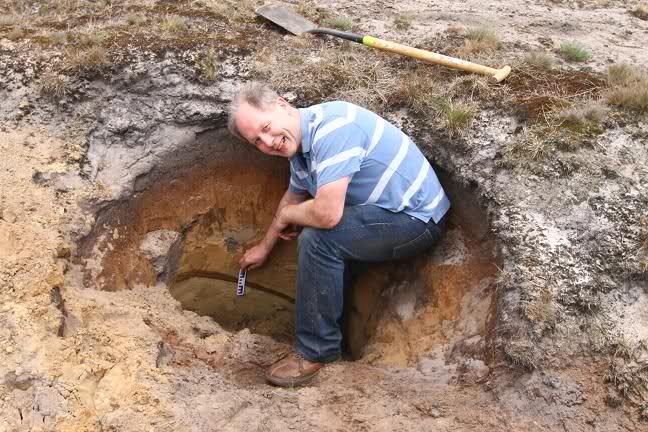
Anyway, so we went on expedition to a well known moor, hunting for the Usselo horizon and we found this:
vndv1g.jpg


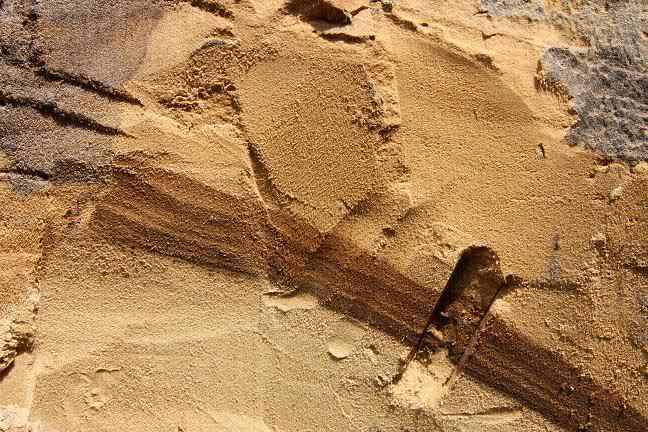
This was one of the last pictures taken -after sampling- but with the camera exactly horizontal so that the inclination can be measured accurately.
egvl88.jpg


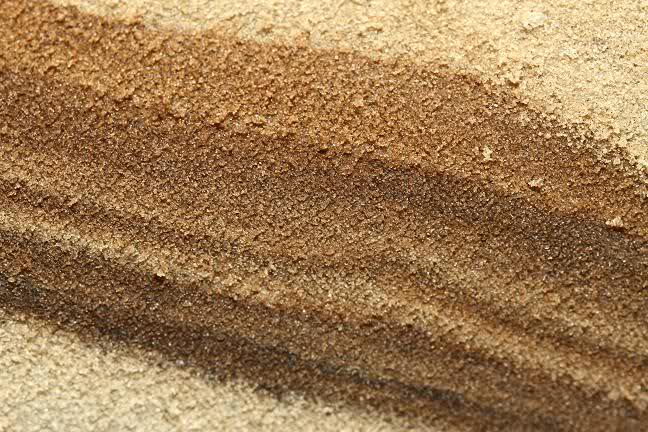
The layer is about 60 mm thick at the highest point but only 20mm at the lowest point. Detail here:
zo73ie.jpg


The layers are predominantly sandy but more dense, likely mixed with clay (loam). The nature of the dark brown color is unclear at the moment.

Anyway the usselo horizon is usually horizontal obviously and not layered (stratified), so what is it?
 
Earth sciences news on Phys.org
Is that dune-sand, so aeolian ??
 
River sand actually; mostly delivered by the Rhine river towards the delta of the low countries where it became aeolian. The Usselo Horizon splits up the "younger cover sand I" and II. See this

Note that the younger cover sand I below the Usselo horzion is slightly paler in color. That can also be seen here, about 100 feet from that location, showing the horizon more typically.

9ptizt.jpg


But also here, and this site is about 100 miles to the north

2encokx.jpg
 
Last edited:
Another source area for the coversands besides the Rhine Meuse, is the basin of the North Sea before it infilled.
 
It's the Younger Dryas Boundary.
 
  • Like
Likes   Reactions: 1 person
Hi Alpha Male,

Yes I do think it is the YDB. Have you seen Annelies van Hoesel's paper on Usselo horizons and nanodiamonds?
 
Hi Andre, I haven't read the papers but black usually means anoxic (low oxygen) conditions.
 
Hi billiards, You cannot generalize to anoxia here. These are coversands and this is a charcoal and organic-rich horizon.